

what it is forex swap? It is an overnight financing adjustment that may be charged or credited when a leveraged currency position remains open after the daily rollover time. For Evest traders, understanding forex swap fees is important because the amount can vary by currency pair, trade direction, position size, market rates, instrument specifications, and account conditions. This guide explains the forex swap meaning, how forex swap works, what determines forex swap rates, and how to approach a forex swap calculation. It also covers swap-free Islamic account conditions and the role of swaps in trading plans.
what it is forex swap in Retail Trading?
In retail trading, a forex swap usually refers to the overnight financing adjustment applied to an open currency position. It is also commonly called a rollover fee, overnight fee, or overnight interest adjustment. When a trader opens a currency position, one currency in the pair is bought while the other is sold. Because currencies are linked to different interest-rate environments, keeping the position open beyond the trading day’s rollover point can create a financing cost or credit.
For example, when a trader buys EUR/USD, the trader is effectively buying euros and selling US dollars. If the position remains open after the daily rollover, the financing conditions associated with the two currencies become part of the overnight adjustment. A long position and a short position on the same pair can therefore have different swap values. In some cases, one direction may have a positive rate while the other has a negative rate. In other cases, both directions may carry a cost after the broker’s pricing and instrument conditions are considered.It is important to distinguish this retail usage from an institutional FX swap. An institutional FX swap normally combines an exchange of two currencies on one value date with an agreement to reverse the exchange on another date. This article focuses specifically on the overnight swap forex cost that affects leveraged retail trading positions.
How Forex Swap Works?
When a position remains open beyond the platform’s daily rollover time, the trading system may apply the relevant overnight adjustment automatically. The trade itself remains open, but the charge or credit appears in the account activity. This helps traders understand what a forex swap is at a practical level, especially when reviewing the total cost of holding a position overnight.
The basic process is:
- The trader opens a buy or sell position.
- The position remains open beyond the daily rollover time.
- The platform checks the instrument’s applicable long or short swap rate.
- The swap amount is calculated according to the position size and contract conditions.
- The amount is credited to or deducted from the account.
This is how forex swap works at a practical level. Traders do not normally need to close and reopen the position manually for the rollover adjustment to be applied. The adjustment is generally applied once for each applicable trading day. However, the value may not remain identical every day. Changes in interest rates, funding conditions, liquidity, market holidays, and platform terms can affect the final rate.
At Evest, overnight financing fees may vary according to the financial instrument, position size, and whether the trade is a buy or sell position. The platform calculates the applicable amount automatically.
Why Forex Swaps Exist?
Forex swaps exist because leveraged currency trading involves exposure to two currencies at the same time. Each currency is connected to a different interest rate and funding environment. When a position is carried from one trading day into the next, the exposure needs to remain funded. The resulting cost or credit is reflected through the overnight financing adjustment.This means the swap is not simply a random charge added after the trade is opened. It represents the financial effect of maintaining the position beyond the current trading day. However, the final amount received or paid by a retail trader is not determined only by central-bank interest rates.
Other factors may include:
- The broker’s terms and pricing.
- Liquidity-provider conditions.
- The type of financial instrument.
- Contract size.
- Position direction.
- Account type.
- Current market conditions.
This explains why two brokers may display different forex swap rates for the same currency pair, even when both are operating within the same global interest-rate environment.
Positive and Negative Forex Swaps
Overnight swap rates are not always a cost. Depending on the instrument and position type, traders may either receive a credit or pay a charge. Understanding how positive and negative forex swaps work is essential for managing overnight positions and estimating their true trading costs.
Positive Swap
A positive swap means an amount is credited to the trading account for holding a position overnight. For example, if a currency pair has a positive short swap, a trader holding a sell position may receive an overnight credit.
However, a positive swap should not be treated as guaranteed profit. If the market moves significantly against the position, the trading loss may easily exceed the accumulated overnight credit. The final swap amount also depends on the live values displayed for the specific instrument, which may change based on broker pricing, liquidity conditions, the asset being traded, and other market factors.
Negative Swap
A negative swap means an amount is deducted from the trading account for holding a position overnight. For example, if a currency pair has a negative long swap, a trader holding a buy position may pay a forex swap fee.
A negative swap does not automatically make a trade unattractive. If the expected price movement is strong enough, the potential return may still outweigh the overnight holding cost, especially when the position is held for only a few nights. Rather than relying on general assumptions about central bank interest rates, traders should always check the current long and short swap values for the specific instrument and include overnight fees as part of their overall trading plan.
What Determines Forex Swap Rates?
Forex swap rates are dynamic and may change over time. Several factors can influence the amount charged or credited. Understanding these factors helps traders answer what a forex swap is beyond the basic definition and shows why the final adjustment can differ from one trade to another.
Interest-Rate Differentials
Currencies are linked to different interest-rate environments. The difference between those environments is one of the main factors considered when overnight financing is priced. If one currency has a higher interest rate than the other, the difference may influence whether the position produces a positive or negative adjustment. However, this factor should not be used alone to predict the final swap.
Trade Direction
The swap rate for a buy position may be different from the swap rate for a sell position. Traders should check both values even when they intend to trade only one direction. A favorable long rate does not mean that the short rate will simply be the exact opposite. Each direction can have a different adjustment.
Position Size
The larger the position, the larger the potential overnight debit or credit. A swap rate that appears small can become more significant when it is applied to a large trade or repeated over several nights. For example, the swap charged on a 0.10-lot position will generally be smaller than the adjustment on a 5-lot position, assuming the instrument and rate are the same.
Instrument and Contract Specifications
Different instruments may use different contract sizes, point values, and calculation methods. The same displayed swap value may therefore produce different monetary results across different currency pairs or asset classes. A calculation made for EUR/USD should not automatically be applied to another pair without checking its contract specifications.
Market and Liquidity Conditions
Changes in market liquidity, interest-rate expectations, funding costs, and volatility may affect forex swap rates. Central-bank announcements and major economic developments may also contribute to changes in the cost of carrying positions overnight.
Broker and Account Conditions
The final swap rate may include the broker’s pricing and can differ according to the type of account being used. A standard account and an Islamic account may operate under different overnight holding conditions. This is why traders should use the live information available through the platform rather than relying on an old rate found in an article or screenshot.
Number of Nights
The longer a position remains open, the more times an overnight adjustment may be applied. A relatively small daily forex swap fee can accumulate into a meaningful cost when the position remains open for several weeks. For example, a daily charge of $3 may appear limited, but over 20 applicable nights it could total $60, excluding any triple-swap effects or changes in the rate.
Evest confirms that swap fees can be affected by the trade direction, asset type, trade size, interest-rate differences, and the broker’s terms and conditions.
Forex Swap Calculation
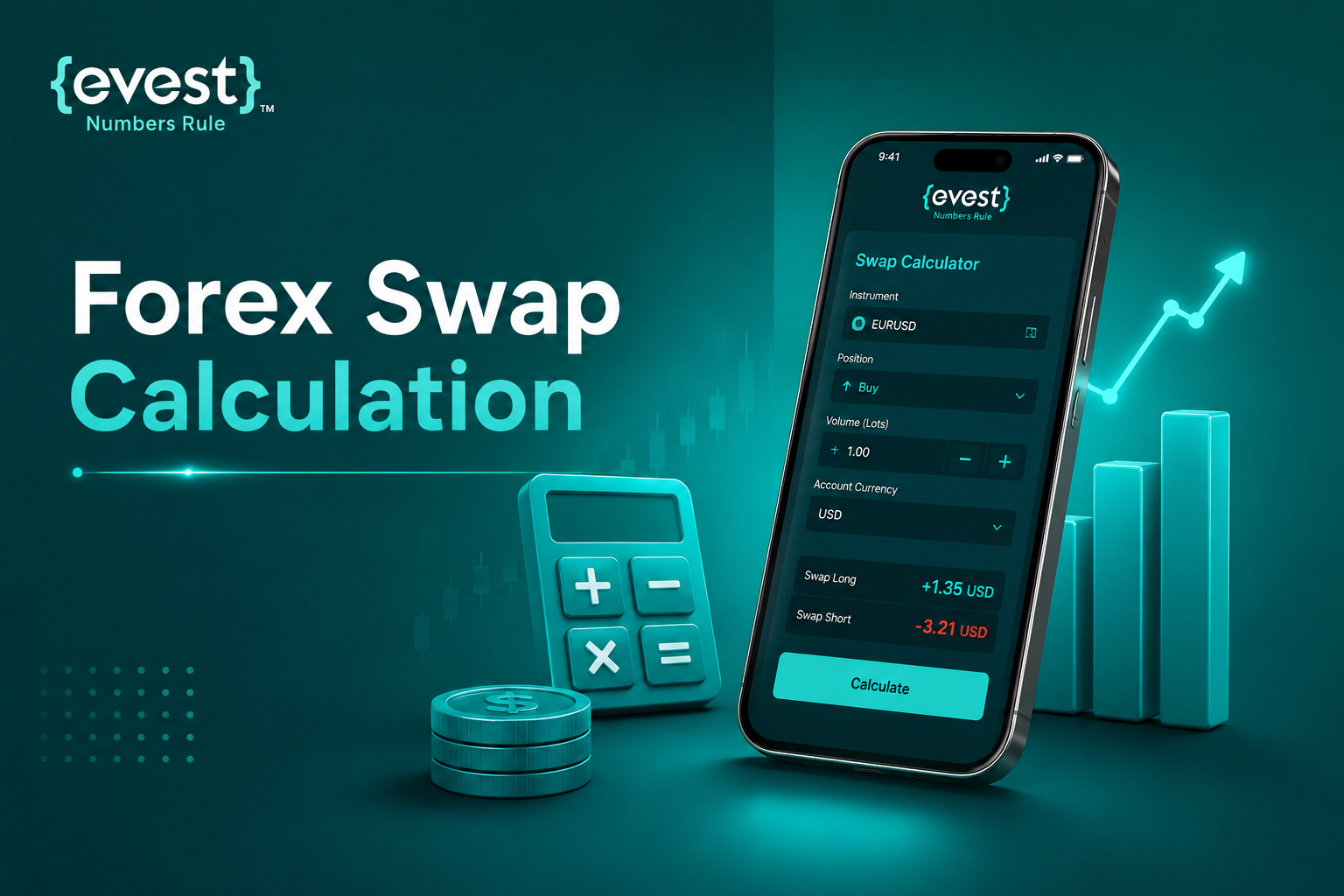
A forex swap calculation should begin with the calculation method shown in the specifications of the selected instrument. Depending on the platform and asset, the swap may be displayed in points, a fixed monetary amount, a percentage, or another instrument-specific format.
When the rate is quoted in points, an illustrative formula may be:
Swap amount = Swap rate × Point value × Number of lots × Number of nights
Assume that:
- The long swap rate is -5 points.
- The point value for the selected position is $1.
- The position size is 1 lot.
- The position remains open for 1 applicable night.
The illustrative forex swap calculation would be:
-5 × $1 × 1 × 1 = -$5
In this example, $5 would be deducted from the trading account. Now assume that the same position remains open for four applicable nights and the rate does not change:
-5 × $1 × 1 × 4 = -$20
The result should not be generalized to every instrument or platform. A displayed rate of -5 does not always mean a $5 or $50 charge. The final amount depends on: - Contract size.
- Point value.
- Number of lots.
- Number of applicable nights.
- Account currency.
- Calculation method.
- The unit used to display the rate.
The likely swap cost on a particular trade comes from the current instrument conditions and expected holding period, not from a universal fixed formula.
Overnight Swap Forex Costs: When Are Fees Applied?
A forex swap fee may apply when a position remains open at the platform’s daily rollover time. Opening and closing a position during the same trading day may avoid the overnight adjustment, provided that the trade is closed before the applicable cut-off.
The exact cut-off may vary according to:
- Platform conditions.
- Instrument type.
- Market schedule.
- Daylight-saving time changes.
- Holidays.
Traders should confirm the rollover time through the current platform information. The fee may be applied even if the position was opened only shortly before the cut-off. For example, a trade opened a few minutes before rollover and kept open after the cut-off may still receive the full applicable adjustment.
This means the fee is not necessarily calculated according to the exact number of hours the position has been open. The rollover point is usually the key factor. The total cost can also increase with the holding period. A small daily charge may become significant when a position remains open for several weeks. Swing and position traders should therefore include the estimated financing cost when calculating potential risk and profitability.
When Is a Triple Swap Applied?
For many forex instruments, a triple swap may be applied on a particular day of the week to account for weekend settlement. Wednesday is commonly used for several currency pairs, but it should not be treated as a universal rule.
The actual triple-swap day can vary according to:
- The selected instrument.
- Settlement conventions.
- Market holidays.
- The broker’s schedule.
- Changes in trading conditions.
If the normal daily charge is -$4, a triple application could result in an adjustment of approximately -$12 during that rollover, subject to the instrument’s calculation method. Triple swap can affect both negative and positive rates. A trader may receive approximately three times the normal overnight credit or pay approximately three times the normal charge, depending on the position direction and instrument.
Evest states that triple swap fees may be applied on a specific day, such as Wednesday, to account for the weekend. Traders should check the current instrument conditions rather than assuming that every position receives a triple adjustment on Wednesday.
How Swap Fees Work at Evest?
Before holding a position overnight with Evest, traders should check the current long and short swap values for the selected instrument, because the applicable amount can depend on the asset, position size, trade direction, account type, number of nights, and current platform conditions. A practical review should also include the current long forex swap rates, current short forex swap rates, the platform’s daily rollover time, the possible triple-swap day, the expected holding period, any account-specific exemption or alternative fee, the instrument’s point value, and the contract size.
What is a forex swap from an Evest trader’s perspective? It is a potential trading cost or credit that should be reviewed before a position is left open overnight. The current value should always be checked through Evest’s official platform information because swap rates and trading conditions may change. A value viewed several weeks earlier should not automatically be used to calculate a new trade.
Evest’s official support information states that swap fees are calculated automatically and that current instrument values can be checked through the company’s official website. Traders should also consider the full cost of the position. The swap is only one element. Spread, commission, price movement, and other applicable charges can also affect the final result.
Is an Islamic Account Swap Free at Evest?
A swap-free account is intended for eligible traders who want to avoid conventional overnight interest charges. At Evest, qualifying Islamic accounts are designed to operate without standard swap or rollover fees. However, swap-free does not necessarily mean that every position can remain open indefinitely without another holding-related charge.
Evest states that if a position remains open for three days or more, a Sharia-compliant commission may be charged according to the applicable Islamic account schedule. This means traders asking whether an Islamic account swap-free option removes all possible costs should review the complete conditions, including:
- Eligibility for the Islamic account.
- Instruments covered by the account.
- The number of swap-free days.
- Any Sharia-compliant commission.
- Applicable spreads.
- Other trading costs.
Evest currently describes three Islamic account types: Islamic Account, Islamic Pro Account, and Islamic Pro Plus Account. The accounts may differ in spreads and Sharia commission per lot. The exact conditions should be confirmed through Evest’s current account and fee information before opening a long-term position.
The expected holding period should also be compared with the account conditions. A position expected to remain open for one or two nights may receive different treatment from a position held for several weeks.
How to Manage Forex Swap Costs?
Traders can take several practical steps to control overnight financing costs:
- Check the long and short swap values before opening the trade.
- Estimate the total charge according to the expected holding period.
- Confirm the rollover time.
- Check the instrument’s triple-swap day.
- Avoid keeping a trade open longer than the strategy requires.
- Include swap costs within risk-to-reward planning.
- Review whether an eligible swap-free account is suitable.
- Recheck the rate when market conditions change.
- Calculate every position separately when holding multiple trades.
- Review the full trading cost, not only the spread.
Before holding a position overnight, estimate what the adjustment is likely to add to or subtract from the expected result. This helps prevent a profitable price movement from becoming an unprofitable net trade after accumulated financing costs.
Why Do Forex Swap Costs Matter Before Entering a Trade?
Overnight financing is easy to overlook because it is not always visible within the initial entry price. A trader may focus on the spread, market direction, stop-loss placement, profit target, and position size. At the same time, the expected overnight holding cost may be left out of the plan. This can create an inaccurate view of the trade’s real risk and potential return.
The impact is generally limited for positions closed before rollover, but it becomes more important as the holding period increases. A swing trade held for several days may receive multiple daily adjustments, while a position trade held for several weeks can accumulate a meaningful cost. The total may also change if the trade passes through a triple-swap day.
For that reason, the overnight adjustment should be treated as part of the trade’s total cost rather than as a separate detail checked after the position has already been opened.
A complete trading plan should consider:
- Spread.
- Commission.
- Estimated swap.
- Expected number of nights.
- Possible triple swap.
- Potential price movement.
This is particularly important when comparing two possible trades. One setup may appear to offer a larger price target, but its negative overnight cost could reduce the expected net return. Another position may have a smaller projected price movement but more favorable holding conditions. The decision should still be based on the complete market analysis, but the financing effect should not be ignored.
Traders should also avoid building a strategy around a positive swap alone. An overnight credit can support the final result, but it cannot protect the position from adverse market movement, volatility, price gaps, or changes in the applicable swap rate.
Common Forex Swap Mistakes
Many traders focus on price movements while overlooking the impact of overnight swap charges. Understanding the most common forex swap mistakes can help reduce unnecessary costs and improve overall trade planning and risk management.
1- Ignoring the Difference Between Buy and Sell Rates
One common mistake is checking only the swap for the intended trade direction. Reviewing both the long and short values provides a clearer understanding of how the instrument is priced and prevents assumptions based only on interest-rate differences.
2- Using an Old Swap Rate
Forex swap rates may change. A value taken from an old article, screenshot, or previous trade may no longer reflect the current instrument conditions. The current rate should be checked when the new trade is being planned.
3- Forgetting the Triple-Swap Adjustment
Some traders calculate the normal daily charge but forget the triple swap. If the position remains open through the relevant rollover, the actual cost may be higher than expected. Market holidays may also affect the applicable schedule.
4- Treating Positive Swap as Guaranteed Income
A positive overnight adjustment does not protect a position from market losses. Price movement remains one of the main factors affecting the trade’s final outcome.
5- Assuming Swap-Free Means Cost-Free Forever
A swap free account may have alternative conditions, eligibility requirements, time limits, or Sharia-compliant commissions. The complete account schedule should be reviewed before relying on its swap-free conditions.
6- Ignoring the Account Currency
The final amount may need to be converted into the base currency of the trading account. This conversion can affect the amount ultimately shown in the account history.
7- Applying the Wrong Point Value
A rate displayed in points must be converted using the correct contract and instrument specifications. Using an incorrect point or pip value can produce a misleading forex swap calculation.
A practical pre-trade review should answer five questions:
- What is the current long or short rate?
- How is the rate quoted?
- How many nights may the position remain open?
- Does a triple-swap day fall within that period?
- Are there any account-specific conditions?
Answering these questions reduces unexpected costs and produces a more realistic estimate of the trade’s net result.
FAQs
What Is a Forex Swap in Trading?
A forex swap in trading is an overnight financing adjustment applied when a leveraged currency position remains open beyond the platform’s rollover time. It may be charged or credited depending on the instrument, trade direction, position size, account conditions, and current forex swap rates.
What Is Swap in Trading?
Swap in trading commonly refers to the cost or credit applied for carrying a leveraged position overnight. The exact meaning can vary by market and instrument, so traders should review the contract specifications and platform conditions before keeping a position open after rollover.
Is There Always a Forex Swap Fee?
No, there is not always a forex swap fee. The adjustment may be negative, positive, or zero depending on the selected instrument, position direction, account type, current rates, and applicable trading conditions. Traders should check live long and short values before holding positions overnight.
How Can I Check Forex Swap Rates at Evest?
Traders can check forex swap rates at Evest by reviewing the current long and short values shown for the selected instrument. They should also confirm the rollover schedule, possible triple-swap day, instrument specifications, and any account-specific conditions before holding a trade overnight.
Can a Positive Swap Guarantee Profit?
No, a positive swap cannot guarantee profit. It is only one part of the trade’s result. Adverse price movement, spread, commissions, volatility, and other costs can exceed the overnight credit, so traders should not build a strategy around positive swap alone.
How Can I Reduce Overnight Swap Costs?
Traders can reduce overnight swap costs by checking rates before entry, estimating the total cost for the expected holding period, closing unnecessary trades before rollover, reviewing the triple-swap schedule, and considering whether an eligible swap-free account fits their trading needs.