

Tesla enters the final months of 2026 with investors balancing record vehicle deliveries against weaker automotive margins, heavy artificial intelligence spending, and uncertainty around autonomous driving. TSLA recently traded in the mid-$300s, while Wall Street targets remain unusually wide, reflecting very different assumptions about cars, energy storage, Cybercab, Full Self-Driving, and Optimus. This Tesla stock price forecast examines the current market position, analyst targets, technical levels, delivery trends, earnings pressure, autonomy, robotics, China competition, energy growth, and long-term scenarios for 2027 and 2030 to explain what could push Tesla shares higher or lower in the coming quarters.
Tesla Stock Price Forecast 2026
The near-term Tesla outlook is mixed. Tesla shares closed at $363.56 on September 10, 2026, according to StockAnalysis. That level sat below the December 2025 record near $498 but well above the 52-week low around $297.
The stock therefore remains volatile, not directionless. Wall Street also remains divided. StockAnalysis showed an average 12-month target of $390.09 from 46 analysts, with estimates ranging from $125 to $600. That spread tells investors more than the average alone because Tesla’s valuation depends heavily on assumptions about businesses that are still developing.
A practical base case is that TSLA remains sensitive to earnings, deliveries, interest rates, Cybercab execution, Full Self-Driving adoption, and AI spending.
The bullish case requires Tesla to convert record vehicle deliveries, growing energy storage, and autonomous technology into stronger margins and cash flow.
The bearish case is that competition, high capital expenditure, regulatory scrutiny, and lower automotive profitability continue to pressure the valuation. Investors should therefore treat the current consensus target as a reference point rather than a promise.
Current Tesla Stock Price and Market Position
Tesla closed at $363.56 on September 10, 2026, after trading through a wide 52-week range of roughly $297 to $499. That price sits between the most bearish and most bullish analyst targets, which is appropriate for a company where current automotive profits and future AI expectations are pulling valuation in different directions.
The stock remains one of the market’s clearest examples of a narrative-sensitive growth company, where one product milestone or regulatory development can move expectations faster than quarterly earnings alone.
The stock’s current position also needs to be separated from its January and February search visibility. Search demand around Tesla exploded early in 2026 because users were looking for specific daily prices, news updates, and month-dated forecasts.
That does not mean the stock’s fundamental outlook was strongest at that moment. For investors today, the important question is whether the company’s current operating performance can justify expectations already embedded in the share price.
Tesla Stock Outlook for the Rest of 2026
The rest-of-2026 outlook depends on three connected questions. First, can the automotive business maintain the delivery recovery seen in Q2 without sacrificing too much margin? Second, can Tesla control the cash demands created by AI infrastructure, robotics, and autonomy? Third, can Cybercab and Full Self-Driving move from investor narrative to measurable commercial activity? If the answer improves across all three, the stock could move closer to the upper half of current analyst targets.
If those areas remain mixed, TSLA may continue trading as a high-volatility range stock rather than entering a sustained trend. Higher interest rates are another important risk because Tesla’s valuation still relies heavily on future earnings.
A higher discount rate reduces the present value of profits expected years from now. That makes Tesla particularly sensitive to bond yields and Federal Reserve expectations compared with slower-growth businesses whose value depends more heavily on current cash generation. U.S. Treasury yields were again near multi-year highs in September as investors priced tighter monetary policy.
Wall Street Tesla Price Targets
Analyst forecasts remain unusually dispersed. Stock Analysis reported an average 12-month target of $390.09 from 46 analysts, with a median target of $410, a low of $125, and a high of $600. Individual September updates were also far apart. Barclays maintained a $370 target, J.P. Morgan maintained $445, RBC reiterated $480, Wells Fargo stayed near $130, and Morgan Stanley maintained $400. Different data providers calculate consensus figures differently, so the range matters more than one average.
| Source or Analyst | Recent Target | View |
| StockAnalysis consensus | $390.09 average | Moderate upside from Sep 10 price |
| Barclays | $370 | Near current market level |
| J.P. Morgan | $445 | Meaningful upside with execution assumptions |
| RBC Capital | $480 | More optimistic autonomy and growth view |
| Morgan Stanley | $400 | Balanced upside and execution risk |
| Wells Fargo | $130 | Deep downside case tied to valuation and execution |
The table shows why Tesla cannot be reduced to one Wall Street number. Bullish analysts assign significant value to autonomy, robotics, energy storage, software, and future platform economics. Bearish analysts place more weight on current automotive margins, competition, capital intensity, and the risk that new businesses take longer to monetize than investors expect.
Tesla Bull Base and Bear Scenarios
A scenario framework is more useful than a single price target because Tesla combines a mature vehicle business with several high-uncertainty growth options. The ranges below are planning zones rather than precise predictions.
| Scenario | Indicative 2026 Zone | What Could Drive It | What Would Weaken It |
| Bullish | $430 to $520+ | Stronger margins, Cybercab expansion, rising FSD adoption, positive cash-flow trend, energy growth | Regulatory setbacks, weak margins, higher rates |
| Base Case | $340 to $430 | Stable deliveries, mixed margins, gradual autonomy progress, no major macro shock | Sharp earnings miss or major execution surprise |
| Bearish | $220 to $340 | Demand weakness, margin pressure, heavy cash burn, competition, regulatory delays | Fast earnings recovery or successful autonomy monetization |
Tesla Q2 2026 Deliveries and Financial Update
Tesla delivered 480,126 vehicles in Q2 2026 after producing 451,758, beating the company-compiled delivery consensus published before the quarter. Energy storage deployments reached 13.5 GWh.
Those operating results were important because they showed demand recovery after a weak first quarter and demonstrated that Tesla could draw down inventory while expanding its energy business.
The financial picture was less comfortable. Reuters reported Q2 revenue of about $28.24 billion, automotive gross margin of 16.3%, and negative free cash flow of roughly $1.1 billion as capital expenditure surged. Tesla is spending heavily on AI, robotics, chips, data centers, autonomy, and manufacturing capacity.
That creates a major valuation tension. Record deliveries are positive, but investors still need to see whether the company can improve profitability while funding those longer-term projects.
Tesla Technical Analysis and Key Levels
Technical analysis should support the forecast rather than replace it. Tesla’s September price near the mid-$300s means the old support around $200 and resistance around $300 in the previous article are no longer useful. Traders should refresh the 50-day and 200-day moving averages, RSI, and recent swing highs and lows on the publication date because TSLA can move quickly after analyst revisions, earnings, regulatory news, or product events.
The key signals to monitor are:
- Whether TSLA can hold above recent support after pullbacks instead of making a sequence of lower lows.
- Whether price can reclaim higher resistance created during the late-2025 and 2026 trading ranges.
- Whether the 50-day moving average is rising or falling relative to the 200-day average.
- Whether momentum improves with volume when price approaches major resistance.
- Whether Tesla is outperforming or underperforming the Nasdaq during broader market moves.
Key Factors Driving Tesla Stock Price
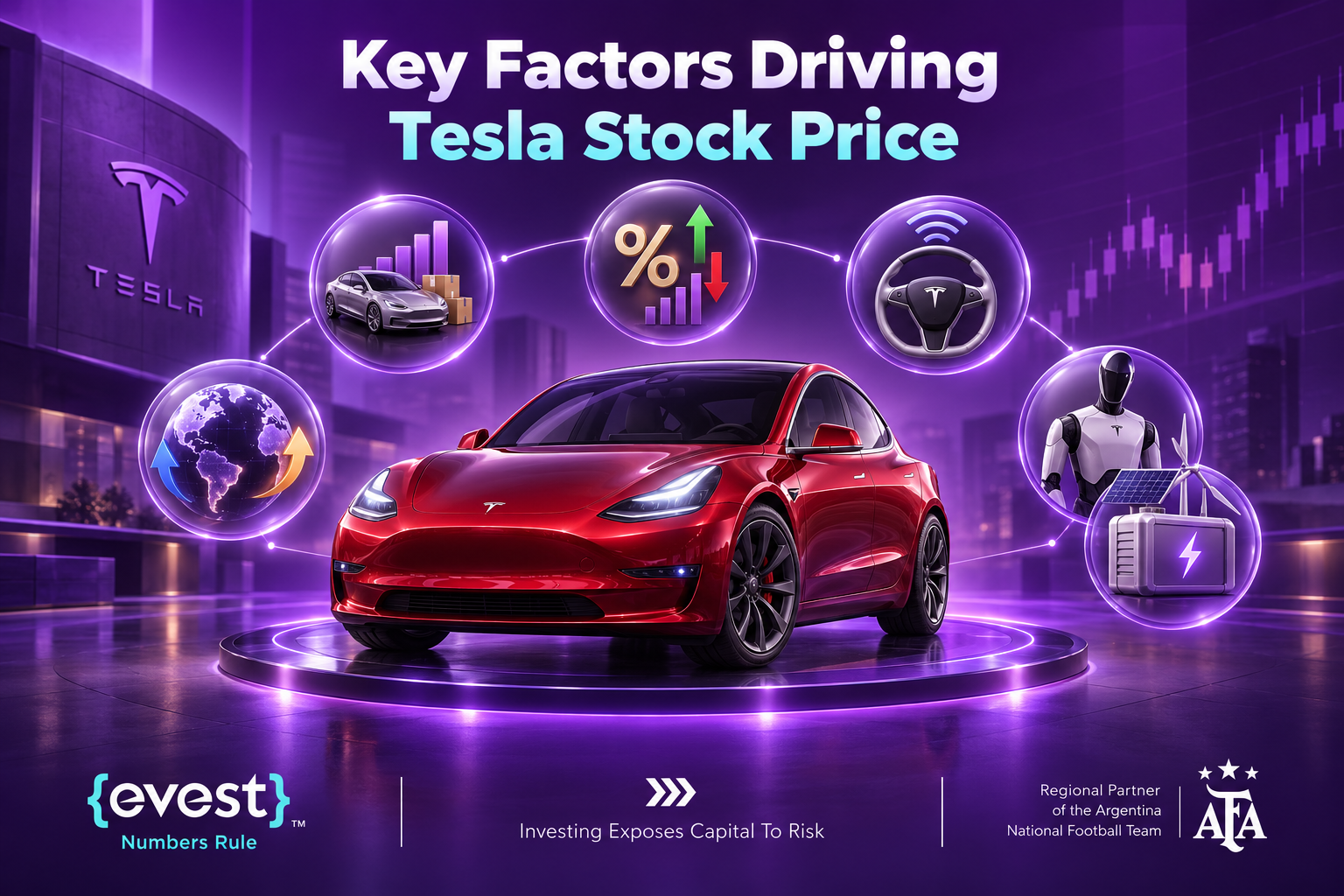
Tesla’s stock is influenced by more than vehicle deliveries. The market increasingly values the company as a combination of automaker, energy-storage provider, autonomy platform, robotics developer, and AI infrastructure investor. That creates more potential upside, but it also means investors are paying for several businesses that remain uncertain.
- Vehicle deliveries and automotive margins remain the foundation of current revenue and profitability.
- Interest rates affect the valuation of long-duration growth stocks and consumer financing costs.
- Cybercab and FSD progress influence assumptions about recurring software and mobility revenue.
- Optimus affects long-term robotics expectations but remains commercially early.
- Energy storage can diversify revenue and reduce reliance on vehicle cycles.
- Competition in China, Europe, and the United States affects pricing power and market share.
Robotaxi Cybercab and FSD Outlook
Autonomy is one of the most important drivers of Tesla’s long-term valuation. Tesla began offering limited Cybercab rides in Austin in September 2026, using a purpose-built vehicle without a steering wheel or pedals. Reuters reported that the U.S. National Highway Traffic Safety Administration was evaluating the rollout. That regulatory scrutiny matters because a successful commercial robotaxi business requires more than technical capability.
Tesla must demonstrate safety, obtain approvals, scale operations, manage insurance and liability, and prove unit economics.
The investment case becomes stronger if Tesla expands autonomous rides across more cities while improving safety data and reducing the need for human monitoring.
It weakens if regulatory approvals move slowly, utilization remains low, or economics disappoint. FSD subscriptions are also relevant because software revenue can improve margins even before full autonomy is achieved.
Investors should therefore track paid adoption, active use, regulatory approvals, and commercial miles rather than relying only on product demonstrations.
Optimus and Physical AI
Optimus represents one of Tesla’s largest long-term optionality stories and one of the hardest businesses to value. The idea is that a general-purpose humanoid robot could perform repetitive industrial and eventually service tasks.
If Tesla can manufacture robots at scale, integrate them with its AI stack, and deploy them economically, the addressable market could be large. However, commercialization remains early, and revenue assumptions for the late 2020s depend on capabilities that still need to be proven.
For the stock forecast, Optimus should therefore be treated as upside optionality rather than a current earnings engine.
Investors should look for measurable milestones such as production volume, deployment inside Tesla facilities, third-party customers, utilization rates, cost per robot, reliability, and revenue. A rising valuation based on robotics without corresponding operating evidence increases downside risk if timelines slip.
Tesla Energy Storage Outlook
Tesla’s energy business has become increasingly important. Q2 2026 energy storage deployments reached 13.5 GWh, continuing strong growth across utility-scale and commercial storage.
The segment provides a useful counterweight to automotive cyclicality because grid storage demand depends on renewable integration, power reliability, and electricity infrastructure rather than only consumer vehicle demand.
The long-term opportunity is attractive, but margins and capital requirements still matter.
Tesla is expanding Megafactory capacity and developing newer storage products, which can support growth if demand remains strong. Investors should track deployment volume, energy revenue, gross margin, project timing, battery-cell availability, and tariff exposure.
Tesla’s regulatory filings also note that tariffs and battery-cell costs can materially affect the economics of the storage business.
China and Global EV Competition
Competition remains one of the clearest risks to the Tesla forecast. Reuters reported that sales of China-made Tesla vehicles reached 86,166 units in August 2026, up 3.6% from a year earlier but down 7.9% from July. Tesla’s battery-electric market share in China was around 6.6% in Q2, far below levels seen earlier in the decade. Local companies such as BYD, Xiaomi, Geely, and others continue expanding technology, pricing, and exports.
The competitive challenge is not limited to China. European markets remain fragmented, and traditional automakers are improving EV lineups while new entrants compete on software and price.
Tesla still benefits from brand recognition, manufacturing scale, charging infrastructure, and software capabilities, but maintaining volume may require pricing actions that pressure margins. A bullish stock forecast therefore requires both sales growth and evidence that Tesla can defend profitability.
Interest Rates Valuation and Market Sentiment
Tesla is especially sensitive to interest rates because a large part of its market value reflects earnings expected in the future. Higher Treasury yields raise the discount rate used to value those profits and can make lower-risk assets more attractive.
In September 2026, U.S. bond yields were near multi-year highs as investors anticipated tighter Federal Reserve policy. That environment can pressure high-multiple technology and growth stocks even when company-specific news is positive.
Interest rates also influence Tesla operationally because many vehicle purchases are financed. Higher borrowing costs can reduce affordability or force automakers to use incentives.
The stock therefore faces a double sensitivity to rates through both valuation and consumer demand. If yields decline, the reverse can happen, supporting multiples and vehicle financing conditions.
Tesla Valuation and Margin Expectations
Tesla’s valuation remains difficult to compare with conventional automakers because investors assign value to businesses that are not yet mature. Current operating data show why that distinction matters. StockAnalysis reported a gross margin near 18.9%, an operating margin around 4.1%, and a profit margin near 3.7% in September 2026.
Those figures are far below the margins often associated with software businesses, so any premium valuation depends on Tesla proving that autonomy, software, robotics, and energy can improve the earnings mix over time.
The key question is not whether Tesla deserves a high or low multiple in isolation. It is whether future profit growth arrives fast enough to justify the multiple investors are paying today.
If software and autonomy revenue scale with limited incremental cost, the valuation case strengthens.
If the company remains capital intensive and automotive margins stay compressed, the stock becomes more dependent on optimistic assumptions about distant earnings. That makes quarterly margin trends, free cash flow, and return on new investment essential parts of the forecast.
Tesla Stock Forecast for 2027
A 2027 Tesla forecast should focus on operating milestones rather than one exact number. The key questions will be whether vehicle deliveries continue growing, whether margins recover, whether free cash flow improves after the 2026 investment cycle, and whether Cybercab, FSD, Optimus, and energy storage begin contributing more measurable economics.
Those outcomes will determine whether Tesla deserves a valuation closer to a conventional automaker or a broader AI and technology platform.
A constructive 2027 scenario would combine stronger automotive profitability with expanding software and energy revenue. A weaker scenario would emerge if capital spending remains high while autonomy commercialization is slower than expected.
Company-compiled sell-side estimates published before Q2 pointed to more than 1.8 million deliveries in 2027, but actual expectations should be refreshed as new quarterly data arrive.
Tesla Stock Prediction for 2030
Tesla’s 2030 value is even more uncertain because the company may look very different by then. A traditional automotive valuation would depend on deliveries, margins, market share, and energy growth.
A much higher valuation would require meaningful revenue and profit from autonomous mobility, FSD software, robotics, AI infrastructure, or other services. That difference explains why long-term price targets vary so widely.
Instead of assuming Tesla must reach $1,000 or $1,500, investors should test the assumptions behind those figures. How many autonomous vehicles are operating commercially?
What is the revenue per mile? How many Optimus units are sold or deployed? What margins does the energy business generate? How much capital is required? A strong 2030 thesis needs evidence that these future businesses create durable cash flow rather than only investor excitement.
What Could Support a Stronger Tesla Rally?
The bullish case becomes more credible when operating results and future-business milestones improve together.
- Automotive gross margin recovers while deliveries remain strong.
- Free cash flow improves after the heavy 2026 capital-spending cycle.
- Cybercab expands beyond limited markets with regulatory approval and improving utilization.
- FSD subscriptions and software revenue grow faster than the vehicle business.
- Energy storage continues scaling with healthy margins.
- Optimus achieves measurable production and commercial deployment milestones.
- Interest rates fall, reducing pressure on growth-stock valuations.
Risks to the Tesla Stock Forecast
Tesla’s upside potential comes with substantial execution risk. The most important threats to the forecast include:
- Automotive margins remain compressed because of pricing competition and incentives.
- Cybercab or FSD expansion faces regulatory, safety, or liability delays.
- Capital expenditure stays elevated while new AI and robotics businesses generate limited near-term cash flow.
- China and other EV markets become more competitive, reducing Tesla’s pricing power and share.
- Higher interest rates pressure both vehicle affordability and equity valuation.
- Optimus commercialization takes longer than investors expect.
- Analyst expectations remain too optimistic relative to actual earnings growth.
These risks do not imply that Tesla must fall. They define the conditions that would require a more cautious forecast. Because TSLA can react sharply to one earnings release or regulatory headline, investors should update assumptions rather than hold fixed targets after the underlying evidence changes.
Tesla Stock Price Forecast 2026 Final Outlook
Tesla enters the final part of 2026 with a stronger delivery picture than it had earlier in the year but a more complicated earnings story.
Record Q2 deliveries and expanding energy storage support the growth case, while weaker automotive margins, negative free cash flow, heavy AI spending, and regulatory questions around Cybercab limit confidence.
Wall Street’s average target near $390 suggests only moderate upside from the September market level, but the $125 to $600 range shows how uncertain the valuation remains.
The strongest forecast is therefore conditional. TSLA can justify higher prices if Tesla converts autonomy, energy, software, and robotics into profitable growth while stabilizing its core automotive economics.
If cash burn, competition, regulation, or margin pressure persist, the stock could remain volatile or move toward the lower end of analyst ranges. Investors should judge Tesla by measurable operating progress rather than one headline target.
FAQs
What is the Tesla stock price forecast for 2026?
Tesla’s 2026 outlook remains mixed. Wall Street’s average 12-month target is around $390, while estimates range from $125 to $600. Deliveries, margins, Cybercab execution, interest rates, energy growth, and AI spending will determine where TSLA ultimately trades next overall today.
What is Tesla’s average analyst price target?
StockAnalysis reports an average Tesla price target of $390.09 from 46 analysts, with a median of $410, a low of $125, and a high of $600. Different platforms use analyst samples, so consensus figures can vary noticeably over time.
Can Tesla stock reach $500 again?
Tesla can trade above $500 again if earnings, margins, autonomy, and investor sentiment improve enough to support the valuation. The stock has previously approached that area, but reaching it again would require stronger operating evidence and favorable market conditions overall.
What could make Tesla stock fall?
Tesla could fall if vehicle demand weakens, margins remain compressed, interest rates stay high, Cybercab or FSD face regulatory delays, capital spending continues to pressure cash flow, competition intensifies, or long-term AI and robotics expectations are revised lower materially overall.
What is the Tesla stock prediction for 2030?
Tesla’s 2030 value depends heavily on businesses that are still developing, including autonomous mobility, FSD software, Optimus, energy storage, and AI. Long-term forecasts are highly uncertain, so investors should focus on revenue, margins, cash flow, and commercialization milestones instead today.