
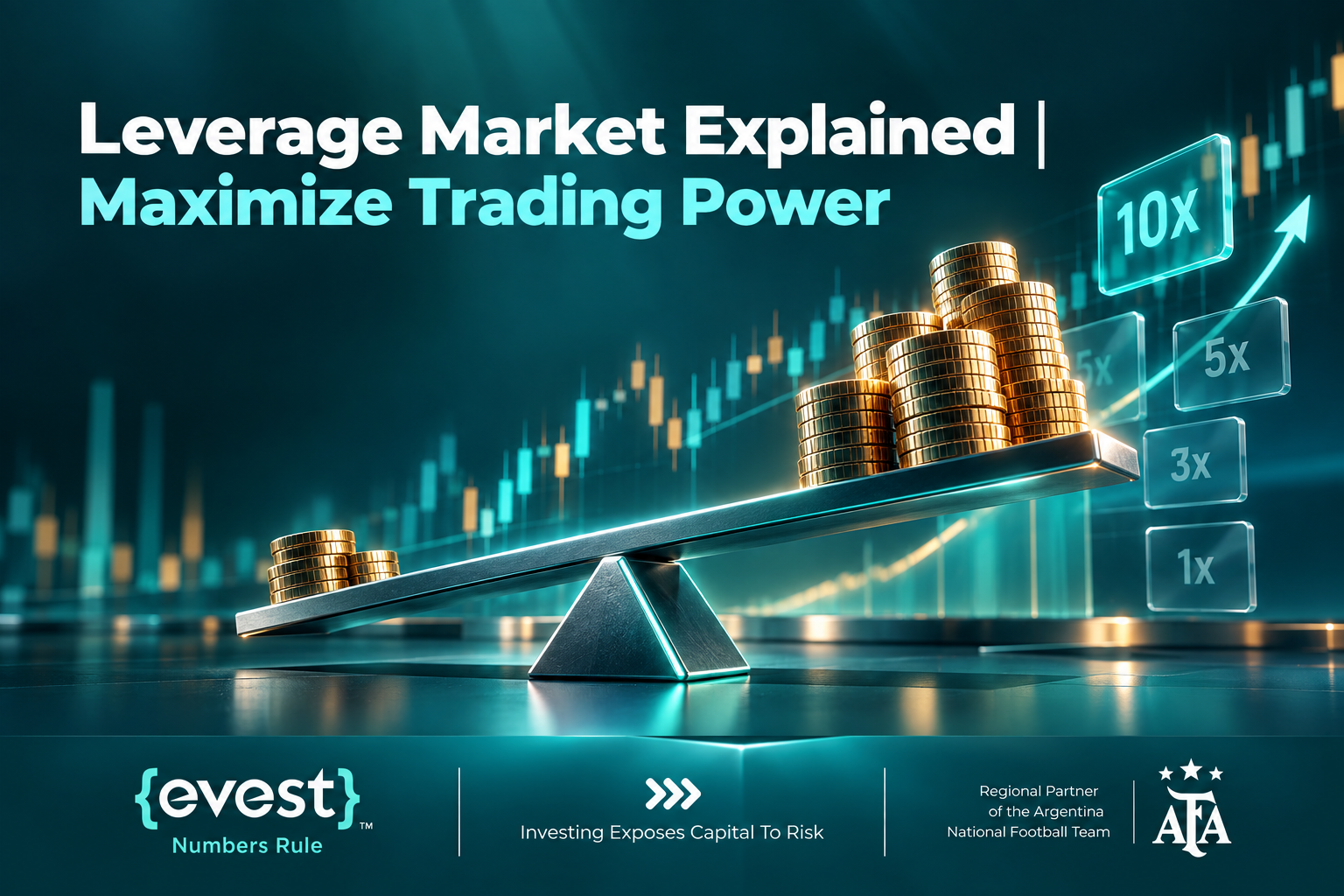
Leverage in trading allows you to open a position larger than the cash you commit as margin. That increased exposure can magnify profits, but it can magnify losses just as quickly, which is why leverage should be understood as a risk mechanism rather than a shortcut to higher returns. In this guide, we explain how leverage works, how it differs from margin, how leverage ratios affect required margin, and what happens when equity falls toward a margin call or stop-out level. You will also see practical examples for CFDs, forex, stocks, and Evest trading conditions, with risk controls explained clearly.
What Is Leverage in Trading?
Leverage in trading is the ratio between the total value of a position and the amount of capital required as margin to open it. Instead of paying the full value of a trade upfront, a trader deposits a smaller amount while gaining exposure to a larger position.
For example, with 1:10 leverage, $1,000 of margin can support a $10,000 position. The important point is that profit and loss are calculated from the full $10,000 exposure, not only from the $1,000 margin. If the market moves 2%, the position changes by roughly $200 before spreads, financing, commissions, slippage, or other costs.
In CFD trading, describing leverage only as “borrowed cash” can be misleading. The trader usually receives leveraged market exposure through a margin-based product; the full notional value is not transferred into the trader’s account as a conventional cash loan. This distinction makes the concept easier to understand and avoids confusing a leveraged derivative position with a traditional personal or investment loan.
That is also why leverage should not be viewed as free capital. What the trader receives is the ability to control a larger market exposure while committing a smaller amount as margin. The resulting profit or loss remains connected to the entire position.
How Does Leverage Work?
Leverage works through margin. When you open a leveraged position, the broker reserves a portion of your account funds as required margin. The remaining account equity is available to absorb price movements, support other positions, or meet changing margin requirements.
A simple way to think about the process is:
- Choose a market and position size. The full position value determines the real market exposure.
- Check the applicable leverage or margin requirement. This can differ between instruments and accounts.
- Required margin is reserved. Profit and loss then fluctuate according to the full position size.
- Monitor equity and margin level. Losses reduce equity and therefore reduce the account’s ability to support open positions.
- Understand forced-close rules. If the margin level deteriorates sufficiently, a margin call or stop-out may occur.
This is why leverage should never be judged only by how much exposure it creates. The more useful question is how much account equity can absorb an adverse move before risk controls are triggered.
Leverage vs Margin and How They Differ in Trading?
Leverage and margin describe the same relationship from opposite directions, but they are not the same thing. Leverage shows how large the position is relative to the capital supporting it. Margin is the amount, or percentage, of your own funds required to open and maintain that position.
| Comparison | Leverage | Margin |
| Meaning | Ratio between position size and required capital | Capital reserved to support a leveraged position |
| Common format | 1:10, 1:30, 1:100 | 10%, 3.33%, 1% |
| Higher value means | More exposure per unit of margin | More capital required for the same position |
| Main risk effect | Larger account impact from small market moves | Less free margin remains available once reserved |
The relationship between the two is inverse. A 10% margin requirement is equivalent to 1:10 leverage. A 5% margin requirement is equivalent to 1:20 leverage. A 1% margin requirement corresponds to 1:100 leverage.
Understanding this conversion is useful because trading platforms do not always display the concept in the same way. One broker may highlight a leverage ratio while another may show the required margin percentage. Economically, both are describing how much capital is required to support a particular position.
How to Read Leverage Ratios?
A leverage ratio tells you the position value that a given amount of required margin may support under the stated trading conditions. At 1:20, every $1 of required margin supports $20 of market exposure. At 1:100, every $1 supports $100.
The basic relationship is:
Required Margin = Position Value ÷ Leverage
So a $20,000 position at 1:20 leverage requires $1,000 in margin. The same $20,000 position at 1:100 requires $200.
The second setup uses less margin, but the $20,000 market exposure has not changed. A 1% market movement still represents roughly $200 of position-level profit or loss before applicable costs.
This is one of the most important ideas in leveraged trading. Lower required margin does not make the underlying position smaller. It simply means less capital is reserved to support the same exposure.
Maximum Leverage vs Effective Leverage
| Comparison Point | Maximum Leverage | Effective Leverage |
| Definition | The highest leverage ratio a broker or account may permit. | The actual market exposure used relative to the account equity. |
| Meaning | Shows the maximum trade size the account may technically support. | Shows how much exposure the trader is actually taking. |
| Example: $10,000 position | An account with $5,000 equity may allow maximum leverage of 1:400. | The actual exposure is approximately 2 times the account equity. |
| Example: $100,000 position | The account may technically permit a much larger position because of the 1:400 limit. | The effective exposure becomes approximately 20 times the account equity. |
| Key distinction | Maximum leverage does not mean the trader must use the full ratio. | The actual risk depends on the position size and total exposure used. |
| Risk factors | Indicates the broker’s permitted limit. | Depends on position size, account equity, market volatility, stop distance, and the combined exposure of all open positions. |
| Main takeaway | A 1:400 account does not automatically mean every trade uses 400 times the trader’s capital. | The leverage actually being used determines the trader’s real market exposure and risk. |
A Complete Leverage Example Using Exposure, Margin, Profit and Loss
Assume a trader opens a $10,000 CFD position using 1:10 leverage. The required margin is $1,000. Now compare the outcome of a 2% market movement with and without leverage.
| Scenario | Position Value | Capital/Margin Used | Market Move | P&L | Return Relative to Capital Used |
| Unleveraged position | $10,000 | $10,000 | +2% | +$200 | +2% |
| 1:10 leveraged position | $10,000 | $1,000 | +2% | +$200 | +20% |
| 1:10 leveraged position | $10,000 | $1,000 | -2% | -$200 | -20% |
The key lesson is symmetry. Leverage does not only increase the percentage return when a position moves in the trader’s favor. The same mechanism increases the percentage loss relative to the margin when the market moves against the position.
Now assume the trading account started with $2,500 and the position requires $1,000 in used margin. If the position develops an unrealized loss of $600, account equity falls to approximately $1,900, assuming there are no other credits, charges, or positions.
The original $1,000 margin remains committed while the trade remains open. The account therefore has less capacity to absorb further losses.
At this point, simply knowing that the position uses 1:10 leverage tells you very little about the health of the account. Equity, used margin, free margin, and margin level become much more important.
Why Small Price Moves Matter More With High Exposure?

- Leverage changes the size of the position that a given amount of margin can support, so a small market movement can become a large change relative to the capital committed.
- If $1,000 of margin supports a $100,000 position, a 0.5% movement in the underlying market represents approximately $500 of position-level profit or loss before trading costs. That equals half of the original $1,000 margin.
- The underlying asset itself has moved only 0.5%. Leverage does not make the underlying market more volatile. What changes is the impact that market movement has on account equity.
- As exposure becomes larger relative to the size of the account, progressively smaller adverse movements can produce significant percentage losses.
This is why proper risk calculation begins with the full position value and planned exit level, not merely the amount of margin that the platform requires to open the trade.
How Leverage Works on Evest?
- Evest currently states that leverage can be available up to 1:400 as a maximum.
- The actual ratio may vary depending on the financial instrument, market risk and volatility, account type, platform conditions, and regulatory policies.
- Evest also notes that leverage levels may be reduced around major economic events or market-moving announcements.
- That means the 1:400 figure should be understood as maximum available leverage under applicable conditions, rather than a fixed ratio automatically applied to every Evest position.
- Evest’s current trading-fees information also describes CFD trading with maximum leverage up to 400 and states a stop-out level of 20% margin. Because account conditions can depend on instrument, client entity, or applicable regulation, current trading specifications should be checked before a position is opened.
The practical sequence is therefore straightforward: determine the instrument, review the applicable leverage, calculate required margin, understand the total exposure, monitor equity and margin level, and know the stop-out rules before increasing the position size.
Leverage Across Forex, Indices, Commodities, Stocks and Crypto CFDs
Leverage is not uniform across financial markets. Brokers and regulators may apply different margin requirements according to volatility, liquidity, product structure, market conditions, and client classification.
Evest also states that available leverage differs according to the instrument and its risk characteristics.
- Forex: Major currency pairs can offer comparatively higher leverage because these markets are often highly liquid, although jurisdictional caps still apply.
- Indices: Available leverage can differ between major indices and less liquid or more volatile indices.
- Commodities: Gold, oil, and other commodities do not necessarily share the same margin requirements because their volatility characteristics differ.
- Stock CFDs: Individual shares often have lower leverage than major forex pairs because a single company’s share price can experience large movements.
- Crypto CFDs: Where such products are legally available, leverage is commonly more restricted because cryptocurrency markets can be highly volatile.
The important point is that the category alone is not enough. Two instruments within the same asset class can carry different leverage requirements, and those requirements may change when market conditions become unusually volatile.
Leveraged Stock CFDs vs Buying Stocks on Margin
| Comparison Point | Margin-Financed Share Purchase | Leveraged Stock CFD |
| Basic structure | The investor generally purchases the actual shares while financing part of the transaction through a brokerage margin arrangement. | The trader enters into a derivative contract based on changes in the price of an underlying share. |
| Market exposure | Can provide exposure greater than the cash initially committed because part of the purchase is financed through margin. | Provides leveraged exposure to the share’s price movements without necessarily purchasing the underlying stock. |
| Ownership | The investor generally acquires ownership of the underlying shares. | The trader does not own the underlying shares. |
| Shareholder rights | May include ownership rights, depending on the broker, jurisdiction, and applicable conditions. | Does not provide the same shareholder rights associated with direct stock ownership. |
| Financing terms | Involves a brokerage margin arrangement with specific financing terms and conditions. | The product is a derivative contract, so it should not automatically be described as borrowing money to purchase actual shares. |
| Evest context | Applies to a conventional margin purchase of actual shares. | Leveraged stock trading on Evest through CFDs provides exposure to price movements rather than ownership of the underlying stock. |
| Key takeaway | Leverage is used to help finance the purchase of actual shares. | Leverage increases exposure to price movements without acquiring the underlying shares. |
How Regulation Affects Trading Leverage?
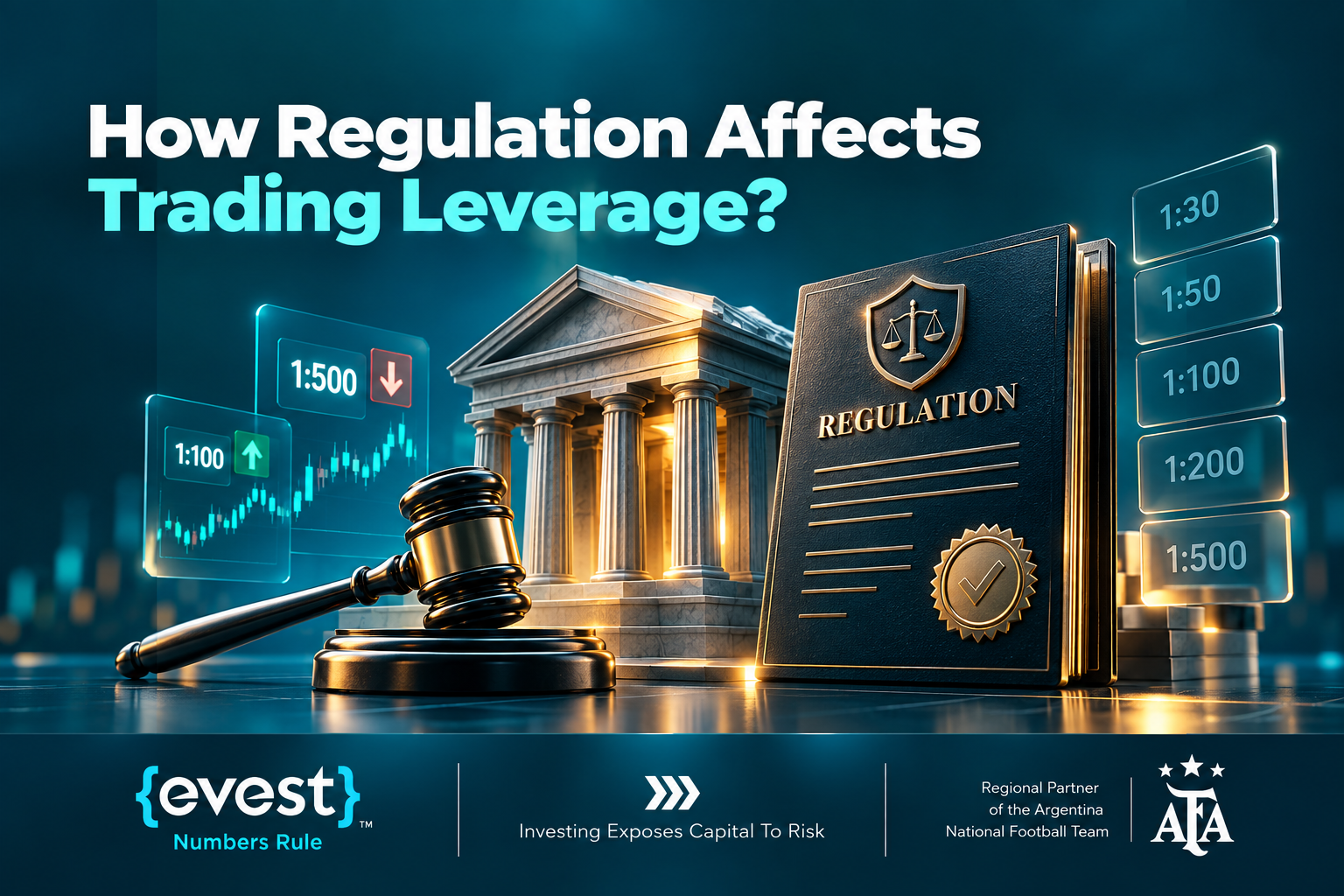
The amount of leverage available to a trader can be heavily influenced by regulation. The same leverage ratio may not be available to every trader because regulatory limits can vary according to jurisdiction, broker entity, underlying asset, and whether the client is classified as retail or professional.
Within the European retail CFD framework, leverage limits are determined according to the type of underlying asset rather than applying one maximum ratio to every CFD product.
Major currency pairs can be subject to leverage of up to 30:1, while non-major currency pairs, gold, and major indices can be limited to 20:1. Other commodities and non-major equity indices can have limits of 10:1, individual equities and other reference values 5:1, and cryptocurrencies 2:1.
The regulatory framework also includes protections such as margin close-out requirements and negative-balance protection for retail CFD clients.
This means that saying European leverage is simply limited to 1:30 does not provide the complete picture. The 30:1 limit applies specifically to major currency pairs, while other asset classes can have considerably lower leverage limits.
Regulatory requirements can also differ outside Europe. Therefore, any leverage ratio used in an educational example should be separated from the leverage actually available to a specific trader, account, product, or jurisdiction.
Trading Costs and Leverage
Leverage also changes how trading costs should be interpreted. Spreads, commissions where applicable, overnight financing, currency conversion costs, and slippage can become significant relative to the smaller amount of capital committed as margin.
A trader may mentally evaluate performance based only on the margin deposit, but many trading costs are linked to the larger position or to maintaining that position over time.
Overnight financing is especially relevant for leveraged CFD positions held beyond the trading day. A strategy that initially appears acceptable may produce a different result once the cost of holding the exposure for several days or weeks is included.
Spreads can also widen during volatile or illiquid market conditions, meaning the market may have to travel farther before a position becomes profitable.
For this reason, a complete leveraged-trading calculation should account for both market risk and the cost of maintaining the position. Looking only at the required margin and potential price movement provides an incomplete picture.
Main Risks of Leveraged Trading
Leverage can make relatively small market movements large in relation to the margin supporting a position. The primary risk is therefore not simply that a trade can lose money, but that losses can reduce account equity quickly enough to restrict flexibility or trigger forced closure.
Important risks include:
- Magnified losses: Profit and loss are calculated from the full position size, so losses may become substantial compared with the initial margin.
- Margin pressure: Falling equity reduces free margin and can move the account closer to a margin call or stop-out.
- Volatility and slippage: Rapid markets can move through a selected stop level, resulting in execution at a different available price.
- Trading and financing costs: Spreads, overnight financing, conversion fees, and other charges can reduce performance.
- Concentration risk: High leverage on one market can allow one adverse movement to dominate the account.
- Behavioral risk: Large fluctuations in account equity can encourage emotional decisions, overtrading, or attempts to recover losses quickly.
Evest itself classifies CFD trading as a high-risk and speculative activity and notes that trading may result in the loss of part or all of invested capital.
How to Manage Leverage Risk?
Risk management starts before the trade is opened. The goal is not to identify a leverage ratio that eliminates risk—no such ratio exists—but to control the relationship between position size, account equity, and potential loss.
Useful controls include:
- Choose the position size before thinking about maximum leverage. Available leverage represents a limit, not a required target.
- Calculate the cash loss at the planned exit level. Knowing that a position uses $200 of margin is less useful than knowing what happens if the market reaches the stop.
- Maintain free margin. Using nearly all available margin leaves little capacity to absorb adverse movements.
- Use stop-loss orders carefully. A stop can help limit losses, but execution at the exact requested price is not guaranteed during rapid price movements or gaps.
- Include trading costs in the calculation. Financing and other charges can become important when leveraged positions remain open.
- Monitor total account exposure. Several trades may appear diversified but still respond similarly to the same economic event.
A lower leverage setting does not automatically make a poor trade safe, while access to higher leverage does not require the trader to use maximum exposure. Position sizing and total account risk remain the critical variables.
Common Mistakes When Using Leverage
Many leverage-related problems begin with a misunderstanding of how the leverage ratio actually works. A trader may use the maximum leverage available simply because the platform allows it, focus on potential profit without considering an equivalent loss, or assume that a low margin requirement means the overall position is small.
Another common mistake is confusing margin with a trading fee. Margin is capital reserved to support a leveraged position, not a direct cost of opening the trade. Traders may also ignore free margin or open several correlated positions at the same time, increasing total account exposure without fully realizing how much risk is concentrated in one market direction.
Relying too heavily on stop-loss orders can create another misunderstanding. A stop-loss can help manage risk, but it does not always guarantee execution at the exact requested price, particularly during rapid market movements, gaps, or periods of limited liquidity.
A particularly important mistake is treating the broker’s maximum available leverage as a recommendation for how much leverage should actually be used. It is not. A platform may technically allow a large position, but whether that exposure is appropriate depends on account equity, market volatility, stop distance, existing positions, and the amount of capital that could be lost if the trade moves against the trader.
The better approach is to evaluate leverage as part of the overall position risk, rather than choosing a position size based only on the maximum ratio available.
FAQs
What is leverage in trading?
Leverage in trading lets you control a position larger than the margin you deposit. It is expressed as a ratio, such as 1:10 or 1:100. Profits and losses are calculated from the full position value, so both can increase significantly.
What does 1:100 leverage mean?
With 1:100 leverage, every $1 of required margin can support $100 of market exposure. A $1,000 margin deposit could therefore support a $100,000 position, subject to broker rules. The same ratio magnifies losses as well as potential gains proportionally overall.
What is the difference between leverage and margin?
Leverage is the ratio between position size and required capital, while margin is the amount of capital reserved to support that position. For example, 1:20 leverage corresponds to a 5% margin requirement. They describe the same relationship differently in practice.
What are a margin call and stop-out?
A margin call occurs when account equity falls near or below the broker’s required maintenance level. A stop-out happens when the margin level reaches a forced-close threshold and the platform automatically closes positions, usually to prevent the account from deteriorating.
What is the maximum leverage available on Evest?
Evest states that leverage can be available up to 1:400, but the actual ratio varies by instrument, volatility, account type, platform settings, and regulatory rules. The maximum can also change around major market events, so live specifications should be checked.