
An EVEST Islamic Account is designed for traders looking for an account structure that removes conventional overnight interest while keeping access to supported financial markets and normal trading features. EVEST currently provides three Islamic account options: Islamic, Islamic Pro, and Islamic Pro Plus. These options differ mainly in spreads and the Sharia commission that may apply under the account conditions. Choosing an Islamic trading account therefore involves more than checking whether it is swap-free. Traders should also review account type, costs, available instruments, leverage, activation requirements, and trading risks before deciding whether the structure matches their needs.
What Is an EVEST Islamic Trading Account?
An Islamic trading account is an account structure intended for traders who want to avoid conventional interest-based overnight charges associated with certain leveraged trading positions.
In a standard trading account, positions that remain open beyond the broker’s daily rollover point may be subject to an overnight financing adjustment. An Islamic account changes that part of the account structure by removing the conventional swap or rollover interest applied to eligible positions.
At EVEST, this feature forms part of a broader Islamic account offering rather than being the only difference between account types. The account also has its own pricing conditions, available tiers, Sharia commission schedule, supported instruments, and activation process.
That distinction is important because an Islamic trading account should not be evaluated purely by the phrase “swap-free.” A trader still needs to understand the complete account conditions, including spreads, commissions, leverage, margin requirements, instruments, and the cost of keeping positions open for longer periods.
EVEST’s Islamic account should therefore be viewed as a specific account structure with its own trading conditions rather than simply a standard account with one fee removed.
EVEST Islamic Account at a Glance
The main characteristics of the EVEST Islamic Account can be summarized as follows:
- EVEST currently lists three Islamic account options: Islamic, Islamic Pro, and Islamic Pro Plus.
- Conventional overnight swap or rollover interest is removed under the Islamic account structure.
- A Sharia commission may apply when a position remains open for three days or more, according to the relevant schedule.
- The three account types mainly differ in their spreads and Sharia commission conditions.
- EVEST states that Islamic accounts provide access to more than 400 financial instruments, including more than 300 global stocks, currency pairs, and commodities.
- Conversion to Islamic account conditions is requested through EVEST customer support after account activation.
These features need to be assessed together. A tighter spread can reduce one part of trading cost, but another trader may care more about holding periods, instrument availability, or the commission structure.
How Does the EVEST Islamic Account Work?
- The EVEST Islamic Account changes the account’s overnight financing structure while allowing the trader to continue using the trading environment according to the applicable account conditions.
- The trader can still open and close positions, use leverage where available, maintain margin, and access supported instruments. Market movements also continue to affect the account in the same way they would under other leveraged trading conditions.
- The important difference is that conventional overnight swap or rollover interest is removed from eligible positions under the Islamic account structure.
- EVEST also states that positions remaining open for three days or more may become subject to a Sharia commission according to the applicable Islamic account schedule.
- For the Islamic Account page, the important point is not the detailed mechanics of rollover itself. What matters is that the account has a defined cost structure that changes depending on the selected account tier, traded instrument, and holding period.
- A trader considering the account should therefore evaluate the complete package rather than focusing on one feature.
Types of EVEST Islamic Accounts
EVEST currently lists three Islamic account options. The main differences between them are the spreads and the Sharia commission charged per lot under the applicable conditions.
Islamic Account
The Islamic Account is the standard option within EVEST’s Islamic account structure.
It provides the core interest-free overnight structure while operating under its own spread and commission schedule.
A trader considering this tier should review the applicable pricing for the instruments they plan to trade rather than assuming that the standard option will automatically have the lowest overall cost.
The relevant cost can depend on trade frequency, position size, chosen market, and how long positions usually remain open.
Islamic Pro Account
The Islamic Pro Account uses a different combination of spreads and Sharia commission rates.
The practical difference is therefore primarily related to pricing conditions rather than a completely different trading model.
Traders comparing the Islamic Account with Islamic Pro should look at the total cost of their typical strategy rather than judging the accounts using the headline spread alone.
For example, a trader who opens and closes positions frequently may evaluate pricing differently from someone whose strategy keeps positions open for longer periods.
Islamic Pro Plus Account
EVEST states that Islamic Pro Plus offers the tightest spreads among its three Islamic account options.
A tighter spread can be important, but it should not be considered in isolation.
The trader should also review the applicable Sharia commission, account conditions, position size, trading frequency, and expected holding period.
The account with the lowest visible spread is not necessarily the account with the lowest total trading cost for every strategy.
EVEST Islamic Account vs Standard Trading Account
An Islamic trading account and a standard trading account can provide access to similar trading activities, but they differ mainly in the way overnight financing is handled.
| Feature | Standard Trading Account | EVEST Islamic Account |
| Conventional overnight interest | May apply | Removed under Islamic account conditions |
| Longer-held positions | Standard rollover conditions may apply | Sharia commission may apply under the relevant schedule |
| Spreads | Depend on account and instrument | Depend on Islamic account type and instrument |
| Leverage | Available under relevant conditions | Still available under relevant conditions |
| Margin requirements | Apply | Apply |
| Market risk | Present | Present |
| Available instruments | Depends on account conditions | More than 400 instruments are stated as available |
| Activation | Standard account setup | Islamic conditions requested after account activation |
The comparison shows that the Islamic Account is not a completely different trading system.
The trader still needs to consider leverage, margin, volatility, execution, pricing, and risk. The main structural difference is how the account handles conventional overnight financing and the alternative conditions attached to longer-held positions.
What Costs Apply to an EVEST Islamic Account?
An Islamic account should not be described as a fee-free account.
Removing conventional overnight interest changes one part of the cost structure, but other trading and account-related costs can still remain relevant.
The main items to review include:
- Spread: the difference between the buy and sell price, which can vary by account tier and instrument.
- Sharia commission: EVEST states that a Sharia commission may apply when a position remains open for three days or more.
- Trading commission: certain products or account conditions may include additional transaction-related charges.
- Currency conversion: this may become relevant when the account currency and the traded instrument use different currencies.
- Payment or account-related charges: applicable deposit, withdrawal, inactivity, or other account conditions should be reviewed in the current terms.
- Instrument-specific pricing: costs may differ depending on the market being traded.
The useful question is therefore not simply whether the account charges swap.
A better question is: What is the total cost of using this account for the instruments, trade sizes, and holding periods I normally use?
That approach provides a more accurate picture of account cost than focusing on one individual fee.
Sharia Commission on Longer-Held Positions
One of the important conditions traders should understand is the treatment of positions that remain open for several days.
EVEST states that a Sharia commission may apply when a trade remains open for three days or more. The amount can depend on the instrument and the applicable Islamic account schedule.
For the Islamic Account page, the key takeaway is simple: the account removes conventional overnight interest, but longer-held positions can still have additional costs.
Traders who regularly hold positions across several sessions should therefore review the current schedule before trading.
The detailed mechanics of overnight swap, rollover, grace periods, and holding-cost calculation belong to the separate Swap-Free Islamic Account guide.
Which Markets Are Available With an EVEST Islamic Account?
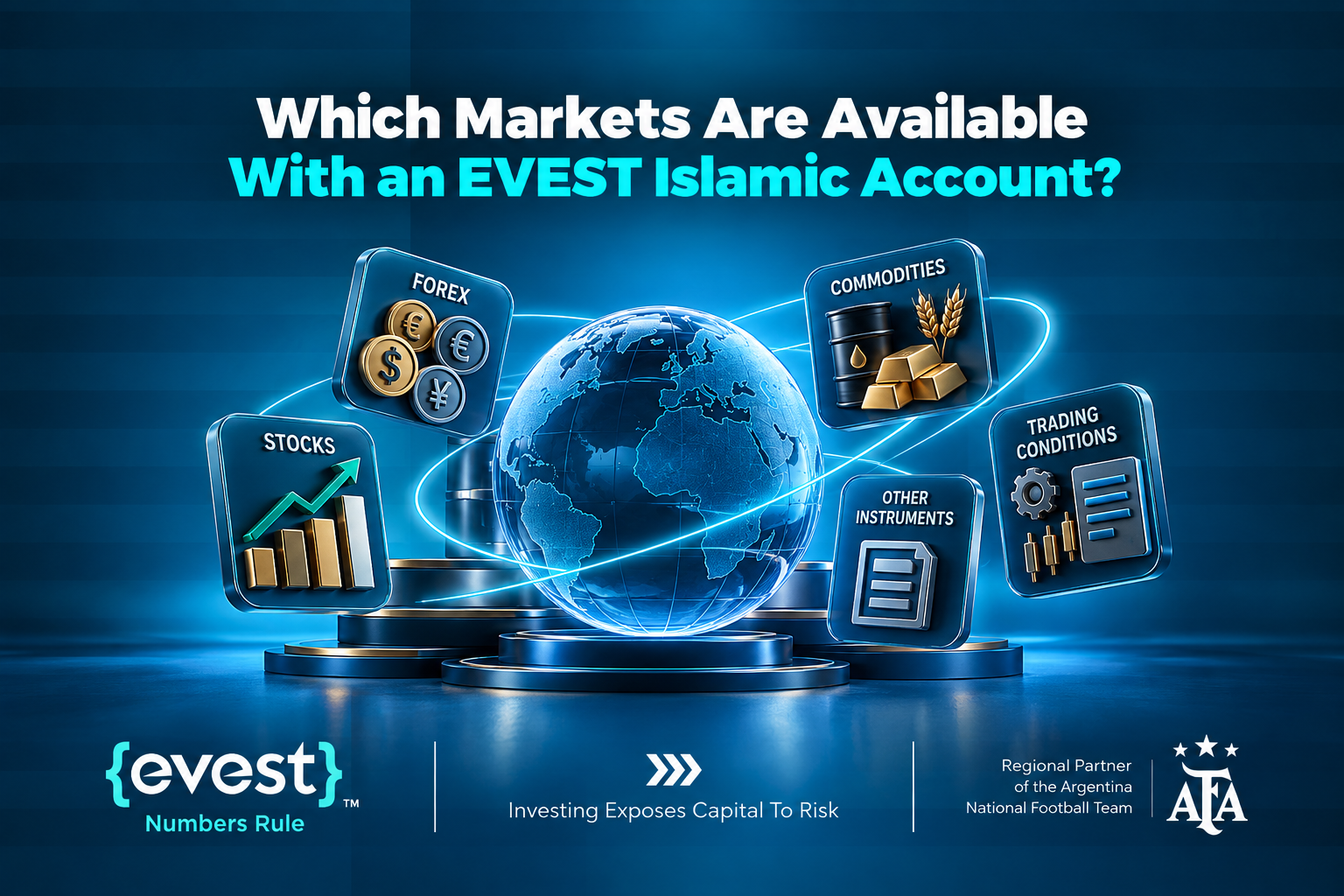
EVEST states that its Islamic accounts provide access to more than 400 financial instruments, including more than 300 global stocks, foreign currency pairs, and commodities.
The available categories can include:
- Forex: supported currency pairs available under the relevant account conditions.
- Stocks and stock-related instruments: EVEST states that more than 300 global stocks are available.
- Commodities: supported products can include precious metals, energy-related instruments, and agricultural commodities.
- Other supported instruments: availability can depend on the current EVEST product range, legal entity, and jurisdiction.
- Instrument-specific conditions: spreads, leverage, margin, and Sharia commission schedules can differ between products.
Access to a market does not mean that every instrument has identical trading conditions.
A trader should review the contract specifications and account rules for the individual product before trading.
This is particularly important when moving between forex, stocks, commodities, or other leveraged products, because each market can have different risk, pricing, margin, and execution characteristics.
Does an Islamic Account Automatically Make Every Trade Halal?
No automatic conclusion should be made.
An Islamic account structure can address the conventional overnight-interest component associated with certain trading positions, but that does not determine the religious status of every trade executed through the account.
A broader Sharia assessment may also consider the underlying asset, contract structure, ownership, settlement, leverage, margin, uncertainty, speculation, and the nature of the transaction itself.
For that reason, it is more accurate to describe the EVEST Islamic Account as providing interest-free or swap-free account conditions under its published rules rather than treating the account label as a universal religious ruling.
The account structure and the religious assessment of an individual trade are related questions, but they are not identical.
A trader who requires a specific religious ruling should review the exact instrument and transaction structure and seek guidance from an appropriately qualified Sharia authority.
This distinction is especially important for financial content because wording such as “Islamic account” or “halal trading account” can otherwise be interpreted more broadly than the account conditions actually support.
Does the Islamic Account Change Leverage?
EVEST states that conversion to the Islamic account structure does not automatically change leverage or other general trading conditions.
This means the trader should not assume that an Islamic account removes the normal risks associated with leveraged trading.
Leverage can increase the market exposure controlled by a smaller amount of capital. This can magnify favourable price movements, but it can also magnify losses.
Margin requirements also remain relevant. If market movements reduce account equity below the required margin level, positions may be affected according to the applicable platform and account conditions.
The Islamic account structure therefore changes the treatment of conventional overnight financing, not the fundamental relationship between leverage, margin, price movements, and trading risk.
How to Open an EVEST Islamic Account?
According to the account information included in the audit, EVEST’s Islamic account conditions are requested after the live account has been activated.
The process can be organized into six steps:
- Create an EVEST account. Provide the required registration and contact information.
- Complete identity verification. Submit the documents required under the relevant verification process.
- Activate the live account. Complete the standard account activation requirements.
- Contact customer support. Request conversion of the account to EVEST’s Islamic account conditions.
- Review the account details. Confirm the account tier, pricing, Sharia commission schedule, available instruments, and applicable conditions.
- Wait for confirmation. Do not assume the Islamic account structure is active until the conversion has been confirmed.
The final step is important.
Submitting a request and having the account successfully converted are not the same thing.
The trader should confirm the account status and review the current conditions before opening positions under the assumption that Islamic account rules are already active.
What Should You Review Before Choosing an Islamic Account?
Choosing an Islamic trading account involves more than looking for the phrase “interest-free.”
A practical review should consider:
- Which Islamic account tier is available to you?
- What spreads apply to the instruments you normally trade?
- What Sharia commission can apply to longer-held positions?
- Which markets and instruments are supported?
- Does leverage match your intended risk level?
- How is the account activated and maintained?
- Which legal entity and jurisdiction apply to the account?
- What are the current margin and risk conditions?
The important idea is that account suitability depends on how the trader plans to use it.
Two traders can look at the same account and reach different conclusions because one trades frequently and closes positions quickly, while the other uses larger positions or keeps them open longer.
The account should therefore be assessed against the trader’s actual strategy rather than against a generic idea of what an Islamic account is supposed to offer.
Benefits of an Islamic Trading Account
The main benefit of an Islamic trading account is that it provides an account structure designed to remove conventional overnight interest from eligible positions.
- For traders specifically looking for an interest-free overnight structure, that can address an important account-selection requirement.
- Other potential benefits include access to supported financial markets, multiple Islamic account tiers, continued access to leverage under the relevant conditions, and a clearly defined account structure that separates conventional swap from the applicable Islamic account charging model.
- However, a benefit should not be interpreted as a guarantee that the account is cheaper, safer, or religiously suitable for every trader and every transaction.
Its value depends on the trader’s objectives, instruments, position sizes, holding periods, and interpretation of the account conditions.
Limitations of an Islamic Trading Account
An Islamic account also has limitations that should be understood before use. It is not automatically free of all trading costs.
Spreads, commissions, conversion charges, account fees, and Sharia commissions can still apply. The account does not remove leverage or market risk.
It also does not provide a universal religious ruling on every financial instrument or trading strategy. A trader should therefore avoid treating the account as a shortcut that removes the need to review contract specifications, fee schedules, margin conditions, and instrument-level risk.
The account solves a specific structural issue relating to conventional overnight interest while leaving many other trading considerations unchanged.
EVEST Regulation and Account Availability
The account information supplied in the audit notes that EVEST operates through affiliated entities authorised in different jurisdictions, and that the entity serving a particular trader can affect available products, documents, protections, and trading conditions.
This is important because account availability should not be assumed to be identical for every trader in every country.
The applicable legal entity can influence which instruments are available, what documentation is required, and which terms and risk disclosures apply.
Traders should therefore identify the entity connected to their account and review the conditions that apply specifically to that entity.
Regulatory authorisation and religious assessment should also be treated as separate matters. A financial regulator oversees financial-services requirements within its jurisdiction. That role is different from providing a Sharia ruling on a particular financial transaction.
Risks to Understand Before Trading
An Islamic trading account changes part of the account’s cost structure, but it does not reduce the underlying risk of financial markets.
Important risks include:
- Market volatility: prices can move quickly and unexpectedly.
- Leverage risk: leveraged exposure can magnify both gains and losses.
- Margin risk: insufficient margin can affect or close open positions.
- Instrument risk: forex, stocks, commodities, indices, and other products can behave differently.
- Holding-cost risk: longer-held positions may become subject to additional account charges.
- Concentration risk: several related positions can create more exposure than they appear to individually.
Risk management should therefore remain separate from the decision to use an Islamic account.
A swap-free or interest-free structure does not make an individual position safer. The trader still needs to consider position size, loss limits, market volatility, liquidity, leverage, margin, and the characteristics of the instrument being traded.
Why Clear Islamic Account Conditions Matter?
Islamic trading accounts can look similar at first glance while operating under different conditions.
The account name alone does not explain the complete pricing structure, holding rules, available markets, activation process, or account tiers. Clear account information helps traders understand what exactly is being offered and what is not.
For EVEST, the account structure includes multiple Islamic account options, a Sharia commission framework for longer-held positions, access to supported markets, leverage under the applicable conditions, and a separate activation process.
Looking at those features together gives a much more useful picture than focusing only on the absence of conventional overnight interest.
FAQs
What is an EVEST Islamic Account?
An EVEST Islamic Account is an interest-free trading account structure that removes conventional overnight swap or rollover interest. EVEST currently offers Islamic, Islamic Pro, and Islamic Pro Plus options with different spreads and Sharia commission conditions.
What types of Islamic accounts does EVEST offer?
EVEST currently lists three Islamic account options: Islamic, Islamic Pro, and Islamic Pro Plus. The main differences between them are their spread levels and applicable Sharia commission schedules, with Islamic Pro Plus described as offering the tightest spreads.
Does an EVEST Islamic Account have trading fees?
Yes. Removing conventional overnight interest does not make the account fee-free. Spreads, trading commissions, currency-conversion costs, other account charges, and a Sharia commission for longer-held positions may still apply depending on the instrument and account conditions.
Does an Islamic Account mean every trade is halal?
No automatic conclusion should be made. The account addresses the conventional overnight-interest structure, while a religious assessment of an individual trade may also consider the asset, contract structure, ownership, settlement, leverage, uncertainty, and speculation.
How can I activate an EVEST Islamic Account?
EVEST states that Islamic account conditions are requested after activating a live account. The trader contacts customer support, requests conversion, reviews the applicable account tier and conditions, and should wait for confirmation before assuming the Islamic structure is active.