
Automated trading software allows traders to monitor financial markets and execute trades automatically according to predefined rules, technical signals, or algorithmic strategies. Instead of manually watching every market movement, the software follows programmed conditions and reacts instantly when those criteria are met.While automation improves execution speed, consistency, and multi-market tracking, it does not eliminate risk or guarantee profit.For traders using Evest, understanding automated trading software is crucial. This guide covers how it works, how it differs from manual trading, the role of trading bots and Expert Advisors, backtesting procedures, and key selection criteria.
What Is Automated Trading Software and How Does It Work?
Automated trading software is a program or trading system designed to monitor market conditions and execute buy or sell orders when predefined criteria are met.
Depending on the platform and strategy, automation may use rule-based trading bots, forex trading robots, MetaTrader Expert Advisors, custom algorithms, or API-based systems. The process generally involves several core functions:
- Market Analysis: The software monitors prices, indicators, volume, or other selected market data.
- Signal Generation: Predefined conditions determine when a potential trading opportunity exists.
- Order Execution: Once the required conditions are met, the system may automatically submit an order.
- Risk Controls: Position size, Stop Loss, Take Profit, and other limits can be incorporated into the strategy.
- Monitoring: The trader reviews execution and system performance to identify technical or strategic problems.
- Backtesting: Historical data can be used to examine how a strategy would have behaved in previous market conditions.
Automation controls how a trading strategy is executed. It does not determine whether the underlying strategy is effective.
Defining Automated Trading and Algorithmic Trading
Automated trading and algorithmic trading overlap, but they are not always identical. Automated trading generally refers to the automatic execution of predefined trading rules. A basic system may open or close positions when a technical indicator reaches a specific level.
Algorithmic trading software, on the other hand, may use more complex logic, mathematical models, multiple variables, or data-processing methods to determine when and how an order should be executed.
For example, a simple automated strategy could monitor a moving-average crossover and execute an order when the programmed conditions occur. A more advanced algorithm might analyze several market variables simultaneously before generating a trading decision.
The important point is that both approaches depend on programmed logic rather than discretionary decisions made manually by a trader.
Key Components of an Automated Trading System
An automated trading system normally combines four important elements: strategy rules, market data, execution, and risk management.
The strategy defines when the system should enter or exit a position. The software then monitors market data and checks whether those predefined conditions have been satisfied.
Execution may take place directly through a supported trading platform or through an API trading platform that connects the trading system with the broker’s infrastructure.
MetaTrader users may also automate strategies through Expert Advisors. Users searching for expert advisors metatrader are usually referring to automated programs designed to operate within MetaTrader platforms according to predefined instructions.
Some traders also use a Virtual Private Server (VPS) to keep an automated system running continuously. However, uninterrupted operation does not mean the system can be ignored. Connectivity, execution errors, strategy behavior, and changing market conditions still require monitoring.
The Role of AI and Machine Learning in Modern Automated Trading
Artificial intelligence and machine learning can extend automated trading beyond simple rule-based systems. Depending on how a system is built, AI may help analyze large datasets, detect patterns, classify market conditions, process financial information, or adjust certain model parameters.
More advanced algorithmic trading software may therefore process information differently from a basic trading bot.
However, using AI does not mean that a system can reliably predict future prices or guarantee better trading results. Performance still depends on factors such as data quality, model design, market conditions, transaction costs, execution quality, testing, and risk management.
Traders should evaluate how a system actually works rather than assuming that the words “AI-powered” automatically make automated trading software more accurate or profitable.
Advantages and Disadvantages of Using Automated Trading Software
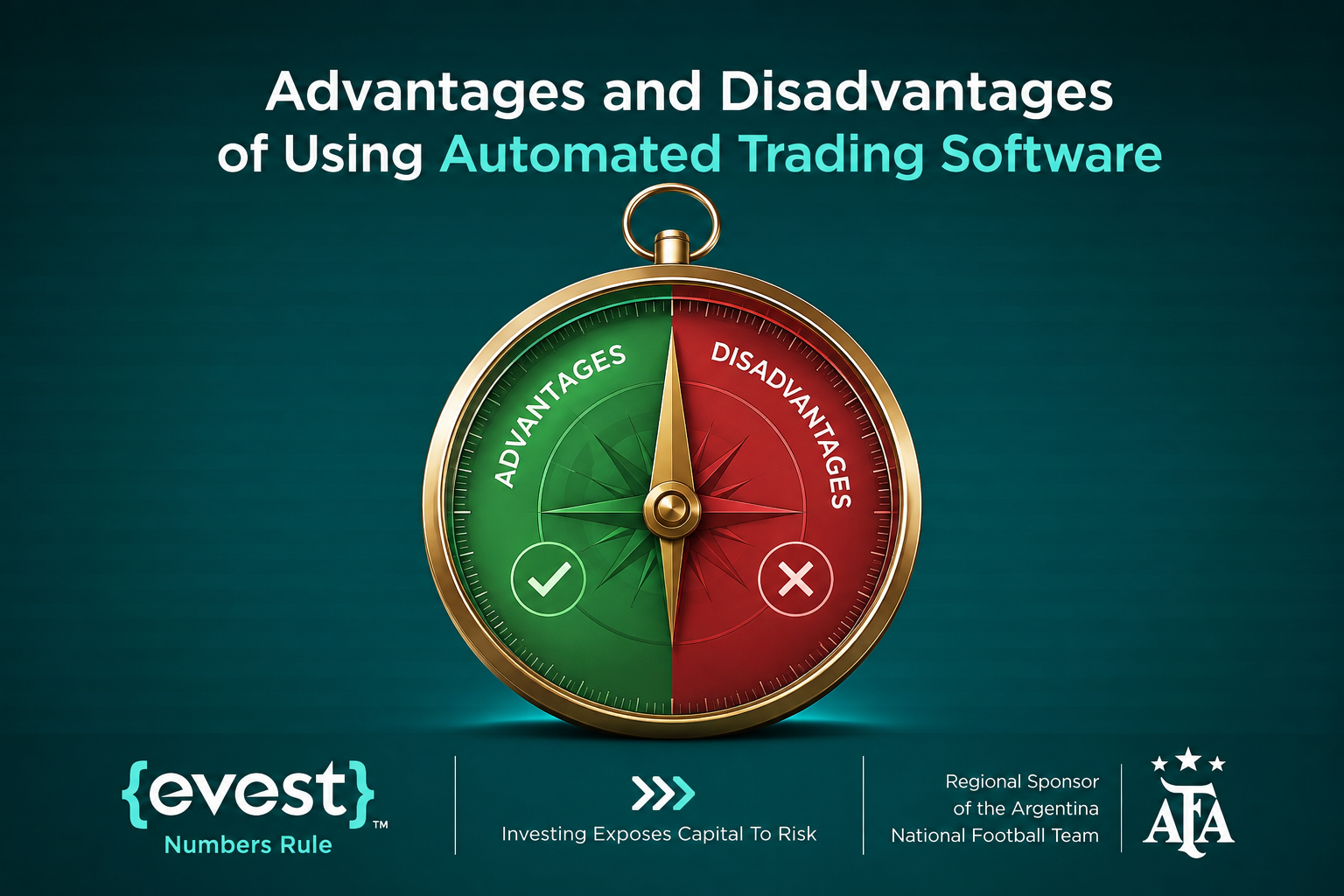
Automated trading can provide practical advantages, but those advantages come with important limitations.
Advantages
- Faster execution when predefined conditions are met.
- Consistent application of trading rules.
- Ability to monitor several markets or instruments simultaneously.
- Reduced impact of emotional decision-making during execution.
- Ability to test strategies using historical data.
- Automated implementation of predefined risk-management rules.
Disadvantages
- Technical failures or connectivity problems can affect execution.
- Strategies may perform differently when market conditions change.
- Historical results can create false confidence.
- Poorly designed algorithms can repeatedly execute poor decisions.
- Some systems require programming, infrastructure, or additional costs.
- Automation can encourage traders to monitor strategies less carefully than they should.
The main benefit of automation is consistency of execution. It should not be confused with certainty of outcome.
Automated vs Manual Trading
The difference between automated vs manual trading is mainly how trading decisions are executed.
| Aspect | Manual Trading | Automated Trading |
| Decision-Making | The trader analyzes the market and decides when to enter, adjust, or close positions. | Predefined rules determine how the system responds when specific market conditions occur. |
| Flexibility & Consistency | Provides greater flexibility and allows discretionary decisions, but can be affected by emotional and behavioral factors. | Can provide more consistent execution, but the system is limited to the rules and logic programmed into it. |
| Risk & Suitability | Poor discretionary decisions can still lead to losses. Suitability depends on the trader’s experience, strategy, and risk controls. | Automation does not eliminate risk; a system may repeatedly execute a strategy that no longer suits market conditions. Suitability depends on the strategy, risk controls, and trading environment. |
What Should You Look for in an Automated Trading Platform?
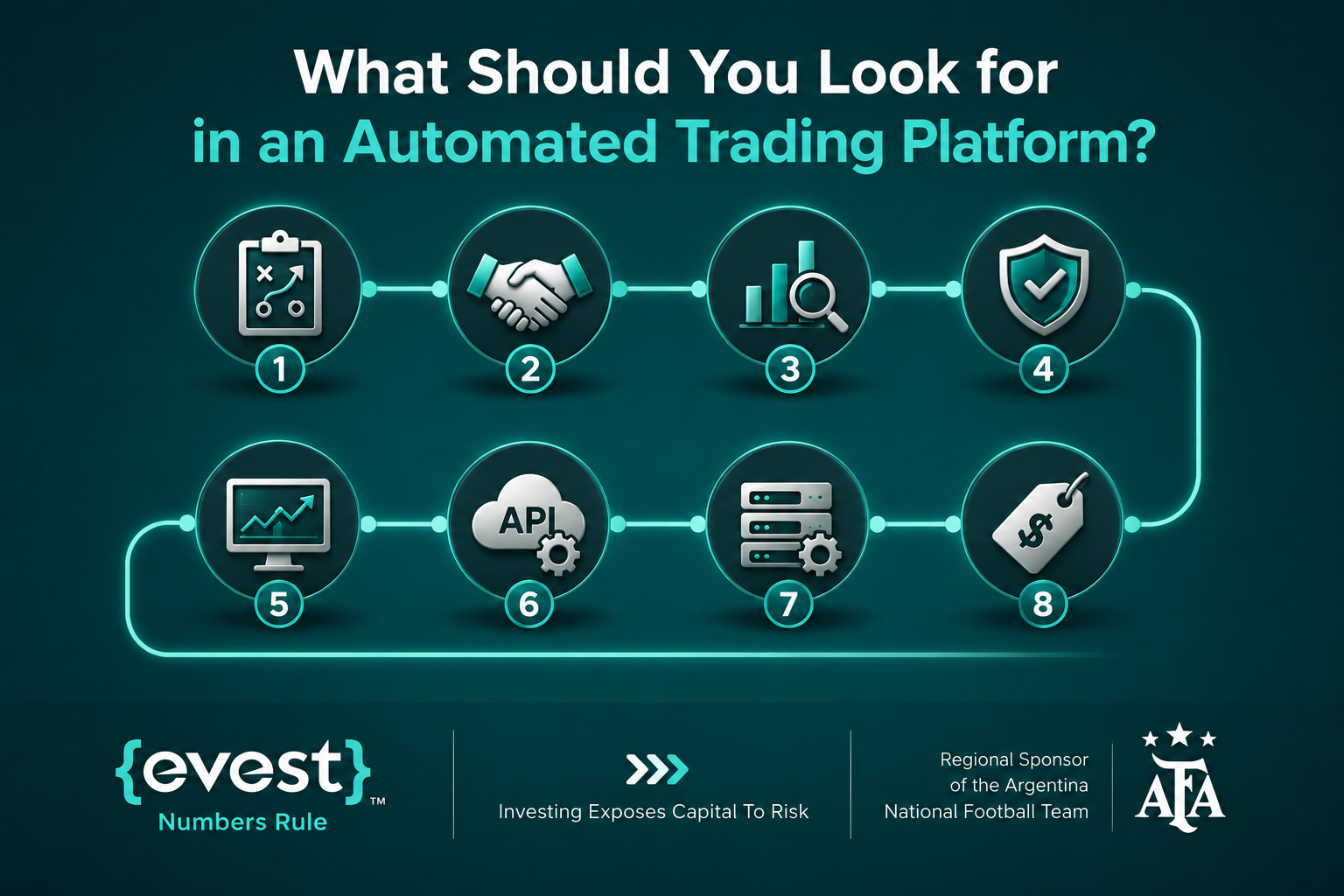
Choosing the best automated trading platforms should not be based on marketing claims or the number of advertised features alone.
The right platform depends on how the trader intends to automate a strategy. Important factors include:
- Strategy Support: Does the platform support the type of automation you need?
- Broker Compatibility: Can the software operate with your chosen broker and trading environment?
- Backtesting: Can strategies be evaluated using historical data?
- Risk Controls: Can position size, Stop Loss, Take Profit, and other limits be defined?
- Execution: How are automated orders transmitted and monitored?
- API Access: Is an API available when external applications or custom systems need to connect?
- Technical Requirements: Does the system require programming, third-party software, or VPS hosting?
- Costs: Consider platform fees, market data, hosting, development, and other potential expenses.
When evaluating automation with a broker such as Evest, traders should first confirm which platforms, integrations, tools, and automated functions are supported for their account and trading environment before connecting third-party software.
Automated Trading Platforms vs Copy Trading Platforms
Automated trading and copy trading both reduce the amount of manual order execution, but they work differently. Automated trading software executes rules defined by a strategy or algorithm.
Copy trading platforms, by contrast, are designed to replicate positions or trading activity from another trader or strategy provider.
This means the source of the decision is different. With automated trading, the programmed system determines the action. With copy trading, the trader chooses whose trading activity to follow.
Both approaches carry risk, and neither should be considered a substitute for understanding how positions are opened, managed, and closed.
Building and Deploying an Automated Trading Strategy
Building an automated trading strategy starts with clear rules.Before using software, the trader needs to define:
- Entry conditions.
- Exit conditions.
- Position sizing.
- Risk limits.
- Conditions under which the strategy should not trade.
The strategy can then be coded or configured within compatible automated trading software.
Backtesting the Strategy
Backtesting trading software allows traders to evaluate how programmed rules would have behaved using historical market data.
This can help identify obvious weaknesses and understand how a strategy responded to different historical conditions. However, backtesting has limits.
A strategy can perform extremely well on historical data because its parameters were optimized specifically for that period. This is known as over-optimization or curve fitting. For that reason, historical performance should be treated as a testing tool rather than a prediction of future results.
Testing Before Live Deployment
After backtesting, a strategy may also be tested in a demo environment to observe how it behaves under market conditions without immediately exposing capital. Live conditions can differ from historical tests because of spreads, slippage, execution speed, market gaps, liquidity, and other factors. Monitoring remains necessary even after automation is activated.
Forex Trading Robots and Expert Advisors
Forex is one of the markets where automated strategies are commonly used. Forex trading robots are programs designed to monitor currency markets and execute predefined strategies automatically. Some operate as standalone systems, while others work inside trading platforms.
MetaTrader users may use Expert Advisors, commonly known as EAs, to automate trading rules. An EA may monitor indicators, price movements, or other programmed conditions and send orders when its requirements are satisfied.
The existence of a forex robot or Expert Advisor does not say anything about its expected profitability. Before using one, traders should understand:
- The strategy behind the robot.
- Its risk parameters.
- The markets and conditions for which it was designed.
- How it was tested.
- Whether its historical results include realistic trading costs.
- How it behaves when market conditions change.
Trading Bots for Beginners: What Should New Traders Know?
Trading bots for beginners can appear attractive because they automate many repetitive parts of trading. But automation does not remove the need to understand the underlying strategy. A beginner should be able to explain:
- Why the bot enters a trade.
- Why it exits.
- How position size is determined.
- What can cause the strategy to lose money.
- How the strategy was tested.
- What happens if the software, internet connection, or trading platform fails.
Beginners should be particularly cautious of systems marketed using guaranteed returns, unusually high historical performance, or claims that suggest no monitoring is required.
The more automated a system becomes, the more important it is to understand what has actually been automated.
How to Choose the Right Automated Trading Software for Your Needs?
The right automated trading software should match the trader’s strategy, technical ability, trading environment, and risk-management requirements. Before choosing a system, consider:
- Compatibility: Confirm that the software can work with the trading platform and broker you intend to use.
- Strategy Flexibility: Some systems only support predefined strategies, while others allow traders to create or modify their own rules.
- Backtesting Capabilities: Look for tools that allow the strategy to be evaluated across different historical market conditions.
- API Support: An API trading platform may be important for traders or developers who want external software to communicate directly with a supported trading environment.
- Risk Management: Automation should allow clearly defined limits rather than focusing only on entry signals.
- Transparenc : Avoid systems where the underlying methodology cannot be explained or independently evaluated.
For Evest users, compatibility with the available account setup and supported trading tools should be confirmed before using any external automated trading solution.
Common Pitfalls and Best Practices for Automated Trading Success
Automated trading is not a “set it and forget it” process. Common mistakes include:
- Relying exclusively on historical backtests.
- Over-optimizing strategy parameters.
- Ignoring transaction and execution costs.
- Running a strategy under market conditions it was not designed for.
- Failing to monitor technical performance.
- Assuming automation guarantees consistent returns.
Better practices include defining risk limits before deployment, testing the system carefully, reviewing performance regularly, and monitoring whether the assumptions behind the strategy remain valid.
Does Automated Trading Work?
Automated systems can successfully monitor markets and execute predefined rules without requiring manual intervention for every trade. But successful execution is not the same as profitable trading.
Results depend on the quality of the strategy, market conditions, execution, costs, risk management, and ongoing monitoring. Automated trading software should therefore be viewed as an execution tool rather than a guarantee of financial performance.
FAQs
Is Automated Trading Software Profitable for Beginners?
Automated trading software does not guarantee profitability for beginners or experienced traders. Beginners still need to understand the strategy, risk controls, testing process, and limitations of the system they use.
Do I Need to Know How to Code to Use Automated Trading Software?
Not always. Some platforms provide configurable or no-code automation tools, while more advanced systems may require languages such as MQL, Python, or C#. Coding knowledge generally provides more flexibility but is not required for every type of automated trading.
Can Automated Trading Software Run on Mobile Devices?
Mobile applications may allow traders to monitor positions or account activity, but many automated strategies depend on a trading platform, computer, server, or VPS that remains active independently of the mobile application.
Is Backtesting Enough Before Using a Trading Bot?
No. Backtesting is useful for evaluating historical behavior, but historical performance does not guarantee future results. Traders should also consider execution conditions, trading costs, strategy assumptions, and how the system behaves when market conditions change.