
Altcoins are cryptocurrencies other than Bitcoin, and they can differ significantly in purpose, technology, market size, and volatility.
On Evest, traders can access several altcoin CFDs, including Solana, Cardano, Litecoin, Polkadot, Stellar, Dogecoin, Shiba Inu, Dash, and Ethereum Classic. These instruments provide exposure to price movements without ownership of the underlying cryptocurrencies.
This guide explains what altcoins are, which ones are available on the platform, what makes them different, and what traders should consider before taking a position.
What Are Altcoins?
Altcoins are cryptocurrencies other than Bitcoin, The term covers a wide range of digital assets, including:
- Smart-contract platforms.
- Payment-focused cryptocurrencies.
- Meme coins.
- Blockchain infrastructure tokens.
- Alternative proof-of-stake networks.
Altcoins can have very different use cases, technologies, and risk profiles.
Which Altcoins Are Available on Evest?
Evest lists several altcoin CFD instruments, These include:
| Cryptocurrency | Instrument |
| Solana | SOLUSD |
| Cardano | ADAUSD |
| Litecoin | LTCUSD |
| Polkadot | DOTUSD |
| Stellar | XLMUSD |
| Dogecoin | DOGUST |
| Shiba Inu | SHBUSD.mln |
| Dash | DSHUSD |
| Ethereum Classic | ETCUSD |
| XRP | XRPUSD |
The crypto market list also includes Bitcoin and Ethereum, but these are usually treated separately because of their larger market roles.
What Is Solana?
Solana is a blockchain network designed for high-speed transactions and decentralized applications. Its native token is SOL. Solana is commonly associated with:
- Decentralized finance.
- NFT applications.
- Blockchain gaming.
- Payments.
- Web3 applications.
The price of SOL can be affected by network activity, application growth, market sentiment, and broader cryptocurrency trends.
On Evest, Solana is available as SOLUSD.
What Is Cardano?
Cardano is a proof-of-stake blockchain platform, and its native cryptocurrency is ADA. Cardano focuses on scalability, security, and decentralized applications. Factors that can influence ADA include:
- Network upgrades.
- Developer activity.
- Adoption.
- Staking participation.
- Broader crypto-market sentiment.
On Evest, Cardano is available as ADAUSD.
What Can Affect ADA Sentiment?
ADA sentiment can change quickly when traders react to market conditions, network developments, or wider cryptocurrency trends.
Indicators such as fear and greed indexes may be used as sentiment tools, but they should not be treated as standalone trading signals. They reflect market mood rather than guaranteed future price direction.
What Is Litecoin?
Litecoin is a cryptocurrency originally designed as a faster and lighter alternative to Bitcoin. Its native asset is LTC.
Litecoin is commonly used for:
- Digital payments.
- Peer-to-peer transfers.
- Cryptocurrency transactions.
LTC price can be affected by:
- Market demand.
- Bitcoin movements.
- Adoption.
- Network activity.
- Broader crypto sentiment.
On Evest, Litecoin is available as LTCUSD.
What Is Polkadot?
Polkadot is a blockchain network designed to allow different blockchains to communicate and exchange data. Its native token is DOT. DOT can be influenced by:
- Network development.
- Ecosystem adoption.
- Parachain activity.
- Developer participation.
- General cryptocurrency sentiment.
On Evest, Polkadot is available as DOTUSD.
What Is Stellar?
Stellar is a blockchain network designed for fast and low-cost transfers of value. Its native cryptocurrency is XLM. Stellar is commonly associated with:
- Cross-border payments.
- Digital transfers.
- Financial infrastructure.
On Evest, Stellar is available as XLMUSD.
What About Dogecoin and Shiba Inu?
Dogecoin and Shiba Inu are meme-based cryptocurrencies that can experience significant volatility.
Their prices can be influenced heavily by:
- Social-media sentiment.
- Market speculation.
- Community activity.
- Broader crypto trends.
On Evest:
- Dogecoin is listed as DOGUST.
- Shiba Inu is listed as SHBUSD.mln.
These assets can experience sharp price movements, making risk management particularly important.
How Are Altcoins Different from Bitcoin?
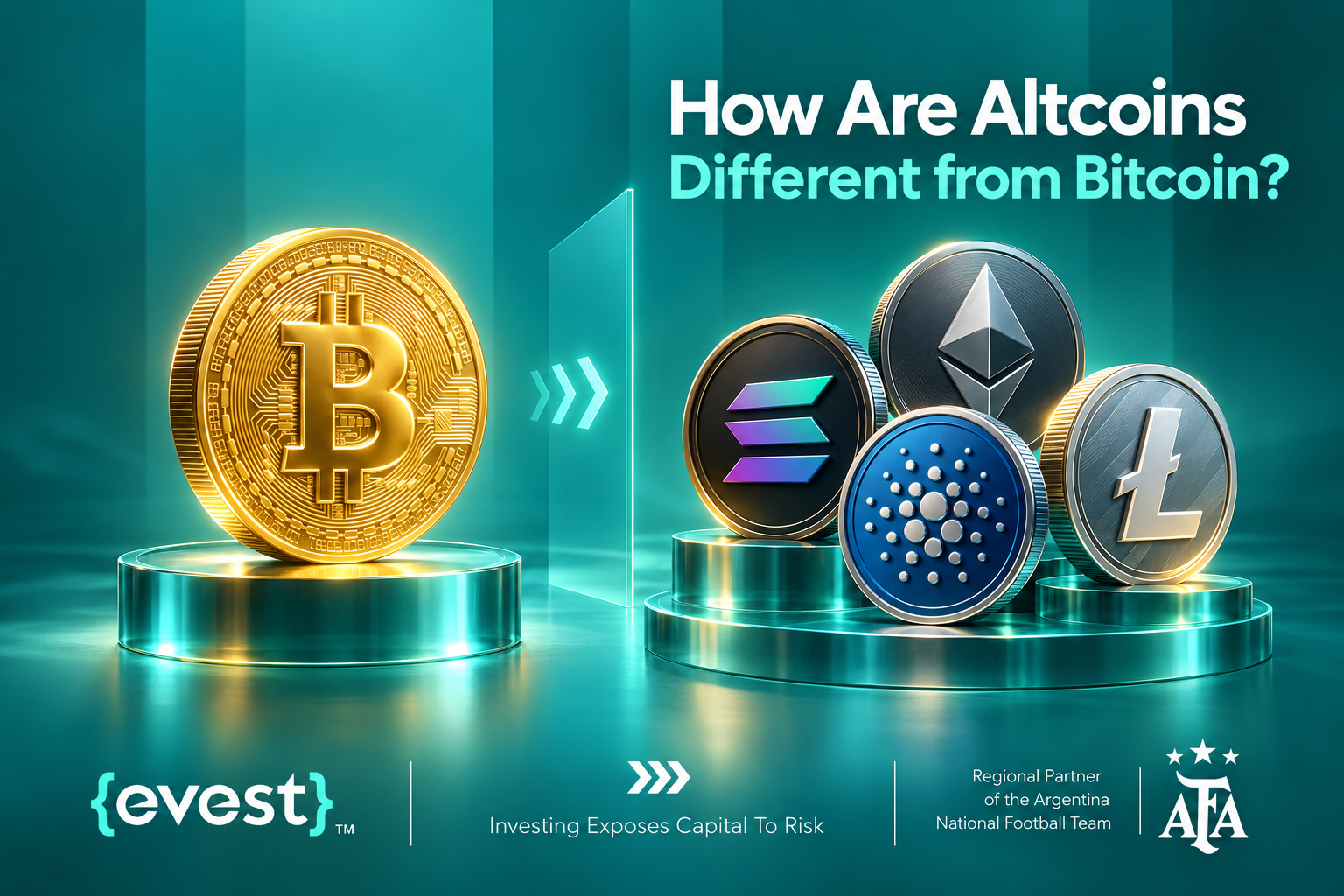
Altcoins differ from Bitcoin in technology, use case, market size, and volatility.
| Feature | Bitcoin | Altcoins |
| Main role | Digital asset / store-of-value narrative | Varies by project |
| Market maturity | Higher | Often lower |
| Volatility | High | Often higher |
| Use cases | Payments, store of value | Smart contracts, payments, DeFi, memes, infrastructure |
| Risk | High | Often higher depending on asset |
Altcoins can sometimes outperform Bitcoin during strong crypto markets, but they can also experience larger declines.
What Moves Altcoin Prices?
Altcoin prices are mainly influenced by market sentiment, project development, adoption, liquidity, and broader cryptocurrency conditions.
Key factors include:
-
- Bitcoin Price Movements: Many altcoins move with the broader crypto market.
- Network Upgrades: Technical improvements can affect expectations.
- Adoption: Increased use can influence demand.
- Developer Activity: Active ecosystems may attract more attention.
- Liquidity: Smaller altcoins may experience sharper price swings.
- Regulation: New rules can influence access and sentiment.
- Market Sentiment: Fear and greed can drive rapid changes in demand.
How to Trade Altcoins on Evest?
Altcoins can be traded through CFDs by taking a position on price movements.
A typical process includes:
- Choose an altcoin instrument.
- Analyze market conditions.
- Decide whether to take a long or short position.
- Set the position size.
- Apply risk-management tools.
- Monitor the market.
- Close the position.
Evest provides cryptocurrency CFD trading rather than ownership of the underlying coins, Crypto trading is available 24/7 according to the market-hours reference.
Buying Altcoins vs Trading Altcoin CFDs
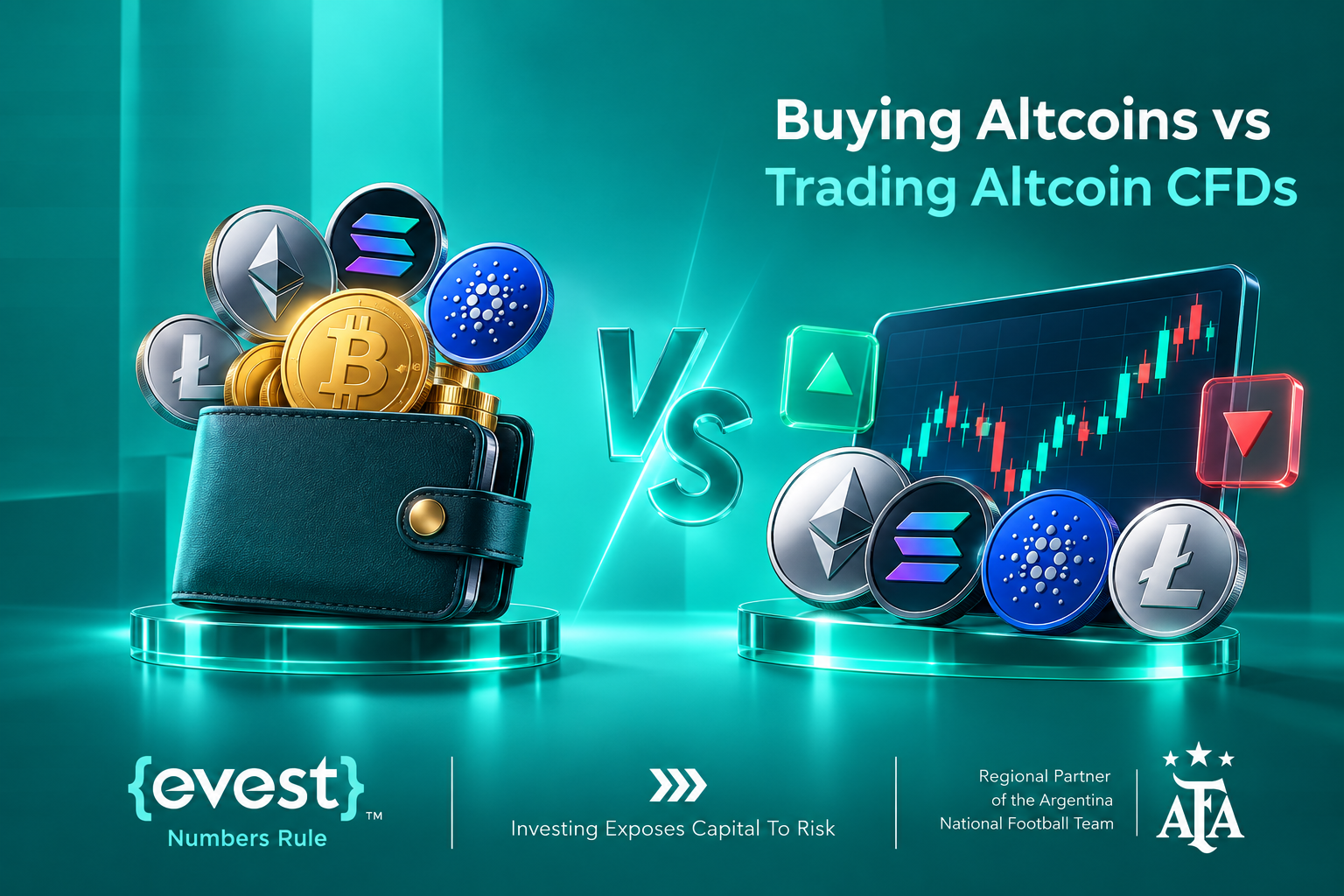
Buying an altcoin means owning the cryptocurrency, while trading an altcoin CFD means gaining exposure to its price without owning it.
| Feature | Buying Altcoins | Trading Altcoin CFDs |
| Own the cryptocurrency | Yes | No |
| Wallet may be required | Yes | No |
| Trade rising prices | Yes | Yes |
| Trade falling prices | Usually requires another product | May be available |
| Leverage | Depends on provider | May be available |
| Main risk | Crypto volatility | Volatility plus leverage risk |
The difference is important because CFDs do not provide ownership of the underlying digital asset.
Risks of Trading Altcoins
Altcoins can be highly volatile and may carry more risk than larger cryptocurrencies.
Key risks include:
- High Volatility: Prices can move sharply in a short period.
- Lower Liquidity: Smaller assets may have wider price movements.
- Project Risk: Technical or development problems may affect value.
- Regulatory Risk: New rules can change market access.
- Sentiment Risk: Prices can react strongly to social media and market mood.
- Leverage Risk: CFD leverage can magnify both gains and losses.
FAQs
What are altcoins?
Altcoins are cryptocurrencies other than Bitcoin. They include a wide range of digital assets with different technologies, use cases, market values, and levels of volatility.
Which altcoins are available on Evest?
Evest lists several altcoin CFDs, including Solana, Cardano, Litecoin, Polkadot, Stellar, Dogecoin, Shiba Inu, Dash, Ethereum Classic, and XRP. Availability may vary depending on platform conditions and jurisdiction.
Can you trade Solana on Evest?
Yes. Solana is available on Evest as SOLUSD, allowing traders to gain exposure to changes in Solana’s price through a CFD without owning the underlying cryptocurrency.
Can you trade Cardano on Evest?
Yes. Cardano is listed as ADAUSD on Evest. Traders can use the CFD to take a position on Cardano’s price movements without purchasing or holding ADA directly.
Can you trade Litecoin on Evest?
Yes. Litecoin is available as LTCUSD on Evest. The instrument provides exposure to Litecoin’s market price through CFD trading rather than direct ownership of the cryptocurrency.
Do you own the altcoin when trading a CFD?
No. A CFD provides exposure to the altcoin’s price without ownership of the underlying cryptocurrency. You are trading a contract based on price movements rather than purchasing the digital asset itself.
Are altcoins riskier than Bitcoin?
Many altcoins can experience higher volatility and lower liquidity than larger cryptocurrencies such as Bitcoin. These factors can increase the size and speed of price movements and therefore increase trading risk.