
AI stock analysis tools are changing how investors research companies, screen opportunities, monitor market sentiment, and process large amounts of financial data. By combining machine learning, Natural Language Processing (NLP), and predictive analytics, these tools can help investors organize information and identify patterns faster than manual research alone. However, AI does not remove market uncertainty or guarantee profitable decisions. For Evest readers, the practical value of AI is in using data-driven insights as one part of a broader research process that still includes market context, independent analysis, and risk management.
What are AI Stock Analysis Tools and How Do They Work?
AI stock analysis tools are software platforms that use artificial intelligence to analyze financial and market data, detect patterns, screen stocks, evaluate sentiment, and support investment research.
Depending on the platform, they may combine historical prices, company fundamentals, technical indicators, news, analyst commentary, and alternative datasets.
Some tools focus on an AI stock screener that filters companies according to selected criteria. Others use machine learning stock prediction models to estimate possible price scenarios, identify trends, or flag unusual market behavior.
These outputs should be considered probabilities and analytical signals rather than guarantees of future performance.
Defining Artificial Intelligence in Finance
Artificial Intelligence in finance refers to using algorithms that can learn from data, identify relationships, classify information, and automate parts of the analytical process.
In stock analysis, AI may support tasks such as reviewing financial statements, summarizing earnings reports, detecting changes in market sentiment, and monitoring multiple securities at the same time.
The goal is not to replace every human decision. It is to reduce the amount of repetitive research and help investors focus their attention on information that may require deeper analysis.
Core Technologies Powering AI Stock Analysis (Machine Learning, Deep Learning, NLP)
Machine Learning (ML) allows systems to learn patterns from historical data such as stock prices, trading volume, company fundamentals, and economic indicators.
Machine learning stock prediction models may then estimate probabilities, classify different market conditions, or detect unusual behavior.
Deep Learning (DL), a branch of machine learning, can process more complex datasets and may be used to identify relationships across large amounts of structured and unstructured information.
Natural Language Processing (NLP) helps AI systems understand text from news articles, earnings-call transcripts, regulatory filings, analyst reports, and online discussions.
This also makes sentiment analysis stocks research more scalable by helping investors identify whether commentary around a company or sector is becoming more positive, negative, or neutral.
The Data Revolution: How AI Processes Market Information?
AI can process several types of market information at the same time:
- Structured data: stock prices, trading volume, financial statements, valuation ratios, and economic indicators.
- Unstructured data: financial news, company announcements, earnings transcripts, analyst commentary, and social discussions.
- Alternative data: web activity, supply-chain signals, transaction trends, or other non-traditional datasets where appropriately available.
The advantage is primarily speed and scale.
AI stock analysis tools can organize these inputs and highlight relationships that would take a human analyst significantly longer to review manually.
Key Benefits of Using AI Stock Analysis Tools
The main benefit of AI stock analysis tools is not that they “know” where the market will go.
Their value lies in processing information quickly, detecting patterns consistently, and helping investors create a more structured research process.
Enhanced Decision-Making and Predictive Capabilities
Predictive analytics trading systems can combine historical prices, trading volume, technical signals, company data, and market sentiment to identify scenarios that may deserve closer attention.
For example, an AI model may detect unusual trading volume in a listed company while sentiment surrounding its latest earnings release is improving. That does not automatically make the stock a buy.
Instead, it gives the investor a signal that may justify further fundamental and technical analysis.
AI therefore supports faster decision-making without replacing the need to evaluate why a market signal exists.
Automation of Research and Data Processing
AI can monitor large numbers of stocks, scan company announcements, summarize reports, and trigger alerts when selected conditions are met.
This can reduce the amount of time investors spend on repetitive research and allow them to focus more on interpretation, portfolio decisions, and risk.
An AI stock screener can also narrow thousands of listed companies into a smaller group based on criteria such as:
- Valuation
- Earnings growth
- Momentum
- Trading volume
- Volatility
- Technical indicators
- Market sentiment
Screening does not determine whether a stock is automatically suitable for investment. It helps identify companies that may deserve deeper research.
Risk Management and Portfolio Optimization
AI portfolio management systems can analyze volatility, correlations between holdings, concentration risk, and changing market conditions.
Some systems may also suggest rebalancing scenarios based on predefined investment objectives and risk parameters.
This overlaps with robo-advisor investing, where automated systems may use information such as an investor’s objectives, time horizon, and risk profile to recommend or manage diversified portfolios.
However, these recommendations still depend on assumptions, models, and historical data. They should not be treated as risk-free or automatically suitable for every investor.
Identifying Hidden Trends and Opportunities
Because AI can combine multiple datasets, it may identify emerging patterns that are difficult to see through a single indicator.
For example, changes in earnings expectations, market sentiment, trading activity, and sector performance can be analyzed together to highlight companies that may warrant additional research.
The key is to treat these signals as research leads rather than automatic trade instructions.
Top Features to Look for in AI Stock Analysis Tools
When comparing the best AI tools for stock market analysis, investors should focus on the quality and usefulness of their features rather than the number of times the platform uses the term “AI” in its marketing.
Real-time Data Integration and Analytics
Market analysis becomes less useful when the underlying information is outdated. A strong platform should make clear what data it uses, how frequently that data is updated, and whether its analysis reflects current prices, news, and market conditions.
For active investors, timely alerts may be particularly important. Long-term investors may place more emphasis on reliable fundamental information, company earnings, valuations, and transparent analysis.
Predictive Modeling and Backtesting Capabilities
Some AI stock analysis tools offer price forecasting, trend detection, volatility estimates, or strategy backtesting. Backtesting allows investors to examine how a strategy or model would have behaved using historical data.
Historical results, however, do not prove that the same model will perform successfully under future market conditions. Backtesting is therefore more useful for understanding how a strategy behaves, where it performs poorly, and what risks may exist than for proving future profitability.
Natural Language Processing for News and Sentiment Analysis
NLP-based tools can scan large volumes of news and company-related information and then summarize important developments or classify overall sentiment.
For investors using sentiment analysis for stocks, the strongest systems should make it possible to understand the source and timing of the information behind a sentiment score.
A positive or negative score without context can be misleading because markets do not always respond to similar news in the same way.
Customizable Alerts and Reporting
Useful alerts may include:
- Unusual trading volume
- Significant price movements
- Earnings events
- Market sentiment shifts
- Selected technical conditions
Reports and dashboards should also explain why an alert occurred rather than simply generating a “buy” or “sell” label without supporting information.
User Interface and Ease of Use
AI analysis is only valuable when investors can understand what the system is showing them.
A clear interface should explain important metrics, display relevant charts, and allow users to move from an AI-generated signal to the underlying information.
For beginners, clarity may be more valuable than advanced customization.
Experienced investors may prefer deeper controls, APIs, broader datasets, and more flexible analytical tools.
How AI Stock Analysis Tools Compare to Traditional Methods?
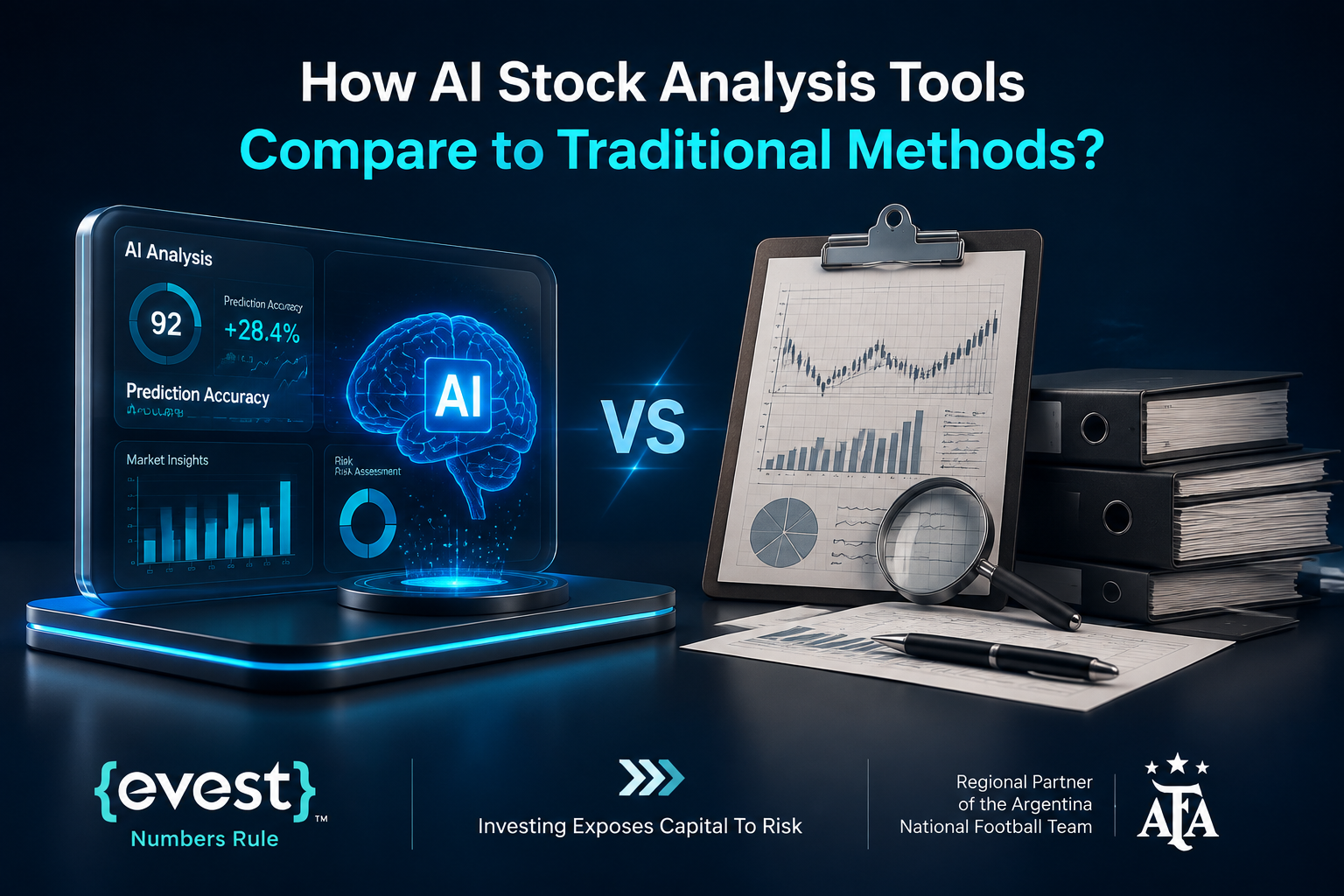
AI does not make traditional stock analysis obsolete. Instead, it changes which parts of the research process can be automated and which parts still depend heavily on human interpretation.
Speed and Efficiency: AI vs. Human Analysts
AI can scan more information and monitor more securities simultaneously than an individual human analyst. That makes it particularly useful for:
- Stock screening
- Data summarization
- Pattern detection
- Sentiment monitoring
- Real-time alerts
Human analysts, however, can question assumptions, evaluate management decisions, interpret unusual events, and add context that may not be fully represented within historical datasets.
AI vs Human Analyst: Which Is Better?
The AI vs human analyst comparison should not be treated as a winner-takes-all competition. AI has a clear advantage in scale, speed, and consistent data processing.
Human judgment becomes particularly important when uncertainty, qualitative information, business context, geopolitical developments, or unusual market conditions need to be interpreted.
AI is also not completely unbiased. While an algorithm does not experience fear, greed, or FOMO in the same way a human investor can, its output may still reflect limitations in its training data, model design, assumptions, or available information.
Complementing Human Expertise
The stronger approach is often a hybrid one. AI handles data-intensive tasks and highlights patterns, while the investor determines whether those signals make sense within the broader market environment.
For Evest users, AI-generated research can therefore be treated as an additional analytical layer rather than as a replacement for understanding the asset, market conditions, and associated risks.
Common Challenges and Limitations of AI Stock Analysis Tools
AI stock analysis tools can improve research efficiency, but understanding their limitations is just as important as understanding their features.
Data Quality and Availability Issues
An AI model is only as useful as the information it receives. Incomplete, outdated, biased, or inaccurate data can result in weak or misleading outputs.
Less liquid stocks and newly listed companies may also have limited
historical data, which can make pattern-based analysis less dependable.
The “Black Box” Problem and Interpretability
Some advanced AI models can generate an output without clearly explaining how every variable contributed to the final result. This is commonly described as the “black box” problem.
For investment research, explainability matters. Investors should ideally be able to understand what information the model considered and which assumptions or signals may have influenced its output.
Over-reliance and Market Volatility
Markets can change quickly because of earnings surprises, economic data, regulatory developments, geopolitical events, or sudden shifts in investor expectations.
Models trained primarily on historical relationships may become less effective when market conditions change.
This is why AI-generated analysis should not replace independent research and appropriate risk management.
Cost and Accessibility for Retail Investors
The price of AI stock analysis tools can vary significantly according to:
- Data quality
- Update frequency
- Screening capabilities
- Backtesting
- Customization
- Market coverage
- Support
A more expensive platform is not automatically more useful. Investors should consider whether they genuinely need the advanced features they are paying for and whether the platform provides enough transparency to support informed decisions.
Choosing the Right AI Stock Analysis Tool for Your Investment Strategy
There is no single platform that qualifies as the best option for every investor. The appropriate tool depends on investment strategy, experience, asset coverage, preferred research style, and budget.
Assessing Your Needs: Beginner vs. Advanced Trader
Beginners may prefer:
- Clear interfaces
- Simple explanations
- Educational guidance
- Basic stock screening
- Sentiment analysis
- Easy-to-understand alerts
Advanced investors may look for customizable models, backtesting, API access, deeper datasets, and integration with AI trading platforms.
The most important question is:
What decision do you need the tool to help you make?
A long-term investor may prioritize company fundamentals and AI portfolio management.
An active trader may place greater value on real-time alerts, an AI stock screener, sentiment analysis, technical indicators, and faster market monitoring.
Evaluating Pricing Models and Subscription Tiers
Before subscribing, compare exactly what is included in each pricing tier.
Check whether:
- Real-time data costs extra
- Historical testing is limited
- Screening features have restrictions
- Alerts are capped
- Premium data requires additional fees
Free trials can be useful for testing whether a platform actually fits your research workflow before paying for unnecessary features.
Integration with Existing AI Trading Platforms
AI trading platforms and standalone analysis tools do not all operate in the same way. Some focus entirely on research, while others may support APIs, integrations, or automated workflows.
For Evest users, it is important to keep analysis and execution separate within the decision-making process. AI may help identify information, patterns, or possible scenarios, but an investment decision should still reflect the investor’s own analysis, objectives, and risk tolerance.
Customer Support and Educational Resources
Good documentation, tutorials, educational material, and responsive customer support can be especially important when a tool relies on complex models or indicators. Investors should be able to understand:
- What a feature does
- Which data it uses
- How its output should be interpreted
- Where its limitations are
Can AI Predict Stock Prices?
Can AI predict stock prices with certainty? No.AI can analyze historical and real-time information to estimate possible scenarios, detect patterns, and calculate probabilities, but future stock prices remain uncertain.
Machine learning stock prediction models and predictive analytics in trading can also become less reliable when market behavior changes or unexpected events occur.
AI should therefore be used as a decision-support tool rather than as a guarantee of future market performance.
FAQs
How do AI stock analysis tools help in predicting market movements?
AI stock analysis tools can analyze combinations of historical prices, trading volume, company data, technical indicators, news, and sentiment. They use this information to identify patterns and estimate possible market scenarios. Their outputs should be treated as probabilities rather than guaranteed predictions.
What is the difference between AI and algorithmic trading?
Artificial Intelligence is a broad technology that can be used for data analysis, language processing, pattern recognition, and prediction. Algorithmic trading refers specifically to software executing trades according to predefined rules. An algorithmic strategy may use AI-generated information, but not every algorithmic trading system uses artificial intelligence.
Are AI stock analysis tools suitable for beginners?
They can be, especially when a platform provides clear explanations, accessible dashboards, and educational guidance. Beginners should avoid treating automated signals as direct instructions and should understand the risks involved before making investment decisions.
What should I look for in the best AI stock analysis tools?
Focus on data quality, transparency, relevant stock coverage, screening capabilities, explainability, pricing, alerts, backtesting where appropriate, and whether the platform matches your investment strategy.