Regulatory certainty is rapidly becoming one of the most influential factors shaping investment decisions in the digital assets industry, as financial institutions accelerate the adoption of blockchain technology, stablecoins, and tokenised real-world assets.
The shift is redefining competition among global financial centres. Rather than relying solely on market size or investment incentives, jurisdictions are increasingly competing to offer transparent, innovation-friendly regulatory environments capable of attracting digital asset companies and long-term institutional capital.
Dubai, United Arab Emirates: Regulatory certainty is rapidly becoming one of the most influential factors shaping investment decisions in the digital assets industry, as financial institutions accelerate the adoption of blockchain technology, stablecoins, and tokenised real-world assets.
The shift is redefining competition among global financial centres. Rather than relying solely on market size or investment incentives, jurisdictions are increasingly competing to offer transparent, innovation-friendly regulatory environments capable of attracting digital asset companies and long-term institutional capital.
Regulatory certainty is rapidly becoming one of the most influential factors shaping investment decisions in the digital assets industry, as financial institutions accelerate the adoption of blockchain technology, stablecoins, and tokenised real-world assets.
The shift is redefining competition among global financial centres. Rather than relying solely on market size or investment incentives, jurisdictions are increasingly competing to offer transparent, innovation-friendly regulatory environments capable of attracting digital asset companies and long-term institutional capital.
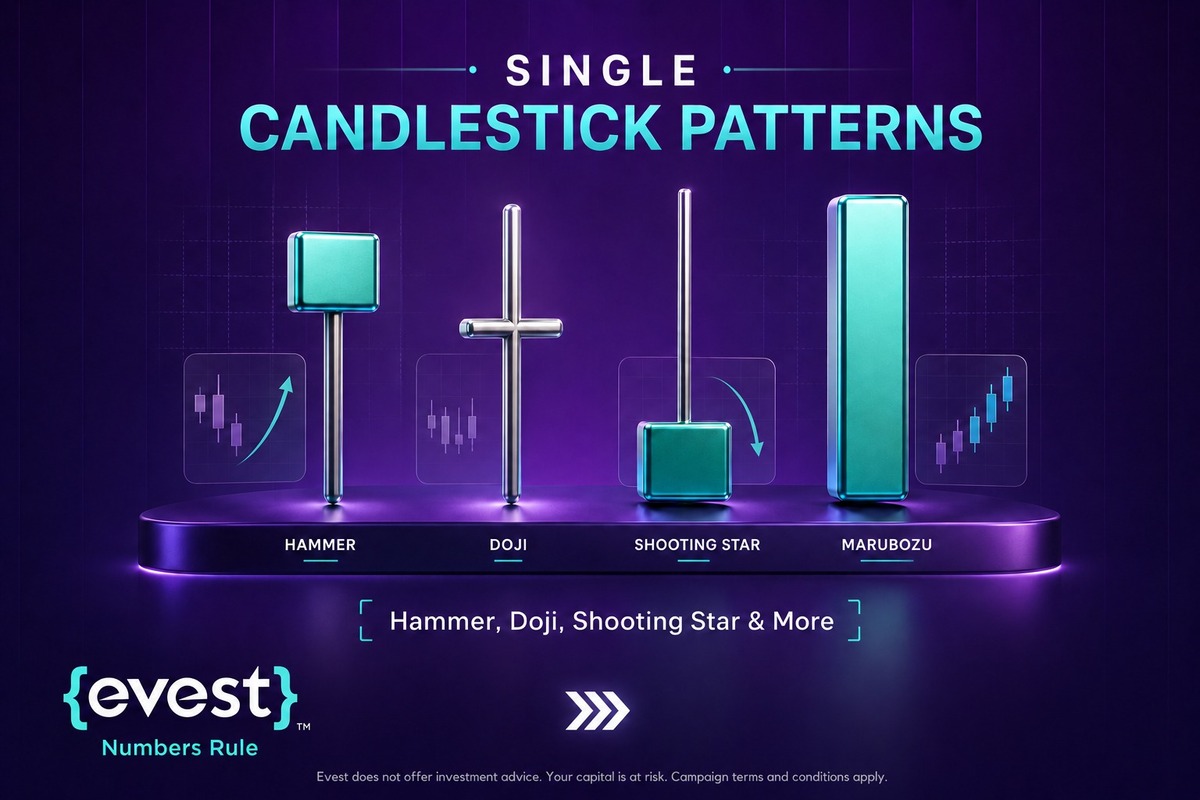
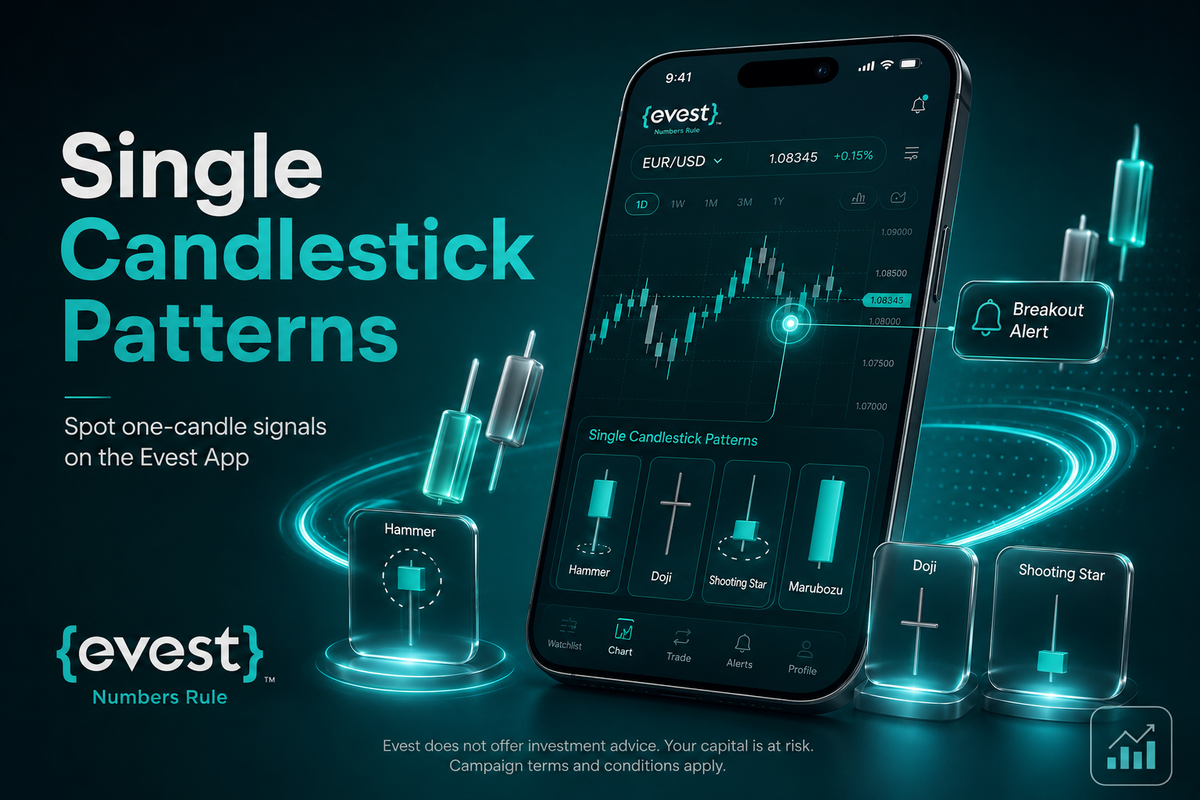
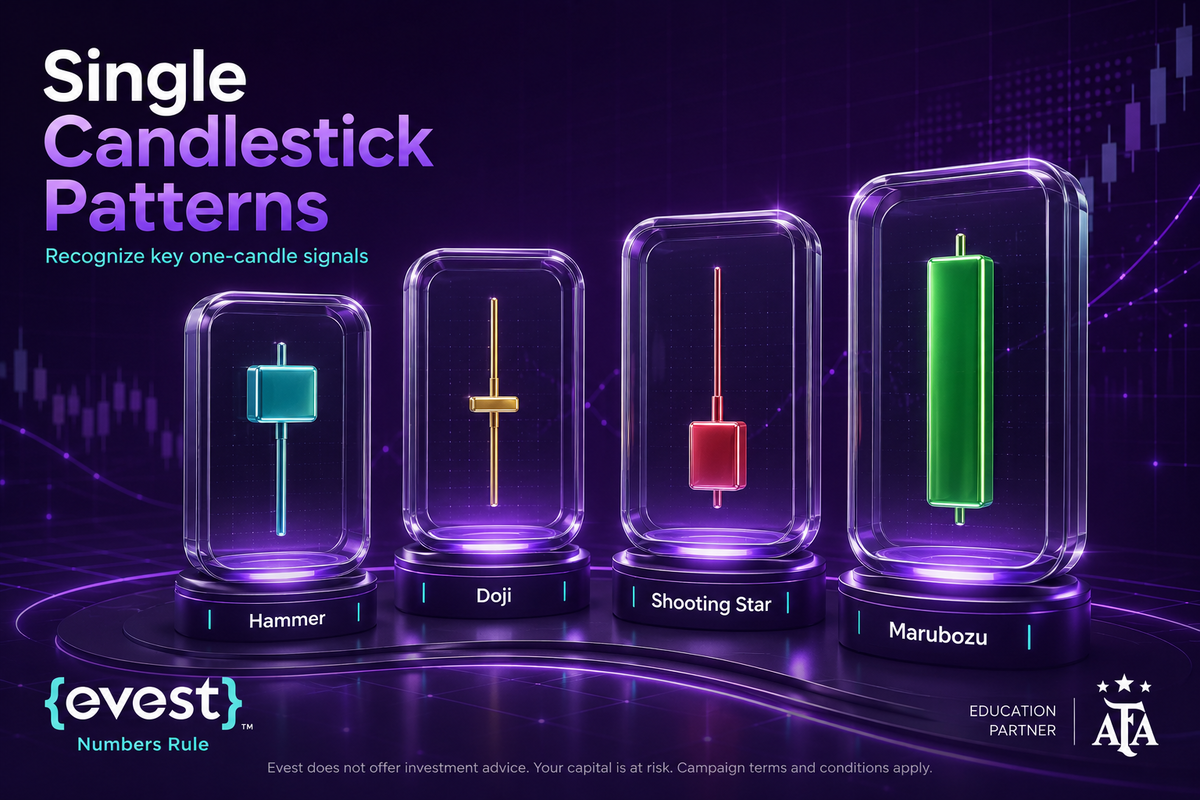
Single candlestick patterns are individual price formations that may help traders identify buying pressure, selling pressure, price rejection, momentum, or market indecision.
However, the shape of a candle does not provide a complete trading signal on its own. Its meaning depends on where it appears, the trend that preceded it, nearby support and resistance levels, the selected timeframe, and whether the following price action confirms the signal.
In this Evest guide, you will learn how the main bullish, bearish, and indecision candlestick patterns are formed, what they may indicate, and how traders can evaluate them within a broader risk-managed trading plan.
How to Read a Single Candlestick?
Each candlestick contains four price points:
Open: the price at the beginning of the selected period.
High: the highest price reached during that period.
Low: the lowest price reached during that period.
Close: the price at the end of the period.
The area between the opening and closing prices is called the real body. A long body may indicate stronger directional momentum, while a small body may indicate reduced momentum or indecision.
The lines above and below the body are known as wicks or shadows. A long upper wick shows that price moved higher before being pushed back down. A long lower wick shows that price moved lower before recovering.
Timeframe also affects interpretation. A pattern on a daily chart represents more trading activity than the same pattern on a one-minute chart, although no timeframe makes a pattern automatically reliable.
Visual requirement: Add an annotated candlestick diagram showing the Open, High, Low, Close, real body, upper wick, and lower wick.
The Foundation of Price Action Body, Shadows, Color, and Timeframe
A single candlestick has a real body and shadows, also known as wicks. The real body shows the distance between the opening and closing prices. A large body usually reflects stronger directional movement, while a small body often reflects hesitation or indecision.
The upper shadow shows the highest price reached during the period, while the lower shadow shows the lowest price reached. Long shadows often suggest price rejection at extreme levels.
The candle color shows whether the session closed higher or lower than it opened. A bullish candle usually means the close was above the open, while a bearish candle means the close was below the open.
The timeframe is also important. A Hammer on a daily chart may carry more weight than a Hammer on a one-minute chart because the daily candle reflects a larger period of market behavior.
What Can a Candlestick Reveal About Market Behaviour?
Candlesticks convert price movement into a visual summary of the interaction between buyers and sellers during a specific period.
A long bullish body may indicate that buyers maintained control into the close, while a long bearish body may indicate stronger selling pressure. Long wicks show that price reached an extreme but failed to remain there before the candle closed.
A Doji may reflect temporary balance between buyers and sellers. A Hammer may show that sellers pushed price lower before buyers recovered much of the decline. A Marubozu may reflect strong directional momentum because it forms with little or no wick.
These interpretations describe what happened during the candle period. They do not confirm what the market will do next, which is why traders normally assess the surrounding trend, price levels, liquidity, and subsequent candles.
Key Bullish Candlestick Patterns and Their Trading Implications
Single candlestick patterns
Bullish single candlestick patterns may suggest potential upward movement or reversal when confirmed by context. They are often more meaningful when they appear after a decline, near support, or after a period of selling pressure.
These candles do not guarantee a reversal. Instead, they show that buyers may be starting to defend a price area or challenge seller control.
The Hammer A Potential Bullish Reversal Pattern
The Hammer is a potential bullish reversal pattern, especially when it appears near support after a downtrend. It has a small real body near the top of the candle, a long lower wick, and little or no upper wick. The long lower shadow shows that sellers pushed price down during the session, but buyers managed to push it back up before the close.
The following example is hypothetical and for illustration only: if EUR/USD is moving lower and forms a Hammer near a known support level, some traders may watch the next candle for confirmation before considering a bullish setup.
A Hammer alone is not enough. Traders often wait for a confirmation candle, a reaction from support, or a break above a short-term resistance level before entering.
The Inverted Hammer Early Sign of Possible Buying Interest
The Inverted Hammer is another potential bullish reversal candle. It usually appears after a downtrend and has a small real body near the bottom of the candle with a long upper wick.
This candle shows that buyers tried to push price higher during the session, but sellers pushed it back down near the open. That means buyers appeared, but they did not fully control the close.
Confirmation is important because the long upper wick also shows that sellers rejected higher prices during the session. The pattern becomes more useful if the next candles show stronger buying follow-through.
The Bullish Marubozu Strong Buying Pressure
The Bullish Marubozu is a strong momentum candle that may indicate buying pressure. It has a long bullish body with little or no upper or lower wick.
This structure suggests that buyers controlled most of the session, with the price opening near the low and closing near the high. It may appear during a breakout, a continuation move, or the early stage of a bullish reaction.
For example, if USOIL forms a Bullish Marubozu after consolidation, it may suggest stronger buying pressure. However, traders should still confirm the move with trend direction, resistance levels, volume, and broader market conditions.
The Dragonfly Doji Rejection of Lower Prices
The Dragonfly Doji forms when the open, high, and close are very close to each other, while the candle has a long lower wick.
This pattern may suggest rejection of lower prices, especially when it appears after a decline or near a support area. Sellers pushed price down, but buyers managed to bring it back near the opening level before the candle closed.
However, the Dragonfly Doji requires confirmation from the next candles. Without follow-through, it may simply represent temporary hesitation rather than a true reversal.
Key Bearish Candlestick Patterns and Their Trading Implications
Bearish single candlestick patterns may suggest potential weakness when they appear after an uptrend, near resistance, or after an extended rally.
These patterns do not mean price must decline. They show that sellers may be challenging buyer control, but traders still need confirmation from price action, trend structure, support and resistance, or volume.
The Hanging Man Warning After an Uptrend
The Hanging Man has the same basic shape as the Hammer, but it appears after an uptrend. It has a small body near the top of the candle and a long lower wick.
The candle shows that sellers managed to push price lower during the session, even though buyers later pushed it back near the open. After a strong uptrend, this may warn that selling pressure is starting to appear.
It is more meaningful near resistance or after an extended uptrend. Context is important because the same candle shape can have a different meaning depending on where it appears.
The Shooting Star A Potential Bearish Reversal Signal
The Shooting Star is a potential bearish reversal signal that appears after an uptrend. It has a small real body near the bottom of the candle and a long upper wick.
This structure shows that buyers pushed the price higher, but sellers rejected those higher levels before the close. The longer the upper wick, the stronger the rejection may appear.
The following example is hypothetical and for illustration only: if XAU/USD reaches a new high and forms a Shooting Star near resistance, it may warn of weakening buying pressure, especially if followed by bearish confirmation.
The Bearish Marubozu Strong Selling Pressure
The Bearish Marubozu is a strong bearish momentum candle. It has a long bearish body with little or no upper or lower wick.
This candle suggests that sellers dominated most of the session, with price opening near the high and closing near the low. It may appear at the beginning of a downward move or as a continuation candle during an existing downtrend.
If a DFM-listed stock forms a Bearish Marubozu, it may indicate strong selling pressure. This is an illustrative example only, not a recommendation to trade any specific stock.
The Gravestone Doji Rejection of Higher Prices
The Gravestone Doji forms when the open, low, and close are close to each other, while the candle has a long upper wick.
This candle may suggest rejection of higher prices. Buyers pushed price higher during the session, but sellers brought it back down near the open before the close.
It becomes more relevant near resistance or after a prolonged uptrend. Like other single candlestick patterns, it should be confirmed by the next candles before being used in a trading decision.
Indecision Candles Doji and Spinning Top
Not every candlestick pattern signals a reversal. Some candles mainly show uncertainty.
The Doji forms when the open and close are very close. It reflects balance between buyers and sellers during the candle period. A Doji may appear during consolidation, after a trend, or near an important price level. It shows indecision; reversal depends on trend context and confirmation.
The Spinning Top is similar to the Doji candle but has a small real body. It also has upper and lower shadows, showing that price moved in both directions but closed near the open. Unlike a Doji, the Spinning Top has a visible body, but both patterns reflect uncertainty.
These candles become more meaningful when they appear at important support or resistance levels, or after an extended move.
How to Confirm a Single Candlestick Pattern?
Recognising a candle’s shape is only the first step. Traders also need to evaluate the market conditions in which it appears.
The following factors may help assess the strength of a candlestick signal:
Previous Trend
A reversal pattern should normally appear after a clear directional move. A Hammer after a decline has a different meaning from the same candle in the middle of a sideways range.
Support and Resistance
A bullish rejection candle near support may be more relevant than one that forms directly below major resistance. Similarly, a bearish rejection candle may carry more weight when it forms near resistance.
Higher Timeframe Structure
The broader timeframe can provide directional context. For example, a trader may use a daily chart to assess the main trend and an hourly chart to examine a potential entry.
Follow-Through
The candle that forms after the pattern can help confirm whether buyers or sellers are maintaining pressure. A bullish reversal pattern may be supported by a higher close, while a bearish pattern may be supported by a lower close.
Volume and Participation
When reliable volume data is available, increased activity near an important price level may support the interpretation. Volume should still be considered alongside price structure rather than used as confirmation in isolation.
Technical Indicators
Indicators such as RSI, MACD, or Stochastic may add supporting information, but they should not replace price action, market context, or riskmanagement.
Candlestick patterns may help with trade timing, but they should not determine the entire trading decision.
Understanding the Limitations of Single Candlestick Patterns
Single candlestick patterns are useful visual tools, but their reliability varies.
They are often weaker in choppy markets, low-liquidity conditions, or during high-impact news events. They can also produce false signals if traders ignore broader market structure.
A common mistake is to see a Hammer and buy immediately, or see a Shooting Star and sell immediately, without checking trend, support and resistance, volume, and risk.
No single pattern is foolproof. Traders should use candlestick patterns as part of a broader process, not as a standalone system.
Risk Management for Candlestick-Based Setups
A candlestick pattern does not remove trading risk. Before evaluating any setup, traders should define where the original interpretation would become invalid.
For a bullish pattern such as a Hammer, the candle’s low may be used as a reference when identifying potential invalidation. For a bearish pattern such as a Shooting Star, the candle’s high may serve as a similar reference. The exact Stop Loss level depends on the strategy, volatility, market structure, and execution conditions.
Traders should also consider:
The amount of capital at risk.
The distance between the entry and invalidation levels.
Position size.
Available liquidity.
Market volatility.
Potential risk-to-reward.
The effect of spreads, gaps, and slippage.
When leveraged products such as forex or CFDs are involved, losses may increase as quickly as potential gains. A valid pattern can still result in a significant loss if the position is too large or excessive leverage is used.
Stop Loss orders may help manage risk, but execution at the requested price is not guaranteed during gaps, fast-moving markets, or periods of limited liquidity.
Using Candlestick Patterns in Saudi and UAE Markets
Single candlestick patterns may appear acrossSaudi and UAE stocks, regional indices, commodities, forex pairs, and CFDs, depending on the instruments available through the trading platform.
Although the principles of candlestick analysis remain broadly similar, market-specific conditions can influence how a candle forms and how it should be interpreted. These conditions may include:
Local trading sessions.
Market liquidity.
Bid-ask spreads.
Daily price limits where applicable.
Corporate announcements.
Overnight economic or geopolitical developments.
Differences between exchange-listed assets and leveraged derivatives.
For example, a Bullish Marubozu on a Saudi-listed stock may reflect strong buying pressure during that session, but the candle alone cannot explain the source or sustainability of that demand. A Shooting Star on a UAE-listed stock may show rejection of higher prices, but subsequent price action is still required to evaluate whether the rejection develops into a broader decline.
The instrument, exchange rules, product structure, and execution conditions should therefore be reviewed before applying any candlestick-based analysis.
All examples are provided for educational purposes and do not represent recommendations to trade a specific instrument.
Limitations and Common Candlestick Trading Mistakes
Single candlestick patterns provide visual information about price behaviour, but their reliability varies across markets, assets, timeframes, and trading conditions.
Signals may be less reliable during:
Sideways or highly volatile markets.
Periods of limited liquidity.
Major economic announcements.
Sudden gaps.
Irregular trading activity.
Conditions where reliable volume data is unavailable.
There is no fixed success rate that applies to a Hammer, Doji, Shooting Star, or any other pattern in isolation. The outcome depends on market context, confirmation criteria, execution, and risk management.
Common mistakes include:
Entering immediately after recognising a candle shape.
Ignoring the previous trend.
Trading directly into major support or resistance.
Treating indecision patterns as confirmed reversals.
Using excessive leverage.
Increasing position size after losses.
Failing to define an invalidation level.
Assuming that every correctly identified pattern must succeed.
Candlestick analysis is therefore better used as one part of a structured trading process rather than as a standalone trading system.
Explore the Markets with Evest
Evest provides traders with access to a range of financial markets through a user-friendly trading environment supported by educational resources and market insights. After learning how single candlestick patterns are formed and interpreted, traders can use Evest’s charting tools to observe price action, compare different timeframes, and practise applying technical analysis within a structured risk-management approach. Candlestick patterns should always be evaluated alongside broader market conditions and should not be treated as guaranteed trading signals.
FAQs
What is the difference between bullish and bearish single candlestick patterns?
Bullish single candlestick patterns may suggest buying pressure or a possible upward reversal, especially after a decline or near support. Examples include the Hammer, Inverted Hammer, Bullish Marubozu, and Dragonfly Doji. Bearish patterns may suggest selling pressure after a rally or near resistance, such as the Hanging Man, Shooting Star, Bearish Marubozu, and Gravestone Doji. These signals indicate possibilities, not guarantees.
How do you identify a Hammer candlestick pattern?
A Hammer candlestick pattern has a small real body near the top of the candle, a long lower wick, and little or no upper wick. It usually appears after a decline and becomes more meaningful near a support level. The long lower wick shows rejection of lower prices, but traders often wait for the next candle to confirm buying interest.
Are single candlestick patterns enough for making trading decisions?
Single candlestick patterns are not usually enough for making reliable trading decisions on their own. They can provide useful clues about market sentiment, but they should be confirmed with trend direction, support and resistance, volume, and higher timeframe structure. Traders also need clear risk management, proper position sizing, and an invalidation level before entering any trade based on a candle signal.
Which single candlestick pattern indicates strong market indecision?
The Doji is one of the clearest single candlestick patterns for market indecision. It forms when the open and close prices are very close, showing that neither buyers nor sellers had clear control during the candle period. A Spinning Top can also reflect uncertainty, but it has a small visible body, while the Doji has almost no real body.
How can I improve the accuracy of single candlestick pattern signals?
To improve the accuracy of single candlestick pattern signals, traders should avoid using the candle shape alone. A signal becomes stronger when it aligns with trend direction, support and resistance, volume, higher timeframe structure, and relevant market conditions. It is also important to define the invalidation level, use suitable position sizing, and manage risk before entering the trade.
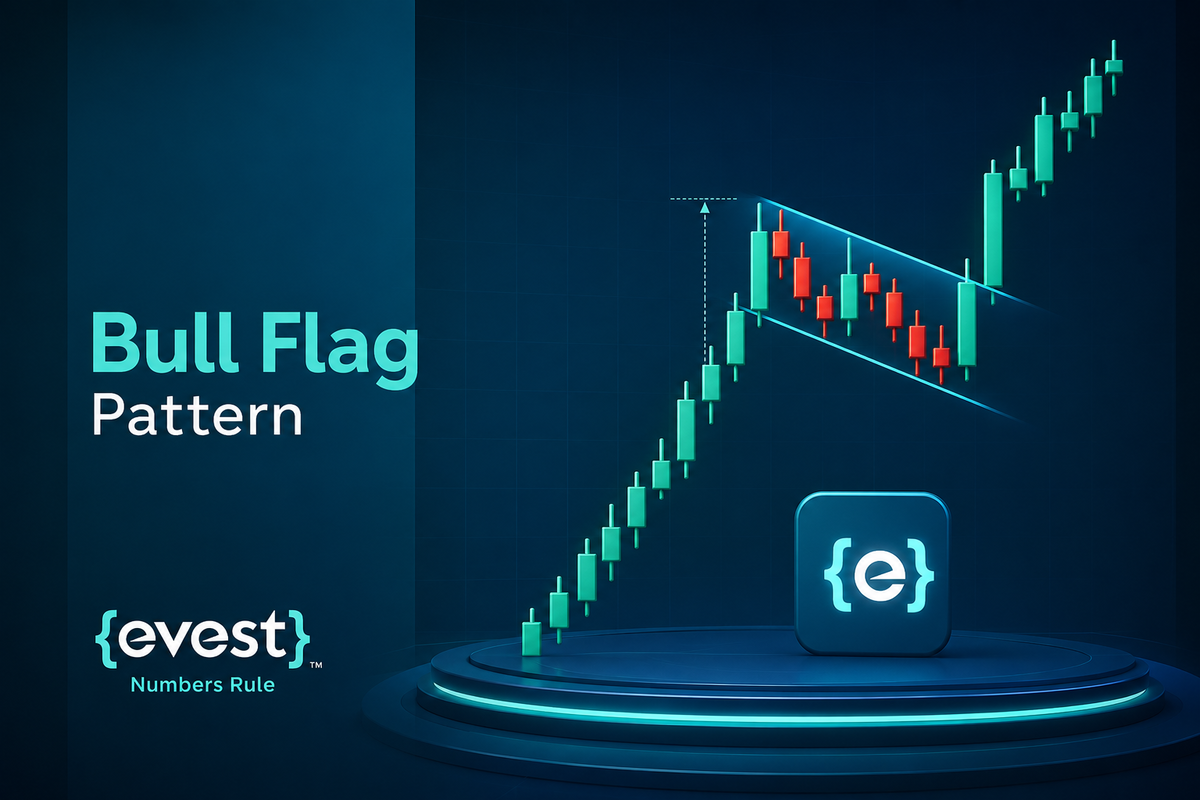
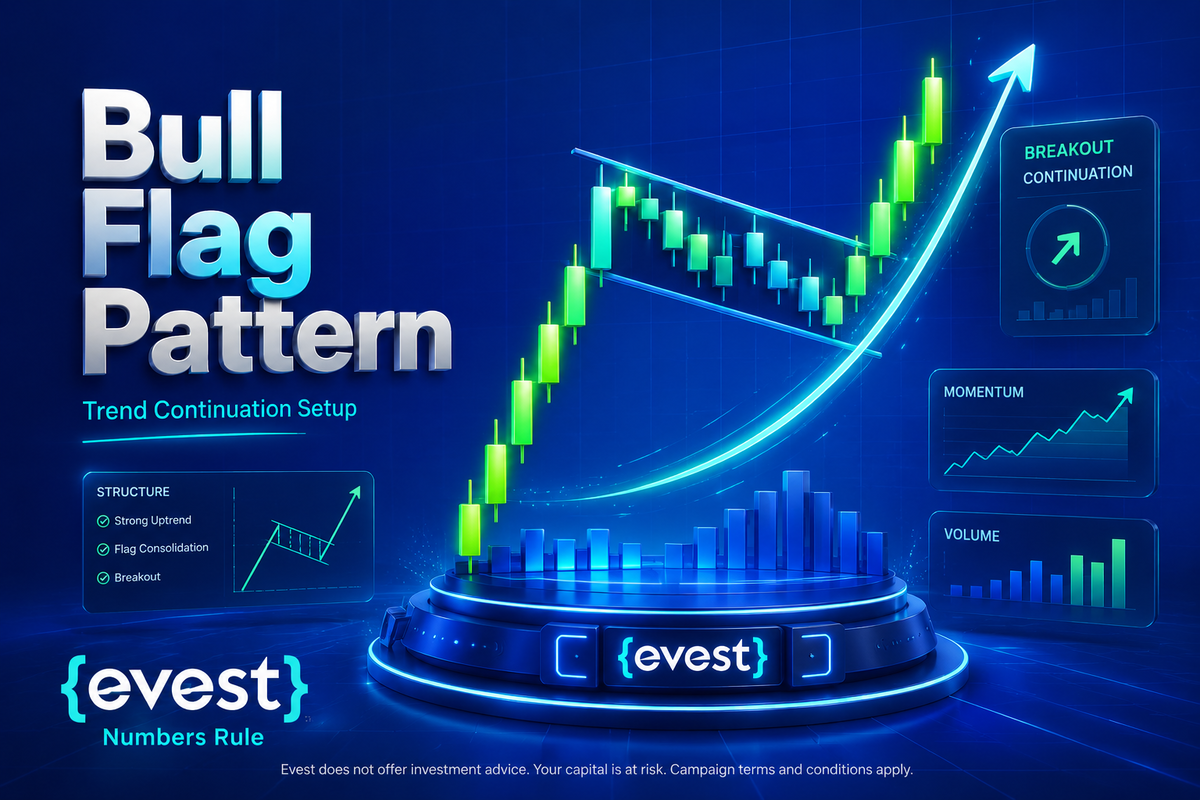
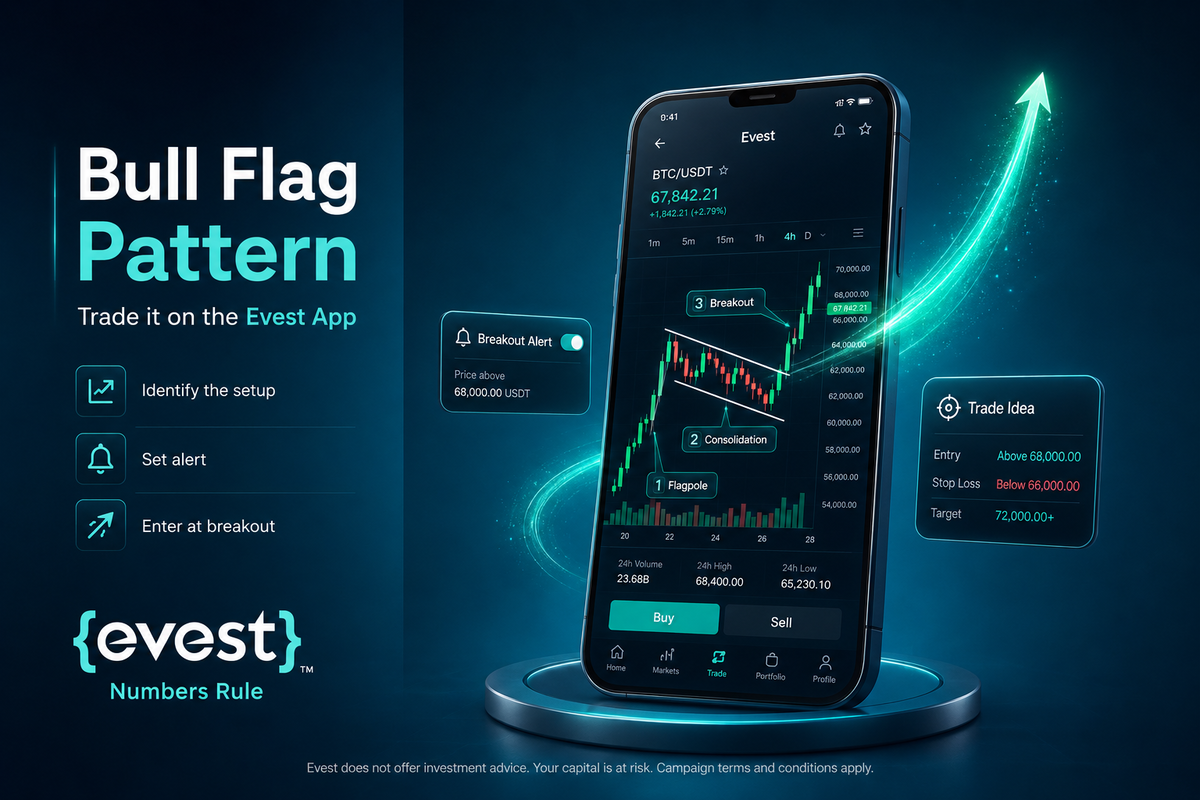
The Bull Flag Pattern is a commonly used bullish continuation pattern in technical analysis. It may help traders identify potential continuation setups within an existing uptrend, especially when the setup is supported by price structure, volume, and broader market context.
This chart pattern usually appears after a sharp upward move, followed by a short consolidation phase before the price may continue higher. However, like all technical patterns, it does not guarantee future price movement. Traders should treat it as a probability-based setup, not a certainty.
This guide explains what the Bull Flag Pattern is, how to identify it on charts, how traders approach entries and exits, and how to manage risk when trading potential breakouts.
What Is a Bull Flag Pattern and Why Do Traders Watch It?
A Bull Flag is a bullish continuation pattern that forms after a strong price rally. The rally creates the flagpole, while the smaller sideways or downward-sloping consolidation creates the flag.
The formation represents a temporary pause within an existing uptrend rather than an automatic reversal. If price later closes above the flag’s upper boundary with sufficient momentum, traders may interpret the move as a possible continuation of the previous trend.
In simple terms, the Bull Flag shows a strong upward move followed by a short pause or pullback. If the price later breaks above the flag resistance with confirmation, traders may view it as a potential continuation signal. The important word here is potential. A Bull Flag is not a guarantee that price will continue higher.
The Market Psychology Behind Bull Flag Formation
The Bull Flag Pattern is often interpreted as a pause in buying momentum rather than a full trend reversal.
The initial rally, or flagpole, reflects strong demand. After that move, some traders may take profits, causing the price to consolidate. If selling pressure remains limited and buyers return, the price may break above the flag and continue the prior uptrend.
This interpretation is probabilistic and should not be treated as certainty. Market conditions can change quickly, especially around major news events, earnings releases, or high-volatility sessions.
Key Characteristics of a Valid Bull Flag Pattern
A higher-quality Bull Flag setup commonly includes:
A clear and impulsive upward move that forms the flagpole.
A shorter consolidation that moves sideways or slightly downward.
A pullback that does not erase most of the initial rally.
Lower volatility during the consolidation phase.
A breakout above the flag’s resistance in the direction of the previous trend.
Supporting volume or momentum during the breakout.
Sufficient space before the next major resistance level.
Market context remains essential. A Bull Flag that forms within an established uptrend is generally more relevant than a similar shape appearing in a sideways or highly unstable market.
How to Identify a Bull Flag Pattern on Charts?
To identify a Bull Flag Pattern, start by looking for an existing uptrend and a sharp upward move. Then observe whether the price forms a controlled consolidation that does not fully reverse the prior move.
A practical process is to find a strong flagpole, check whether the consolidation is shallow and organized, review volume or momentum, and wait for breakout confirmation. The setup can be useful, but the shape alone is not enough. Traders still need to evaluate market context, risk-reward, and invalidation levels before entering.
Recognizing the Strong Uptrend Flagpole
The first step is identifying the flagpole. This is usually a sharp upward movement that shows strong buying pressure.
The following example is hypothetical and for illustration only: if EUR/USD rallies from 1.0800 to 1.0950 within a short period, that move may form a potential flagpole. However, the setup is not complete unless price later forms a controlled consolidation and then confirms a breakout.
A strong flagpole should stand out clearly on the chart. It usually shows momentum, price expansion, and limited overlap between candles. Without that initial strength, the pattern may simply be ordinary sideways movement rather than a true Bull Flag setup.
Identifying the Consolidation Phase Flag
After the flagpole, the price may move sideways or slightly downward. This creates the flag.
The flag should usually be shorter and calmer than the flagpole. A very deep pullback may suggest that the trend is weakening rather than pausing.
Many traders prefer shallow retracements, often below 50%, but this is a guideline, not a fixed rule. A retracement that is too deep, such as one that erases most of the flagpole, may reduce the quality of the setup.
The flag may take different forms:
A small downward channel.
A rectangular range.
A slightly sideways consolidation.
A tight pullback with lower volatility.
Volume Analysis Confirming the Pattern
Volume can provide useful context when assessing a Bull Flag, particularly in stocks and exchange-traded instruments.
A commonly observed sequence is:
Higher volume during the initial rally.
Lower volume while price consolidates.
Renewed volume as price breaks above the flag.
This sequence can indicate strong participation during the flagpole, limited selling pressure during the pullback, and renewed demand during the breakout.
Volume should not be treated as a standalone signal. Traders should also review the breakout candle, market trend, nearby resistance levels, and the point at which the pattern would become invalid.
In decentralized markets such as spot forex, centralized volume data may not be available. Tick volume, candle structure, momentum, and price behavior around the breakout level can be used as supporting information.
Timeframe Considerations for Bull Flags
Bull Flag Patterns can form on many timeframes, including:
5-minute charts.
15-minute charts.
1-hour charts.
4-hour charts.
Daily charts.
Weekly charts.
Longer timeframes may filter out some market noise and may provide cleaner setups. Shorter timeframes may offer more frequent setups, but they are more vulnerable to noise, spread, slippage, and false breakouts.
Multi-timeframe analysis can help. For example, a Bull Flag on a 4-hour chart may be more meaningful if the daily chart also shows an uptrend.
Effective Strategies for Trading the Bull Flag Pattern
Trading a Bull Flag Pattern usually involves waiting for breakout confirmation, defining risk, and calculating position size before entering.
A basic trading approach may include:
Identifying the flagpole.
Waiting for flag consolidation.
Watching for a confirmed breakout.
Setting a Stop Loss below the flag or recent swing low.
Estimating a potential Take Profit target.
Calculating position size based on risk.
Position size should be calculated based on account size, stop-loss distance, and risk percentage. Traders should avoid choosing lot size randomly or based only on confidence in the setup.
Entry Points Without Colon Breakout Confirmation and Retests
The most common entry approach is to wait for a breakout above the upper boundary of the flag.
A stronger breakout may include:
A candle close above the flag resistance.
Increased volume or momentum.
A breakout in the direction of the broader trend.
A favorable risk-reward ratio.
Some traders prefer to wait for a retest of the breakout level. In this case, the former resistance may act as support.
Avoid chasing the breakout after a large move, as the risk-reward ratio may become weak. Entering too late can mean that the Stop Loss is far away while the potential target is limited.
Setting Stop Loss Orders for Risk Management
Stop Loss placement is an important part of trading Bull Flag setups.
Common Stop Loss locations include:
Below the lower boundary of the flag.
Below the most recent swing low.
Below a nearby support level.
At a level that invalidates the pattern.
Stop Loss orders reduce risk but may not execute at the exact price during gaps or high volatility. This is especially important around major news events or low-liquidity periods.
The goal is not to avoid every loss. The goal is to keep losses controlled when the setup fails.
Determining Take Profit Targets Using Flagpole Measurement
Consider a hypothetical market that rises from 100 to 110, creating a 10-point flagpole. Price then consolidates between 107 and 109 before closing above the flag’s resistance at 109.
A trader evaluating the setup might consider:
Possible entry: After a confirmed close above 109 or after a successful retest of the breakout level.
Possible invalidation level: Below the lower boundary of the flag or the most recent swing low.
Projected target: Adding the 10-point flagpole measurement to the breakout area, producing a theoretical target near 119.
Additional consideration: Reviewing nearby resistance before relying on the full projected target.
This example is for educational purposes only. The projected target is not guaranteed, and price may reverse before reaching it. Position size should be determined using the entry price, stop-loss distance, account size, and predefined risk limit.
Combining Bull Flags with Other Technical Indicators
Technical indicators can provide additional context, but they should not replace the pattern’s price structure.
The most useful supporting tools may include:
Volume: To assess participation during the flagpole, consolidation, and breakout.
Moving averages: To review the direction of the broader trend and possible dynamic support.
ATR: To understand current volatility and avoid placing a stop loss inside normal price movement.
Support and resistance: To identify nearby barriers and logical invalidation levels.
A Bull Flag should not be considered valid simply because several indicators produce bullish readings. Price structure, breakout quality, market context, and risk remain more important than the number of indicators used.
Common Mistakes to Avoid When Trading Bull Flag Patterns
Before using advanced tools, traders should understand the most common mistakes.
These include:
Entering before breakout confirmation.
Ignoring volume.
Chasing price after a large breakout candle.
Placing Stop Loss too close.
Using excessive leverage.
Ignoring market context.
Treating the pattern as a guaranteed signal.
Trading directly into major resistance.
A Bull Flag is a setup, not a certainty. The quality of the trade depends on execution, confirmation, and risk management.
Ignoring Volume Confirmation
Ignoring volume is one of the most common mistakes when trading Bull Flag setups.
A breakout with weak volume may fail quickly, especially in stocks. If price moves above the flag but lacks participation, it may fall back into the consolidation area.
In decentralized markets like spot forex, volume data may be limited or represented as tick volume. In this case, traders may also rely on momentum, candle structure, and price behavior around the breakout level.
Entering Too Early or Too Late
Entering before confirmation exposes the trader to unnecessary risk. The price may continue consolidating, break down, or invalidate the setup.
Entering too late can also be a problem. If the breakout already moved too far, the Stop Loss may become wide and the reward-to-risk ratio may become unattractive.
A disciplined trader waits for confirmation, then checks whether the trade still offers a reasonable setup.
Improper Stop Loss Placement
A Stop Loss that is too tight may be triggered by normal market fluctuation. A Stop Loss that is too wide may expose the account to unnecessary loss.
The Stop Loss should be placed where the pattern would be considered invalid, not at a random distance.
For example, if the flag support is clearly defined, a Stop Loss below that structure may be more logical than placing it too close to the entry price.
Over-Leveraging on Bull Flag Trades
High leverage can turn a small false breakout into a large account loss. Even if the pattern looks strong, leverage should be used carefully. A valid-looking Bull Flag can still fail because of news, low volume, strong resistance, or a sudden shift in market sentiment. Traders should define risk before entry and avoid risking more than they can afford to lose.
Advanced Bull Flag Trading Techniques and Considerations
Advanced traders may use additional tools to refine entries, targets, and trade management.
These may include:
Fibonacci extensions.
Multi-timeframe analysis.
ATR-based Stop Loss placement.
Liquidity analysis.
Market sentiment.
Correlation with related assets.
News-event awareness.
These tools can support decision-making, but they do not remove trading risk.
Trading Bull Flags with Fibonacci Extensions
Fibonacci extensions are sometimes used to project potential price targets after a breakout.
Common extension levels include:
127.2%.
161.8%.
200%.
Fibonacci extensions are projection tools, not guaranteed price targets. Price may fail before reaching any extension level.
They are best used alongside support and resistance, prior highs, volume, and market context.
The Role of Liquidity and Volatility in Bull Flag Breakouts
Liquidity and volatility can strongly affect breakout quality.
High liquidity may help reduce slippage and improve execution. Low liquidity can increase slippage and make breakout entries less reliable.
High volatility may create fast breakouts, but it can also produce false moves and wider stop-loss requirements.
Before trading a breakout, traders should consider:
Spread.
Slippage.
Market session.
News events.
Asset liquidity.
Volatility level.
Managing Failed Bull Flag Patterns and False Breakouts
Not every Bull Flag succeeds. Failed patterns and false breakouts are part of trading.
Warning signs of a failed Bull Flag may include:
Breakout without volume.
Price closing back inside the flag.
Breakout directly into major resistance.
Weak momentum after the breakout.
Sudden negative news.
Deep retracement during the flag.
If price closes back inside the flag after the breakout, traders often reassess or exit based on their plan.
A predefined plan is important because emotional decisions after a failed breakout may increase losses.
Bull Flag Pattern vs. Other Continuation Patterns
The Bull Flag is one of several continuation patterns. It is often compared with the Bull Pennant, Ascending Triangle, and Bear Flag.
Pattern
Direction
Structure
Typical Meaning
Bull Flag
Bullish
Rectangular or slightly downward consolidation after a sharp rally
Potential continuation of an uptrend
Bull Pennant
Bullish
Small symmetrical triangle after a sharp rally
Potential continuation after compression
Ascending Triangle
Often bullish
Flat resistance with rising support
Buyers may be gaining pressure
Bear Flag
Bearish
Rectangular or slightly upward consolidation after a sharp decline
Potential continuation of a downtrend
Factors Influencing Bull Flag Reliability
A Bull Flag may be more reliable when:
The flagpole is strong and impulsive.
The consolidation is shallow.
Volume declines during the flag.
Volume increases during breakout.
The broader trend is bullish.
The breakout is not directly below major resistance.
The risk-reward ratio is reasonable.
A Bull Flag may be weaker when:
The flag retraces too deeply.
The consolidation lasts too long.
Volume increases during the pullback.
The breakout lacks momentum.
The broader market is weak.
Major news is about to be released.
Practical Application of Bull Flag Patterns in Saudi Arabia and the UAE
The Bull Flag Pattern can be applied to different asset classes, including stocks, indices, commodities, and forex pairs. However, application depends on the asset, broker, exchange, and applicable regulation.
Traders in Saudi Arabia and the UAE should verify the licensed entity before trading. Regulatory oversight depends on the legal entity, product type, and jurisdiction. Do not assume one license covers all products.
The pattern may appear on:
Regional stocks.
Local indices.
Global stocks.
Commodities.
Currency pairs.
ETFs or CFDs, depending on availability.
Trading Bull Flags on Regional Stocks
Bull Flags may appear on stocks listed on exchanges such as Tadawul, DFM, or ADX.
Any stock example should be treated as illustrative only and not a recommendation to trade any specific stock.
Regional stocks may have different liquidity, trading hours, price limits, and news drivers compared with global markets. These factors should be considered before trading.
Practising Bull Flag Analysis as an Evest Reader
Before considering any Bull Flag setup, turn the pattern into a repeatable analysis process rather than relying on visual appearance alone.
Start by marking:
The beginning and end of the flagpole.
The upper and lower boundaries of the flag.
The breakout confirmation level.
The level that would invalidate the pattern.
The next major resistance area.
The expected reward compared with the amount at risk.
Reviewing these points before making a decision can help separate a structured setup from an emotional reaction to a fast price move.
Evest educational content is designed to help readers understand how market structures are evaluated. It does not guarantee that a specific pattern, trade, or strategy will produce a profit.
FAQs
What is the Bull Flag Pattern’s success rate?
There is no fixed universal success rate for the Bull Flag Pattern. Its performance depends on several factors, including confirmation, timeframe, asset class, volume, market conditions, and risk management. Backtesting results may also vary depending on the rules used to define the pattern and the market being tested.
How often do Bull Flag Patterns occur?
Bull Flag Patterns are relatively common in trending markets, especially during strong uptrends. They appear less frequently in sideways or choppy markets. Their frequency also depends on the asset’s volatility and the timeframe being observed.
When do Bull Flag Patterns fail?
Bull Flag Patterns may fail when the breakout lacks volume, the price falls back into the flag, the consolidation becomes too deep, or unexpected news changes market sentiment. They may also fail when the breakout occurs directly below a major resistance level, which can limit further upside movement.
How long can Bull Flags last?
The duration of a Bull Flag depends on the timeframe being analyzed. On intraday charts, a Bull Flag may last minutes or hours, while on daily charts, it may last several days or weeks. If the consolidation lasts too long or becomes too deep, the continuation setup may weaken.
Is a Bull Flag Pattern a continuation or reversal pattern?
The Bull Flag Pattern is generally classified as a bullish continuation pattern. It suggests a temporary pause within an existing uptrend before the price may continue higher. However, it is not a reversal pattern and does not guarantee that the uptrend will continue.
What technical analysis indicators are used with Bull Flags?
Traders often use volume, RSI, MACD, moving averages, Bollinger Bands, ATR, and support and resistance levels with Bull Flag setups. However, volume and price structure are usually more important than relying on indicators alone, as they help confirm whether the breakout has real strength.
What timeframe of price charts do Bull Flag Patterns form on?
Bull Flag Patterns can form on any timeframe, from minute charts to weekly or monthly charts. Longer timeframes may provide cleaner signals and reduce market noise, while shorter timeframes may produce more frequent setups but also more false breakouts.
What is the difference between a Bull Flag and a Bull Pennant?
A Bull Flag usually forms as a small rectangular or slightly downward-sloping channel after a strong rally. A Bull Pennant forms as a small symmetrical triangle after a strong rally. Both are continuation patterns, but the main difference is the structure of the consolidation phase.
What makes a trader dedicate their full focus and strategy to a single competition? The answer is always the Evest Trading Cup rewards — prizes that go beyond mere numbers to become a real experience and an unforgettable memory. Evest designed this season’s reward structure with exceptional care, combining instant deposit-based rewards with performance-based weekly prizes — ensuring every serious trader finds their place in the winners’ circle. Whether you’re looking for an exclusive kit that captures the spirit of the season or dreaming of a live match ticket on the stadium floor, the Evest Trading Cup rewards are built to give every trader exactly what they deserve.
Trading Cup Reward Structure — A Complete Overview
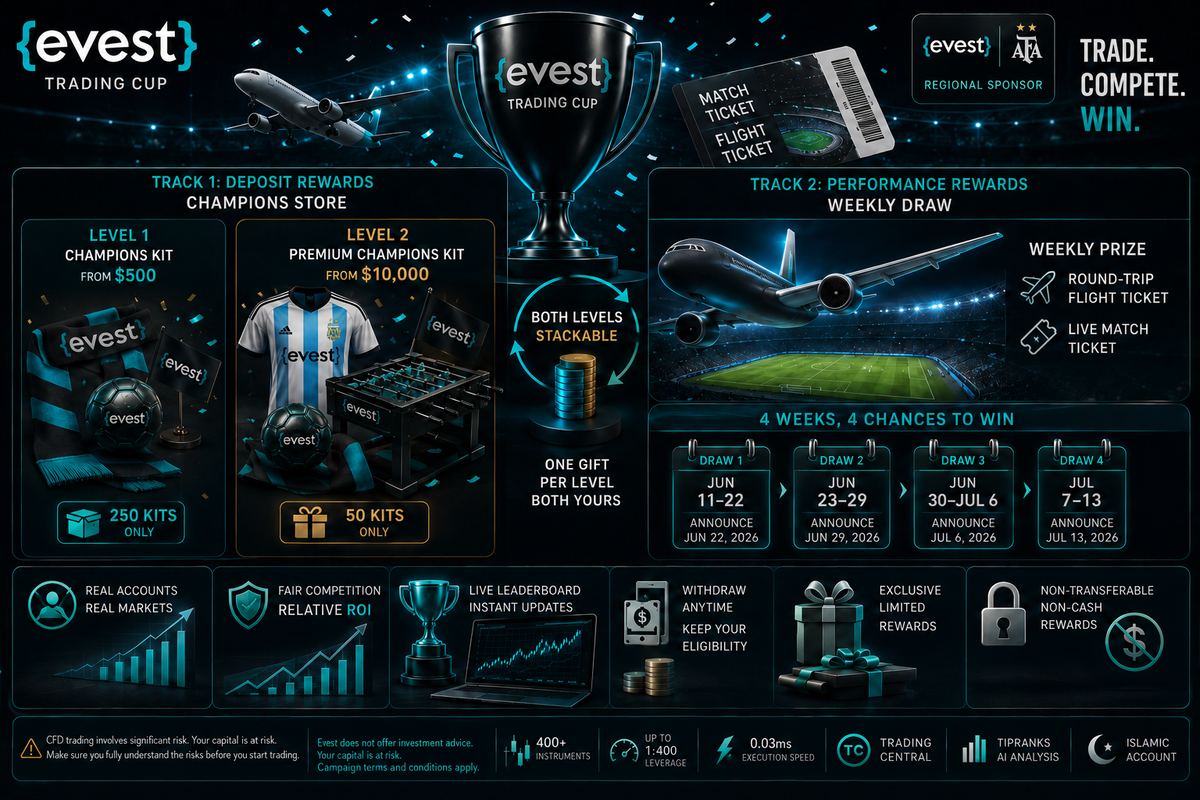
Trading Cup rewards from Evest are split into two fully independent tracks — you can qualify for one or both simultaneously:
Evest offers two distinct reward types this season, and that’s precisely what makes the Trading Cup reward distribution more comprehensive and fair than any other trading competition on the market.
The Two Reward Tracks
Track One — Deposit-Based Rewards (Champions Store) Granted automatically the moment you hit the qualifying deposit threshold — no competition, no ranking required. Just deposit and qualify.
Track Two — Performance-Based Prizes (Weekly Draw) Awarded to the trader with the highest ROI during each weekly draw period.
Champion Kits — Exclusive Champions Store Rewards
Champion kits are the most prominent Evest rewards for traders on the deposit-based track, split into two levels based on qualifying deposit size during the campaign period.
Level 1 — Champions Kit
Available to every trader who makes a single transaction of $500 or more between June 11 and July 19, 2026.
Kit contents:
Official fan scarf
Evest-branded football
Your favourite team’s flag
Only 250 kits available — strictly limited quantity.
Level 2 — Premium Champions Kit
Available to every trader whose cumulative deposits reach $10,000 or more during the campaign period.
Kit contents:
Official fan scarf
Evest-branded football
Official Argentina national team jersey
Your favourite team’s flag
Evest-branded foosball table
Only 50 kits available — extremely limited.
The Two-Level Stacking Rule
One point many traders overlook: the two levels are not mutually exclusive. If you start with a $500 deposit and claim the Level 1 kit, then grow your cumulative deposits to $10,000 later in the campaign, you qualify for the Level 2 kit on top of the first — one gift per level, both yours to keep.
Weekly Trading Competition Prizes — The Weekly Draw
The biggest trading competition prizes in the Evest Cup are those awarded through the performance-based weekly draw. Four draws, four prizes, and four opportunities that don’t repeat.
Weekly Draw Prize
In each draw, the trader with the highest ROI percentage wins:
Round-trip economy flight ticket to the match city
One live match ticket to watch the champions on the pitch
Weekly Draw Schedule
Draw
Period
Announcement Date
Draw 1
Jun 11 → Jun 22, 2026
June 22, 2026
Draw 2
Through Jun 29, 2026
June 29, 2026
Draw 3
Through Jul 6, 2026
July 6, 2026
Draw 4
Through Jul 13, 2026
July 13, 2026
Types of Trading Cup Rewards — Full Comparison
To fully understand the types of Trading Cup rewards, here’s the complete side-by-side comparison:
Criterion
Champions Store
Weekly Draw
Qualification basis
Deposit size
Highest ROI
Number of winners
Everyone who meets the threshold
One trader per week
Prize type
Exclusive sports kit
Flight + match ticket
Quantity available
250 + 50 kits
4 prizes across the season
Stackable
Yes — two levels
No — one win per trader
Withdrawal impact
Does not cancel eligibility
ROI calculated at draw date
Winning Trader Rewards — Claiming Conditions
Winning trader rewards in the Evest Cup are subject to a set of conditions every participant should know:
Non-transferable: Prizes cannot be passed to another person under any circumstances
Non-redeemable for cash: All rewards are physical and cannot be converted to account credit or monetary value
Subject to verification: Submitting a claim does not guarantee delivery until Evest confirms all eligibility conditions are fully met
Claim process: Via the dedicated claim form at champion evest, with full contact and shipping details required
Why Evest Trading Cup Rewards Are Exceptional?
Evest rewards for traders aren’t just financial incentives — they’re a complete experience that reflects Evest’s philosophy as the official regional sponsor of the Argentine national team. Here’s what makes them stand apart:
Priceless emotional value: A live match ticket is a memory that lasts for years — not a number that disappears into your account balance
Exclusive limited-edition kit: Only 250 + 50 kits for an entire season — scarcity that gives them exceptional collector value
A reward for every level: Not just the top performer — everyone who meets the deposit threshold gets their own dedicated reward
Full transparency: The live leaderboard shows you at every moment exactly where you stand relative to the biggest prize
CFD trading involves significant risk. Your capital is at risk. Make sure you fully understand the risks before you start trading.
FAQs
Can I get a Champions Kit and a weekly draw prize at the same time?
Yes — the two prizes are completely independent. If you deposit $500 and claim the Level 1 kit, then achieve the highest ROI in a weekly draw, you receive the kit and the flight and match ticket together. The system is designed to reward the committed trader on more than one level simultaneously, and that's what makes the Trading Cup rewards from Evest structurally unique compared to any other trading competition.
Will my prize be affected if I withdraw funds during the campaign?
No. Withdrawals do not cancel prizes you have already earned. If you qualified for the Champions Kit with a $500 deposit and then withdrew part of your funds, your right to the kit remains fully intact. For the weekly draw, your return is calculated based on your portfolio value at the draw date relative to your total deposits — so a withdrawal affects the calculated ROI percentage, not your fundamental eligibility.
How long does it take to receive Champions Store rewards?
Delivery timelines depend on logistical arrangements and third-party shipping providers, and may vary by country and service provider. Evest contacts winners to request shipping details after eligibility is confirmed. For direct enquiries, reach out via the official campaign email: [email protected]
Not all trading competitions are the same — and if you’ve ever participated in regular trading competitions before, you’ll immediately recognise that the gap between a Trading Cup vs trading contest is far wider than most traders expect. The Evest Trading Cup operates on an entirely different level — the difference isn’t just in prize size or competition duration, but in the complete philosophy the tournament is built on, from the scoring mechanism, to eligibility conditions, to the nature of rewards, all the way through to the overall experience a trader lives throughout the season. If you’re wondering why everyone is talking about the Evest Cup this summer, this article gives you the full answer.
Types of Trading Competitions — Understanding the Landscape
Before diving into the comparison, it’s important to understand the types of trading competitions available in the market so you can place the Evest Trading Cup in its proper context.
The Most Common Models in Trading Competitions
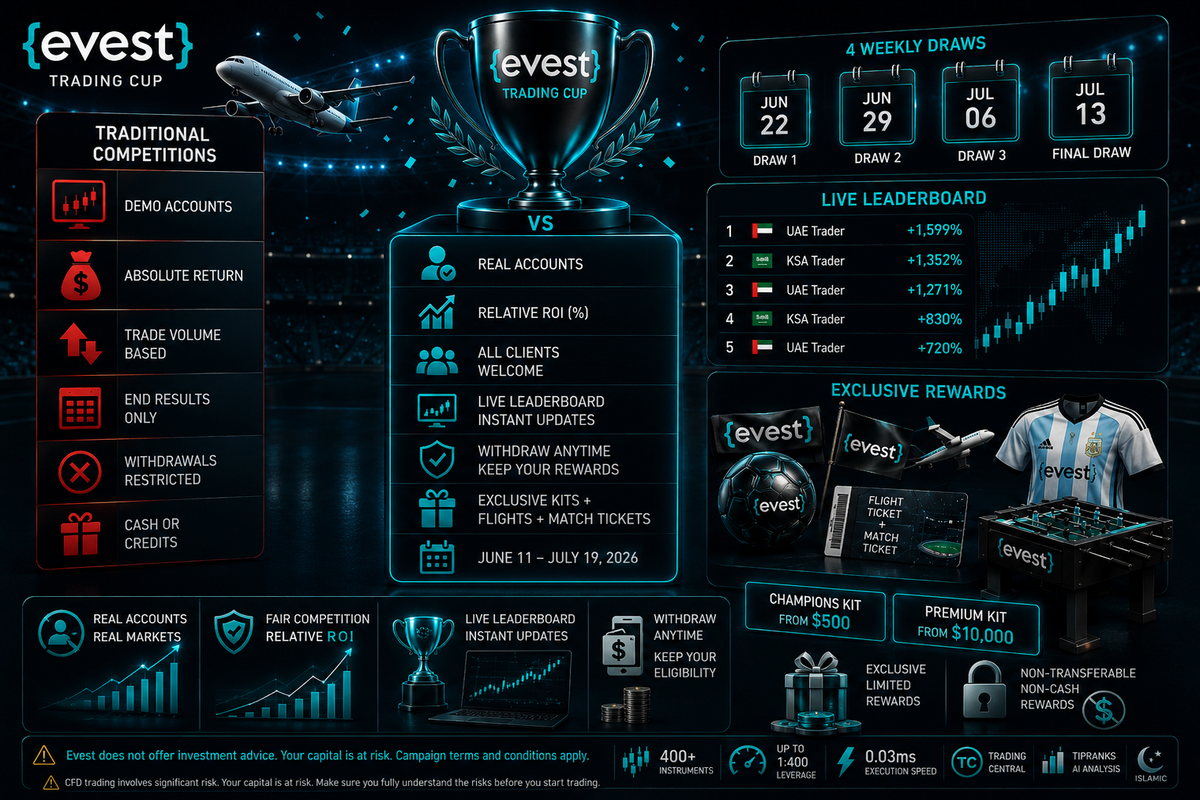
Demo Account Contests The most widespread format in the market — participants compete on virtual accounts with simulated money. No real risk, but no real value in winning either. The winner is often whoever took the most exaggerated risks, precisely because the money isn’t real.
Absolute Return Competitions Whoever generates the largest gain in dollars wins — automatically giving traders with large accounts an unfair structural advantage over smaller participants, regardless of actual trading skill.
Trade Volume Competitions These reward whoever opens the highest number of trades — encouraging random trading over strategic thinking, and often benefiting the broker far more than the trader.
Classic Global Trading Tournaments Typically organised on large platforms over extended periods, relying on complex criteria that don’t suit the everyday trader and often lack transparency throughout the competition window.
Trading Tournament vs Trading Competition — Where the Real Difference Lies
Trading tournament vs trading competition — the difference in terminology reflects a genuine difference in substance. A competition is a passing event. A tournament is a complete experience with structure, philosophy, and prizes that match the level of ambition it demands.
What Makes the Trading Cup Different — The Real Advantages?
What makes the Trading Cup different from everything else isn’t just bigger prizes — it’s a complete system of advantages that make the experience deeper, fairer, and more exciting than any traditional trading competition.
1. Real Account Competition — Not a Demo
The most fundamental difference between the Evest Cup and traditional trading challenges is that every single trade in the Cup is executed with real money in a real market. This means:
Decisions are calculated because real capital is on the line
Genuine skill determines the winner — not luck or reckless risk-taking
Winning means proving actual trading competence against a live global market
2. A Formula That’s Fair for Everyone — Relative Return, Not Absolute
In regular trading competitions built on absolute returns, a trader with $50,000 automatically outperforms a trader with $500 — even if the smaller trader is significantly more skilled. The Evest Trading Cup eliminates this disparity entirely through the relative ROI formula. Everyone competes on the same ground, regardless of account size.
The formula is straightforward:
ROI (%) = ((Portfolio value at draw date − Deposits during campaign) ÷ Deposits during campaign) × 100
A $500 deposit achieving +300% outranks a $50,000 deposit achieving +15% — every single time.
3. A Live, Fully Transparent Leaderboard
Classic global trading tournaments typically announce results only at the very end — keeping participants in the dark throughout the entire competition period. The Evest Trading Cup operates with complete transparency:
Your ranking is visible to you and all participants at every moment
You can adjust your strategy in real time based on where you currently stand
4. Four Weekly Draws — Renewed Opportunities Every Week
Most regular trading competitions produce a single winner at the very end. The Evest Trading Cup gives you four separate chances to win through consecutive weekly draws:
June 22, 2026 — First Draw
June 29, 2026 — Second Draw
July 6, 2026 — Third Draw
July 13, 2026 — Fourth and Final Draw
And if you win one draw, you’re excluded from subsequent ones — opening the door for more traders to claim a prize across the season.
5. Complete Freedom to Withdraw
One of the standout Trading Cup advantages that’s absent from most other competitions is that withdrawing your funds doesn’t cancel your eligibility. You can withdraw at any point during the campaign without losing the rewards you’ve already earned — a level of flexibility that’s extremely rare in traditional trading competition formats.
Trading Cup Advantages — What You Won’t Find Anywhere Else
The Trading Cup advantages go well beyond the competitive structure to deliver a complete experience with no equivalent:
Prizes That Can’t Be Measured in Numbers A round-trip flight ticket and a live match ticket aren’t money that disappears — they’re a memory that stays. This category of prize simply doesn’t exist in any standard trading competition format.
Official AFA Argentina Partnership The Evest Cup isn’t just a trading competition — it’s a seasonal event tied to Evest’s official partnership with the Argentine Football Association (AFA). This connection gives the Cup an exceptional character that bridges the world of financial markets with the spirit of global football championships.
Exclusive Champions Store Alongside the weekly draw prizes, the Cup rewards your deposit directly through the Champions Store — giving every qualifying participant a tangible, exclusive seasonal kit regardless of their leaderboard position.
A Complete Trading Platform The competition runs on the Evest platform equipped with 400+ financial instruments, leverage up to 1:400, order execution at 0.03ms, and advanced analytical tools including Trading Central and TipRanks — everything a professional trader needs in one place.
CFD trading involves significant risk. Your capital is at risk. Make sure you fully understand the risks before you start trading.
FAQs
Why does the Trading Cup use live accounts instead of demo accounts?
Because real competition requires real stakes. On demo accounts, traders tend to make exaggerated decisions precisely because nothing is at risk — which makes the results a poor measure of actual trading skill. The Evest Cup selects traders who prove their competence under real market conditions, which is what makes winning it a genuine achievement that demonstrates measurable, recognisable trading ability.
Can I join the Trading Cup without any previous experience in trading competitions?
Absolutely. The Evest Cup requires no history in global trading tournaments or previous competitions. All you need is an active Evest account, completed KYC verification, and a deposit of $500 or more during the campaign period. The platform also offers the Trading Academy and expert webinars with Ahmed Osama to help new traders build a strong foundation before and during the competition.
What's the real difference between Trading Cup prizes and prizes from other trading competitions?
Most traditional trading challenges offer cash prizes or additional account credit — rewards that disappear with the next trade. The Evest Trading Cup goes in a completely different direction: a flight and a live match ticket are an experience that can't be valued in dollars, and the exclusive Champions Kits are limited-edition seasonal pieces. The goal of this choice is for the memory of winning the Cup to stay with you — not dissolve into the daily movement of the markets.
Hidden divergence is a signal that occurs when the relationship between price action and a momentum indicator suggests that the current trend is about to resume after a pullback or consolidation phase. Unlike regular divergence, which signals potential reversals, hidden divergence is a continuation signal. It tells you that the underlying momentum driving a trend remains intact even when the price has temporarily moved against that trend, and that the market is likely to resume its primary direction with renewed force.
What is Hidden Divergence?
The concept of hidden divergence sits within the broader family of divergence analysis, which compares the behavior of price to the behavior of a momentum indicator to identify situations where the two are telling different stories. Understanding where hidden divergence sits within this family, and why it is distinct from its more widely known counterpart, is the essential starting point.
Regular divergence, the type most traders learn first, occurs when the price makes a new high or low that is not confirmed by the momentum indicator. Price reaches higher, but momentum is actually weakening. This is a reversal warning. Hidden divergence is the opposite scenario. The momentum indicator makes a new extreme that is not matched by a corresponding new extreme in price. Momentum is showing strength that the price has not yet fully reflected. This is a continuation signal.
The distinction matters enormously for how you use the signal. A trader who confuses regular divergence with hidden divergence will be looking for reversals when the market is actually setting up for a powerful trend continuation move, which is one of the most costly analytical errors in trend trading.
How Does Hidden Divergence Work?
Momentum measurement: Hidden divergence is considered a reliable signal because it reflects what the momentum indicator is actually measuring beneath the surface of price movement.
Pullback within an uptrend: When price pulls back during an uptrend but the momentum indicator stays above its previous comparable low, it suggests that buying pressure has not weakened in the same way price has.
Shallow momentum correction: Even if the pullback looks significant on the price chart, the momentum decline may be relatively shallow, indicating that the trend still has underlying strength.
Healthy trend correction: This type of divergence often signals a normal correction within a healthy trend rather than the beginning of a full reversal.
Institutional participation: Markets showing hidden divergence during pullbacks are often supported by continued institutional activity or sustained dominant market flow.
Temporary pullback: The price decline may be caused by profit-taking or short-term sentiment changes, while the main trend direction remains intact.
Objective confirmation: Hidden divergence gives traders a measurable way to assess trend strength instead of relying only on subjective market analysis.
Trend continuation signal: Because the dominant buying or selling pressure remains present, hidden divergence is often used as a continuation signal rather than a reversal signal.
Bullish Hidden Divergence: Finding the Entry Point Within an Uptrend
Bullish hidden divergence is the variation of the signal that appears within an established uptrend and signals that the trend is ready to resume after a corrective pullback. It is formed by a specific relationship between price and the momentum indicator that, once you know what to look for, becomes recognizable on almost any chart where a genuine uptrend is underway.
The setup forms when price makes a higher low during a pullback within an uptrend. This is the key price action condition. Price has corrected, but the correction has held above the previous significant low, confirming that the higher low structure of the uptrend is intact. Meanwhile, the momentum indicator makes a lower low during the same pullback period. The indicator has dropped further than the price has, suggesting that the surface appearance of the correction is slightly more pessimistic than the underlying market reality warrants.
This combination, a higher low in price with a lower low in the indicator, is bullish hidden divergence. It tells you that the correction is complete, that the sellers who drove the pullback have not been strong enough to undermine the trend’s foundation, and that the conditions are in place for upward momentum to reassert itself.
How to Identify and Confirm Bullish Hidden Divergence?
Follow this process to identify valid bullish hidden divergence setups on your charts.
Confirm that the market is in an established uptrend by identifying a series of higher highs and higher lows on the time frame you are analyzing.
Wait for a corrective pullback that forms a new higher low, meaning it does not break below the prior significant low.
Check your momentum indicator at the corresponding point of the pullback low.
If the indicator is showing a lower reading at this higher low in price than it showed at the prior swing low in price, you have bullish hidden divergence.
Look for confirmation from price action, such as a reversal candlestick pattern, a break of short-term resistance, or a return to momentum in the indicator, before entering.
Place your stop below the higher low that formed the divergence, as a break of that level would invalidate the continuation setup.
Bearish Hidden Divergence
Bearish hidden divergence is the mirror image of the bullish variation, appearing within an established downtrend to signal that the trend is resuming after an upward correction. It is equally powerful as a signal and equally important to understand, particularly for traders who are comfortable taking short positions or trading instruments that allow profit from falling prices.
The setup forms when price makes a lower high during an upward correction within a downtrend. This confirms that the corrective bounce has not broken the downtrend’s structure of lower highs and lower lows. At the same time, the momentum indicator makes a higher high during the same corrective period. The indicator is showing more apparent strength than the price is reflecting, but within the context of a downtrend, this is actually a bearish signal because it confirms that the correction is exhausting itself before it can genuinely challenge the prevailing trend.
This combination, a lower high in price with a higher high in the indicator, is bearish hidden divergence. It signals that sellers are likely to regain control and drive prices lower in continuation of the dominant downtrend.
RSI Hidden Divergence
The RSI, or Relative Strength Index, is one of the most widely used momentum indicators in technical analysis and one of the most effective tools for identifying hidden divergence. Developed by J. Welles Wilder and introduced in 1978, the RSI measures the speed and magnitude of price movements on a scale from zero to one hundred, with readings above seventy traditionally considered overbought and readings below thirty considered oversold.
For hidden divergence analysis, however, the absolute level of the RSI matters less than the relationship between successive RSI readings at equivalent points in the price cycle. You are not looking for overbought or oversold conditions. You are comparing where the RSI stands at a current price swing low or high relative to where it stood at the previous equivalent swing point.
Practical RSI Settings for Hidden Divergence Analysis
The standard RSI period setting of 14 is a reasonable starting point for most time frames, but hidden divergence analysis benefits from some flexibility in this setting.
Time Frame
Recommended RSI Period
Rationale
Daily and Weekly Charts
14 periods
Standard setting works well for longer cycles
4-Hour Charts
14 periods
Standard setting appropriate for swing trading
1-Hour Charts
10 to 14 periods
A slightly shorter period increases sensitivity
15-Minute Charts
7 to 10 periods
A shorter period better captures intraday momentum shifts
5-Minute Charts
5 to 7 periods
A very short period was needed to capture fast-moving signals
Regardless of the period you use, the method for identifying RSI hidden divergence remains identical. Compare the RSI reading at successive swing lows during uptrends or successive swing highs during downtrends and look for the divergence between the RSI reading and the corresponding price level.
MACD Hidden Divergence
The MACD, or Moving Average Convergence Divergence indicator, provides another powerful lens through which to identify hidden divergence. The MACD measures the relationship between two exponential moving averages of price and presents this relationship as both a line and a histogram, making it visually intuitive for divergence analysis.
MACD hidden divergence follows the same basic logic as RSI hidden divergence, but uses the MACD line or histogram to identify the momentum condition. In a bullish hidden divergence setup, price makes a higher low while the MACD histogram makes a lower low or the MACD line makes a lower reading than it did at the prior swing low. In a bearish setup, price makes a lower high while the MACD shows a higher reading than it did at the prior swing high.
One of the advantages of using the MACD for hidden divergence analysis is that the histogram makes the divergence visually prominent. The shrinking or growing bars of the histogram at successive swing points create a clear visual representation of whether momentum is expanding or contracting relative to the price being shown.
Why Hidden Divergence Is the Trend Trader’s Best Friend?
Primary application: Trend continuation is the primary application and the primary benefit of hidden divergence analysis.
Established trends: For traders who operate primarily within the context of established trends, identifying high-probability re-entry points after corrective moves is one of the most valuable skills available.
Trend trading challenge: Even strong, well-established trends do not move in straight lines.
Corrective phases: Trends advance and retreat, with corrective phases that can be psychologically difficult to navigate.
Corrections and reversals: Corrections look like reversals until they prove not to be.
Common trader mistake: Many traders exit winning trend positions during normal corrections only to watch the trend resume without them.
Hidden divergence solution: Hidden divergence provides an objective, indicator-based signal that a correction is ending and that the trend is resuming.
Trading application: Rather than exiting the trend during the correction or waiting for a new trend high to confirm resumption, the hidden divergence trader can identify the likely end of the correction before it happens and position accordingly.
The Advantage of Trend Continuation Signals Over Reversal Signals
Trading with the trend using continuation signals rather than against it using reversal signals offers several practical advantages.
Higher probability of success because you are aligned with the dominant market direction
More favorable risk-to-reward ratios because stops can be placed at the correction low or high, which is a defined and logical level
Reduced exposure to false signals because the broader trend context filters out many low-quality setups
More consistent results over time because trend continuation setups occur repeatedly within any sustained trend
Momentum Indicators: Choosing the Right Tool for Your Analysis
While RSI and MACD are the most commonly used momentum indicators for hidden divergence analysis, they are not the only options available. Understanding the strengths and limitations of different momentum tools helps you choose the right one for your specific trading style and the markets you analyze.
The Stochastic Oscillator is another popular choice for hidden divergence analysis. Like the RSI, it operates on a bounded scale and provides clear visual reference points for comparing momentum at successive swing levels. The Stochastic tends to be more sensitive than the RSI, which makes it useful for shorter time frame analysis, but also means it generates more noise that requires filtering.
The Commodity Channel Index, or CCI, operates on an unbounded scale and measures the deviation of price from its statistical mean. Some traders prefer it for hidden divergence because its unbounded nature means extreme readings carry more information than the capped readings of bounded oscillators like RSI.
Regardless of which indicator you choose, the key principles remain the same. You are always comparing the indicator reading at a current price swing point to the reading at the prior equivalent swing point, and you are looking for a divergence between what price is doing and what the indicator is doing that reveals information about underlying momentum.
Building a Complete Hidden Divergence Trading System
Hidden divergence is most powerful when it is integrated into a complete trading system rather than used in isolation. A complete system built around hidden divergence signals typically incorporates the following elements working together.
Trend identification comes first. Before looking for any hidden divergence setup, confirm the direction and strength of the prevailing trend on the time frame above the one you plan to trade. This provides the context that distinguishes a genuine continuation signal from a false setup.
Signal identification comes next. Apply your chosen momentum indicator to your trading time frame and scan for the specific price and indicator conditions that define bullish or bearish hidden divergence at current market swing points.
Confirmation is the third element. Rather than entering immediately on the divergence signal, wait for price action confirmation that the correction is ending. This can take the form of a bullish or bearish reversal candlestick, a break above short-term resistance in a bullish setup, or a break below short-term support in a bearish setup.
Entry and risk management complete the system. Enter the trade after confirmation with a clearly defined stop loss placed at the level that would invalidate the divergence setup, typically just beyond the correction low in a bullish setup or the correction high in a bearish setup. Define your profit target based on the prior swing high or low, a key resistance or support level, or a fixed risk-to-reward ratio.
How Hidden Divergence Performs Across Different Market Conditions?
Best market condition: Hidden divergence performs best in trending markets where a clear price structure makes it easy to identify valid higher lows and lower highs during corrections.
Weak market condition: In ranging or choppy markets, the signal loses much of its effectiveness because there is no dominant trend direction to provide the context that gives the signal its meaning.
Market environment assessment: Assessing the market environment before applying hidden divergence analysis is as important as the analysis itself.
Suitable trending market: A market that has been trending clearly for weeks or months on a daily chart is a far more suitable environment for hidden divergence trading.
Unsuitable ranging market: A market that has been moving sideways within a range for an extended period is less suitable for hidden divergence analysis.
Higher time frame structure: The best markets for hidden divergence analysis show clean, defined structure on the higher time frame.
Clear swings and momentum: These markets have clear swing highs and lows, consistent momentum in the direction of the trend, and proportionate corrections.
Deep correction risk: Corrections should not be so deep that they effectively negate the existing structure.
Best market examples: Forex major pairs, liquid equity indices, and major commodity markets typically provide the cleanest environments for this type of analysis.
FAQs
What is the difference between regular divergence and hidden divergence, and how do I know which one I am looking at?
Regular divergence occurs when price makes a new extreme in its current direction, but the momentum indicator fails to confirm that new extreme, signaling that momentum is weakening and a potential reversal may follow. Hidden divergence is the opposite: the momentum indicator makes a new extreme that price does not confirm, signaling that momentum is stronger than the price action alone suggests and that the current trend is likely to continue. The easiest way to remember the difference is by what each type signals.
Can hidden divergence be used effectively on all time frames and all asset types?
Hidden divergence is a universal concept that applies across all time frames and all liquid financial markets, including forex, equities, commodities, and cryptocurrencies. The signal works on a five-minute chart for intraday traders and on a weekly chart for long-term position traders, using the same identification logic in each case. The key variable is that the quality of the signal generally improves as the time frame increases, because higher time frame signals represent larger and more meaningful moves in momentum and are less susceptible to short-term noise.
How many confirmations should I wait for before entering a hidden divergence trade?
The appropriate number of confirmations depends on your trading style and risk tolerance, but at a minimum, you should always wait for at least one form of price action confirmation before entering a hidden divergence trade. Taking a trade purely on the divergence signal before the price has shown any sign of the correction ending is a common mistake that leads to entering too early and being stopped out by continued corrective moves before the trend resumes.
The question on every trader’s mind before joining the Evest tournament is: Does the Trading Cup depend on account size? And is the trader with the biggest balance always the one who wins? The short answer is no — and that’s precisely what makes this tournament different from any other trading competition out there. The Evest Trading Cup is built on a relative Return on Investment formula, not on the absolute value of returns, placing small and large traders on the same competitive ground. In other words, what determines your position on the global leaderboard is how smart your decisions are — not how big your portfolio is.
How Does the Trading Cup Calculate Rankings?
To understand the impact of account size on trading results in the Cup, you first need to understand the core formula the system runs on:
ROI (%) = ((Portfolio value at draw date − Deposits during campaign) ÷ Deposits during campaign) × 100
This formula says one thing clearly: the percentage is everything — the absolute number is irrelevant.
A Practical Example That Makes It Clear
Trader
Deposit
Gain
Return
Ranking
A
$500
$1,500
+300%
First
B
$10,000
$8,000
+80%
Second
C
$50,000
$20,000
+40%
Third
Trader A deposited the least of all — yet leads the leaderboard by a wide margin. This is the essence of the relative return in the Trading Cup — percentage always outranks size, without exception.
Does Capital Affect the Trading Cup?
Account size in the Trading Cup does have an influence — but not in the way most people imagine. Let’s break this down precisely.
What Account Size Does NOT Affect?
Your leaderboard ranking: The formula is entirely relative and gives no advantage to larger accounts
Your eligibility for the weekly draw: The only requirement is a $500+ deposit during the campaign — regardless of your total account balance
Your right to claim Champions Store rewards: Tied to your qualifying deposit amount, not your overall account size
What a Larger Account Does Provide?
Greater flexibility margin: A larger account absorbs market volatility more comfortably without hitting a margin call
Ability to diversify positions: Opening multiple positions across different instruments simultaneously
Premium Kit eligibility: A $10,000+ cumulative deposit unlocks Level 2 of the Champions Store
Can You Win With a Small Account?
Yes — and the Draw 1 leaderboard figures prove it. The top performer achieved +1,599% — and that extraordinary return doesn’t require a massive account. It requires a solid strategy, precise timing, and smart use of the tools available on the Evest platform.
Why a Small Account Can Compete at the Highest Level?
Leverage compensates for the capital gap: Evest offers leverage up to 1:400 on foreign currencies, giving a trader with $500 a purchasing power of up to $200,000
Focus outperforms diversification: A trader with a small account concentrates carefully on one or two positions — and that focus is itself a competitive advantage.
The formula rewards efficiency, not wealth: $500 achieving +500% beats $50,000 achieving +10% — always and without exception.
Minimum Account Size in the Trading Cup
The trading account in the Trading Cup requires no large balance to get started. The minimum for full participation and eligibility is straightforward:
$500 single deposit during the campaign period to enter the weekly draw and unlock the base Champions Kit
$10,000 cumulative to qualify for the Premium Kit and the full Champions Store package
The minimum account size in the Trading Cup is $500 — a real starting point, not an intimidating figure. Evest set this threshold deliberately because the Cup’s philosophy is built on democratic competition: the opportunity belongs to everyone, and the top belongs to whoever earns it.
Does the Deposit Affect Trader Ranking?
Does the deposit affect trader rankings on the leaderboard directly? The answer: not directly — but it has an indirect effect worth understanding:
A higher deposit reduces your potential return rate if absolute gains are equal, so depositing more means you need to achieve proportionally higher gains to maintain the same percentage
A lower deposit amplifies the impact of every absolute gain on the final rate, which works in favour of the careful trader with a modest account
In the event of a tie in ROI, the trader with the highest absolute gain wins — and this is the only moment where deposit size directly influences the outcome
Trading Cup and Capital Size — The Definitive Summary
Trading Cup and capital size are not linked factors — and that’s the real beauty in how this tournament is designed. Here’s what to keep in mind:
The competition is entirely relative — ROI percentage is the only metric that matters
$500 is enough to enter a genuine contest for the biggest prizes
Evest’s leverage compensates for capital differences between traders
Strategy and timing always outperform size in the Cup’s formula
Does winning depend on capital? The definitive answer: winning depends on your decisions — not your portfolio
CFD trading involves significant risk. Your capital is at risk. Make sure you fully understand the risks before you start trading.
FAQs
Does the trader with the bigger account always beat the smaller trader in the Cup?
No — and the formula structurally prevents it. The relative ROI system makes every trader compete against themselves first: how much were you able to grow what you deposited? A trader with $500 who achieves +400% outranks a trader with $100,000 who achieves +50% — and this isn't an exception in the Cup. It's the foundational rule that the entire competition was built on from day one.
Can I increase my deposit mid-campaign to improve my chances?
Yes, you can deposit at any point during the campaign running from June 11 to July 19, 2026. However, keep in mind that every additional deposit enters the denominator of the ROI formula — meaning you'll need to achieve proportionally higher returns to maintain the same percentage. Additional deposits are useful for qualifying for the Level 2 Champions Store reward ($10,000 cumulative), but they require adjusting your trading strategy to match the new capital size accordingly.
What's the real difference between depositing $500 and depositing $5,000 in the context of the Cup?
The core difference isn't eligibility — both qualify for the weekly draw and the Level 1 Champions Store reward. The difference is in flexibility margin: the trader with $5,000 has a larger safety buffer protecting them from market volatility and the freedom to open multiple diversified positions. But at the end of the day, the leaderboard doesn't see absolute numbers — it sees percentages only, and that's the sole determinant of your ranking.