When to Sell and When to Buy Stocks

When to Sell and When to Buy Stocks

Investing in stocks can be an effective way to build wealth over the long term.
However, succeeding in the stock market requires knowing when to buy and when to sell.
Making the right decisions at the right time can be the difference between profit and loss.
In this article, we will explore some guidelines and tips on how to make smart stock buying and selling decisions.


Topic

When to Buy Stocks

When to Sell Stocks

Tips for Managing Buy and Sell Decisions

Conclusion


When to Buy Stocks

  1. Taking Advantage of Market Dips: Buying during market downturns can provide great opportunities.
    When there is a significant drop in prices, it might be the right time to purchase good stocks at a discount.
  2. Future Growth Potential: Look for companies with strong growth potential.
    If you believe a particular company will experience growth in earnings and returns,
    it might be the right time to buy its stocks.
  3. Positive News: Positive news such as a new product launch or strong financial reports can drive stock prices up. Buying after such news can be a smart move.
  4. Technical Analysis: Using technical analysis can help in determining the right times to buy.
    Monitoring price patterns and technical indicators like the Relative Strength Index (RSI) can provide buying signals.


When to Sell Stocks

  1. Achieving Financial Goals: If stocks have reached your target price that you set for achieving profit, it might be the right time to sell and realize those gains.
  2. Deteriorating Company Performance: If a company starts delivering poor financial results or loses its competitive edge, it might be time to sell before a further decline in price occurs.
  3. Market Changes: Major changes in the market or economy can negatively impact stocks. If you expect market deterioration, selling stocks to avoid losses might be wise.
  4. Need for Liquidity: Sometimes, you may need to sell stocks to provide liquidity for personal reasons or to invest in other opportunities.


Tips for Managing Buy and Sell Decisions

  1. Diversification: Avoid putting all your money into one stock. Diversification can reduce risks and help protect your investment portfolio.
  2. Regular Analysis: Review your investments regularly. Analyzing stocks and evaluating their performance periodically can help make informed decisions.
  3. Financial Advice: Don’t hesitate to seek advice from financial advisors. Experts can provide valuable insights and help you make better investment decisions.
  4. Patience: Investing in stocks requires patience. Avoid emotional and hasty decisions and maintain a long-term investment strategy.


Conclusion

Making the right decisions about when to buy and when to sell stocks can be the difference between success and failure in the stock market. By following the guidelines above and using appropriate analytical tools, you can improve your chances of achieving sustainable profits and building long-term wealth.


When to Sell and When to Buy Stocks
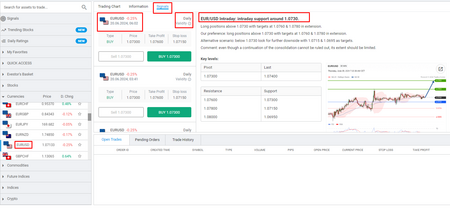
Trading Signals from Trading Central: A Key Resource for Traders:

Trading Signals from Trading Central: A Key Resource for Traders: In the fast-paced world of financial markets,
trading signals are invaluable tools that help traders identify and act on potentially profitable opportunities.
The Trading Central, a renowned provider of financial market research and investment analytics,
offers robust trading signals to enhance traders’ decision-making processes.


Content

What Are Trading Signals

Benefits of Trading Signal

How to Use Trading Signals

Conclusion


What Are Trading Signals?

Trading signals are recommendations or ideas related to specific financial assets.
They indicate the optimal times and price levels for traders to execute their trades.
These signals are derived from thorough analysis, incorporating various technical indicators and market trends.


Benefits of Trading Signal

Timely Information: Trading signals provide real-time insights, allowing traders to make swift decisions.

Expert Analysis: Signals are based on comprehensive technical analysis performed by experienced market analysts.

Strategic Trading: By following trading signals, traders can develop well-informed strategies, enhancing their chances of success.


How to Use Trading Signals

Understanding the Signal: Each signal includes detailed information about the asset, including entry and exit points.

Setting Up Trades: Use the provided levels to set up your trades, ensuring you follow the recommended timing and price points.

Monitoring Performance: Monitor your trades and adjust based on updated signals and market conditions.


Conclusion

Trading signals from Trading Central empower traders with the knowledge and timing needed to capitalize on market opportunities.
By integrating these signals into their trading strategies, traders can improve their decision-making and increase their potential for profitable trades.


Trading Signals from Trading Central: A Key Resource for Traders

What is Leverage in Foreign Exchange Trading?

Foreign exchange (Forex) trading is a vast financial market that
offers significant opportunities for investors and traders.
One of the most important and widely used tools in this market is leverage.
But what is leverage, and how does it affect your trading?
In this article, we will clarify the concept of leverage and how it is used in Forex trading.


Topic

What is Leverage

How Does Leverage Work

Benefits of Leverage

Risks of Leverage

How to Manage Risks

Conclusion


What is Leverage

Leverage is a financial tool that allows traders to increase their trading positions using borrowed capital.
In other words, it enables traders to control large amounts of money in the market
with a relatively small amount of personal capital.
Leverage is expressed as a ratio, such as 1:50, 1:100, or even 1:500.


How Does Leverage Work

Leverage works by borrowing money from the broker to increase the size of the trade.
For example, if the leverage is 1:100, it means that a trader can control
a $100,000 position using only $1,000 of their own capital.
This allows traders to achieve greater profits than they could with their personal capital alone,
but it also comes with higher risks.


Benefits of Leverage

  1. Increased Return on Investment: Traders can achieve greater profits using leverage compared to trading with their personal capital alone.
  2. Opportunity to Enter Larger Trades: Leverage allows traders to enter larger trades than they could afford without it.
  3. Portfolio Diversification: Leverage can be used to diversify an investment portfolio by spreading capital across multiple trades.


Risks of Leverage

  1. Increased Losses: Just as leverage can increase potential profits, it can also amplify potential losses.
  2. Risk of Bankruptcy: Large losses can lead to the complete loss of the invested capital, and potentially more.
  3. Impact on Liquidity: High leverage can lead to liquidity issues, especially if market movements go against the trader.


How to Manage Risks

To effectively manage risks when using leverage, traders should:

  • Determine the Appropriate Level of Leverage: Choose a leverage level that matches personal risk tolerance.
  • Use Stop-Loss Orders: Stop-loss orders help limit potential losses.
  • Manage Capital Wisely: Allocate capital wisely and avoid risking more than can be afforded.


Conclusion

Leverage is a powerful tool in Forex trading that allows traders to increase
their trading positions and achieve greater profits.
However, it comes with significant risks that require careful management and awareness.
By understanding how leverage works and how to use it smartly,
traders can maximize its benefits in their trading activities.


Amazon’s Market Value Reaches Two Trillion Dollars Thanks to AI

Amazon’s Market Value Reaches Two Trillion Dollars Thanks to AI

Amazon has achieved a historic milestone by reaching a market value of two trillion dollars for the first time,
driven by the AI boom that pushed its stock price to record levels.


Topic

Details


Details

Amazon’s stock rose by 3.6% on Wednesday, reaching $193.04,
which pushed its market value past the two trillion dollar mark.
This achievement places Amazon in the elite club of companies that have surpassed this threshold.
Alphabet reached this milestone in late April, while Nvidia, Microsoft,
and Apple have surpassed the three trillion dollar mark.


Amazon’s stock has experienced significant fluctuations since the announcement of its first-quarter earnings,
with its cloud unit recording the strongest sales growth in a year.
This helped the stock return to its highest level in April.
The stock continued to rise in June, recovering its losses from late May and achieving a 27% increase so far this year.


Amazon’s stock price benefited over the past year from cost-cutting measures
and business restructuring to better capitalize on the AI boom.
Additionally, Amazon Web Services showed signs of accelerating growth,
which boosted investor optimism.


According to Dan Romanoff, an analyst at Morningstar Investment Service,
Amazon’s strong stock performance over the past six to nine months
is partly due to its oversold status at the end of 2022.


Amazon’s Market Value Reaches Two Trillion Dollars Thanks to AI


Why is the Cost of Developing Artificial Intelligence So High?

Why is the Cost of Developing Artificial Intelligence So High?

The push towards larger AI models, coupled with the increasing need for chips and data centers,
is driving up costs for tech companies.


Topic

details

Massive Investments for Early Gains

Rising AI Costs: Bigger Models and Increasing Demand

Large Language Models Require Massive Investments

Chip and Computing Costs: Major Investments in Advanced Technology

Renting Chips: Another Expensive Option

Conclusion


details

After more than 18 months of intense focus on generative AI,
some of the biggest tech companies have shown that this technology can be a real revenue source.
However, it also represents a significant expense.
Microsoft and Google’s parent company, Alphabet,
both reported increases in cloud services revenue in their latest quarterly results,
with customers spending more on AI services.
Meta Platforms indicated that its AI efforts have enhanced user engagement and ad targeting,
although it is still far from making substantial profits from this technology.


Massive Investments for Early Gains

The three companies have spent billions on AI development to achieve these early gains and plan to increase these investments.
On April 25, Microsoft announced that its capital expenditures reached $14 billion in the last quarter,
a 79% increase from the previous year’s quarter was partly driven by AI infrastructure investments.
Alphabet spent $12 billion during the same quarter, a 91% increase from the previous year,
and expects spending to remain at the same level or higher for the rest of the year,
focusing on AI opportunities.
Meanwhile, Meta raised its investment estimates for the year,
now projecting capital expenditures to range between $35 billion to $40 billion,
a 42% increase at the upper end of the range.


Rising AI Costs: Bigger Models and Increasing Demand

The rising cost of AI has surprised some investors,
with Meta’s stock falling in response to spending projections paired with slower-than-expected sales growth.
However, within the tech industry, it has long been known that AI costs would rise.
This is due to two main reasons: AI models are becoming larger and more expensive to develop,
and the global demand for AI services necessitates building more data centers to support them.


Large Language Models Require Massive Investments

Today’s most popular AI products, like OpenAI’s ChatGPT,
rely on large language models, systems fed with massive amounts of data to provide the best possible responses to user queries.
Many leading AI companies are betting that the path to more advanced AI,
and possibly systems capable of surpassing humans in many tasks, lies in making these large language models even bigger. This requires more data, computational power, and longer training periods.
Dario Amodei, CEO of Anthropic, a competitor to OpenAI, stated that current AI models cost around $100 million to train, with future models potentially costing $1 billion, and between $5 billion to $10 billion by 2025 and 2026.


Chip and Computing Costs: Major Investments in Advanced Technology

A significant portion of the cost is tied to chips, not the usual CPUs but powerful GPUs that can process vast amounts of data at high speeds, like Nvidia’s H100 chip, which sells for about $30,000.
Major tech companies need many of these chips; Meta’s CEO Mark Zuckerberg stated that his company plans to acquire 350,000 H100 chips by the end of the year to support its AI research.


Renting Chips: Another Expensive Option

Companies can avoid buying physical chips by renting them, but this is also costly.
Renting Nvidia’s H100 chip sets costs about $100 per hour.
Nvidia revealed a new processor design called Blackwell,
which is highly efficient at handling large language models and is expected to be priced similarly to the Hopper chip line, which includes the H100.
Nvidia stated that it would take around 2,000 Blackwell GPUs to train an AI model with 1.8 trillion parameters,
the estimated size of OpenAI’s ChatGPT-4. In comparison, it would take 8,000 Hopper GPUs to perform the same task.


Conclusion

Ultimately, the tech industry is pushing towards building larger and more advanced AI models,
significantly increasing costs.
Despite the high expenses, companies continue to invest heavily in developing this technology to achieve potential future gains.


Why is the Cost of Developing Artificial Intelligence So High?

What is a Lot in the Forex Market and How is it Calculated?

What is a Lot in the Forex Market and How is it Calculated?: The Forex market is one of the largest financial markets in the world,
with investors and traders trading currencies around the clock.
As a newcomer to this market, you will encounter various terms that you must understand to succeed.
One such term is “lot.”
This article will explore the Forex market and explain how it is calculated.

Content
What is a Lot
How to Calculate a Lot
Importance of Understanding Lots
Conclusion


What is a Lot?

A lot is the basic unit of measurement for trade volume in the Forex market. In other words,
When you open a trade in the Forex market, you measure the size of the trade in lots.
There are several types of lots:

Standard Lot: Equivalent to 100,000 units of the base currency.

Mini Lot: Equivalent to 10,000 units of the base currency.

Micro Lot: Equivalent to 1,000 units of the base currency.

Nano Lot: Equivalent to 100 units of the base currency.


How to Calculate a Lot?

To calculate the lot size for a trade, you need to know the trade volume you wish to open and the leverage used.
Leverage is crucial in determining the capital required to open a specific trade. Here’s an example of how to calculate a lot:

Example:

Suppose you want to open a trade on the EUR/USD currency pair with a size of 1 standard lot. In this case,
you would have bought 100,000 euros. If the leverage is 1:100, you need only 1% of the trade value as margin.
Therefore, the required margin would be:

Required Margin=Trade SizeLeverage\text{Required Margin} = \frac{\text{Trade Size}}{\text{Leverage}}Required Margin=LeverageTrade Size​

Required Margin=100,000 euros100=1,000 euros\text{Required Margin} = \frac{100,000 \text{ euros}}{100} = 1,000 \text{ euros}Required Margin=100100,000 euros​=1,000 euros


Importance of Understanding Lots

Understanding lots is crucial as it helps you manage risk more effectively.
The lot size you choose determines the amount of risk you take on each trade.
For instance, trading with a standard lot increases the risk and potential returns, while trading with a micro lot reduces the risk.


Conclusion

A lot is a fundamental concept that every Forex trader must understand accurately.
It helps you determine trade sizes and manage risk effectively.
Before you start trading, ensure you understand how to calculate a lot and use leverage to your advantage.
With knowledge and practice, you can improve your performance and increase your chances of success in this dynamic market.


What is a Lot in the Forex Market, and How is it Calculated?

Nvidia Leads U.S. Stock Indices Down as Futures Expire

Nvidia Leads U.S. Stock Indices Down as Futures Expire: The U.S. financial markets have experienced sharp fluctuations recently, and the expiration of futures contracts has affected stock indices.
In this context, Nvidia was at the heart of the events, sparking a wave of market activity and volatility.


Content

Nvidia Leads U.S. Stock Indices Down

The Triple Witching Effect on Trading Volumes

Nvidia’s Role in Market Volatility

The Impact of Rebalancing on the Technology Sector

Record Investments in Technology Stocks

Expected Volatility in the Second Half of 2024

Performance of Major Indices


Nvidia Leads U.S. Stock Indices Down

The expiration of futures contracts has led to significant losses for Nvidia, the artificial intelligence chip manufacturer.

It lost more than $200 billion in market value in two days.
This resulted in a drop in U.S. stock indices, with trading volumes increasing significantly.


The Triple Witching Effect on Trading Volumes

The U.S. stock exchanges saw a substantial increase in trading volumes during the “triple witching” period,
with volumes rising 55% above the three-month average.
Approximately 18 billion shares were traded on U.S. exchanges on Friday, a significant increase from the average.


Nvidia’s Role in Market Volatility

Nvidia played a major role in these fluctuations, with the value of contracts linked
to the chipmaker being the second largest of any underlying asset,
trailing only the S&P 500 Index.
The expiration coincided with the periodic review of the index by S&P Dow Jones Indices.


The Impact of Rebalancing on the Technology Sector

Analysts believe that the major rebalancing was set to occur in the Technology Select Sector Index,
leading to a significant increase in Nvidia’s relative weight at the expense of Apple.
This caused concern among traders about large moves late in the day.


Record Investments in Technology Stocks

Technology funds received record investments of about $8.7 billion in the week ending June 19,
reflecting the ongoing AI craze.
However, investors are concerned about the risks of stock concentration.


Expected Volatility in the Second Half of 2024

Analysts anticipate significant market volatility in the second half of 2024,
and investors’ decisions now to navigate this period effectively will be crucial.
History shows that stock prices do not rise in a straight line, requiring wise diversification, patience, and discipline from investors.


Performance of Major Indices

The S&P 500 Index fell by 0.2% at 4 PM New York time.

The Nasdaq 100 Index dropped by 0.3%.

Bitcoin’s price fell by 1.2% to $64,301.01.

The spot price of gold declined by 1.6% to $2,322.32 per ounce.


Nvidia Leads U.S. Stock Indices Down as Futures Expire

AI Brings TSMC’s Market Value Closer to $1 Trillion

 AI Brings TSMC’s Market Value Closer to $1 Trillion: Optimistic voices about Taiwan Semiconductor Manufacturing Company (TSMC)
are growing increasingly louder amid a series
of stock price increases that bring its market value close to the $1 trillion mark.


Contents

Performance of Taiwan Semiconductor Manufacturing Company

The Role of AI Technology in TSMC’s Growth

Wall Street Evaluations

 Attractive Risk Reward


Performance of Taiwan Semiconductor Manufacturing Company

Last week, Taiwan Semiconductor Manufacturing Company (TSMC) surpassed Berkshire Hathaway Inc.
To become the eighth-largest company in the world by market value,
based on the company’s American Depositary Receipts (ADRs).
This year, a 73% increase in ADRs has driven TSMC’s market value to $932 billion, nearing the $1 trillion mark.


The Role of AI Technology in TSMC’s Growth

The leading chip manufacturing company has emerged as a major beneficiary of the expanding adoption of artificial intelligence.
Its advanced technology and reasonable valuation make it a favorite among global investors.
Additionally, the company has thrived as the primary supplier of advanced chips to Nvidia,
which recently became the world’s most valuable company.


Wall Street Evaluations

Wall Street investment banks raised their price targets for TSMC this week;
increased demand linked to artificial intelligence and potential price hikes in 2025 could boost profits.
JPMorgan Chase increased its revenue estimates from AI for the company to 35% of total sales by 2028,
while Citigroup raised its price target by 12% based on stronger profit expectations.
Goldman Sachs Group noted that chip manufacturing prices for the three and five-nanometer
nodes are increasing by “less than five percentage points” and raised its 12-month price target by 19% to NT$1,160.


Attractive Risk Reward

Goldman analysts, including Bruce Lo, wrote in a note on Tuesday:
“We now see a more attractive risk-reward for TSMC amid growing positive sentiment around AI.
With the ongoing spread of AI, we see TSMC as one of the main beneficiaries of this trend.”


AI Brings TSMC’s Market Value Closer to $1 Trillion.

News Trading – Capitalizing on Economic Events for Profits

 News Trading—Capitalizing on Economic Events for Profits: News trading is a strategy for profiting from price fluctuations resulting from economic news and events.
In this article, we will discuss how to apply this strategy successfully.


Content

What is News Trading?

Tools

Tips

Conclusion


What is News Trading?

This trading strategy predicts market movements based on economic, political, and geopolitical events.
This type of trading requires staying informed and making quick decisions based on events’ impact on financial markets.


News Trading Tools

Economic Calendar: Follow the economic calendar to know the dates of important events, such as earnings announcements,
interest rate decisions, and economic reports.

Fundamental Analysis: Assess the impact of news on the economy and companies to determine potential price directions.

Technical Analysis: Use technical tools to identify entry and exit points after news releases.


News Trading Tips

Preparation: Prepare trading plans based on anticipated events. Determine potential entry and exit levels before news releases.

Rapid Analysis: After news releases, quickly analyze the impact and make immediate decisions.

Risk Management: Use stop-loss and take-profit orders to protect capital and minimize potential losses.


Conclusion

this trading strategy requires understanding how economic and political events affect financial markets.
Through rapid analysis and well-informed decisions, significant profits can be achieved.
However, to ensure continuity and success in this type of trading, it is crucial to be cautious of high volatility and to manage risks effectively.


News Trading – Capitalizing on Economic Events for Profits

Nvidia Takes the Lead The Most Valuable Company in the World Thanks to AI

Nvidia Takes the Lead The Most Valuable Company in the World Thanks to AI: With the development of technology,
Nvidia has become the most valuable company in the world,
surpassing tech giants Apple and Microsoft.
The company’s market value has reached $3.3 trillion,
reflecting the continuous rise in its stock and the growing role of artificial intelligence in the investment world.


Content

Nvidia Surpasses Apple and Microsoft

Focus on Artificial Intelligence

The Race to $4 Trillion

More Than Just a Chip Company


Nvidia Surpasses Apple and Microsoft

The continuous rise in Nvidia’s stock has pushed the semiconductor giant’s market value to higher levels than its counterparts in the tech industry,
helping it claim the title of the most valuable company in the world amidst the ongoing AI craze.
Stocks rose by as much as 4% to approximately $3.3 trillion on Tuesday, surpassing Apple and Microsoft.
Throughout the month, the stocks of the major companies competed for the top spot, with Nvidia finally outperforming its tech peers.


Focus on Artificial Intelligence

This ranking serves as another reminder that artificial intelligence is a primary focus for many investors.
Nvidia is seen as the biggest and oldest beneficiary of this technology, as it dominates the market with its highly desirable chips,
which help data centers perform the complex computing tasks required by AI applications.
The demand for its H100 accelerators has helped increase the chip maker’s sales by over 125% in the past year.
Microsoft is also seen as one of the early winners in the AI craze, given its investments and partnership with OpenAI, the creator of ChatGPT.
This week, Apple’s shares rose after the iPhone maker finally unveiled its plan to use artificial intelligence, satisfying investors after a long wait.


The Race to $4 Trillion

Daniel Ives, an analyst at Wedbush Securities, wrote in a note:
“We believe the race to reach a market value of $4 trillion in the tech sector over the next year will be the focus among the three companies.”
The rise in Nvidia’s stock price has made co-founder and CEO Jensen Huang one of the richest people in the world.
His net worth has increased by more than $70 billion since the beginning of the year, reaching $115 billion,
placing him 12th on the Bloomberg Billionaires Index. This is the largest gain among his billionaire peers.


More Than Just a Chip Company

Investors and Huang see Nvidia as more than just a chip manufacturer.
In an interview, Michael Lippert, vice president and portfolio manager at Baron Capital,
referred to the company’s proprietary software and development ecosystem:
“They don’t just sell chips; they sell systems.”
Nvidia’s rapid rise to the top has been record-breaking,
It is one of the few companies with significant revenue growth from AI.
As of the latest close, the stock has risen by more than 160% in 2024, adding more than $2 trillion to its market value.
Ives said that the company’s graphics processing unit chips are the new gold or oil in the tech sector
as more companies and consumers rapidly move in this direction with the Fourth Industrial Revolution in full swing.


Nvidia Takes the Lead The Most Valuable Company in the World Thanks to AI