
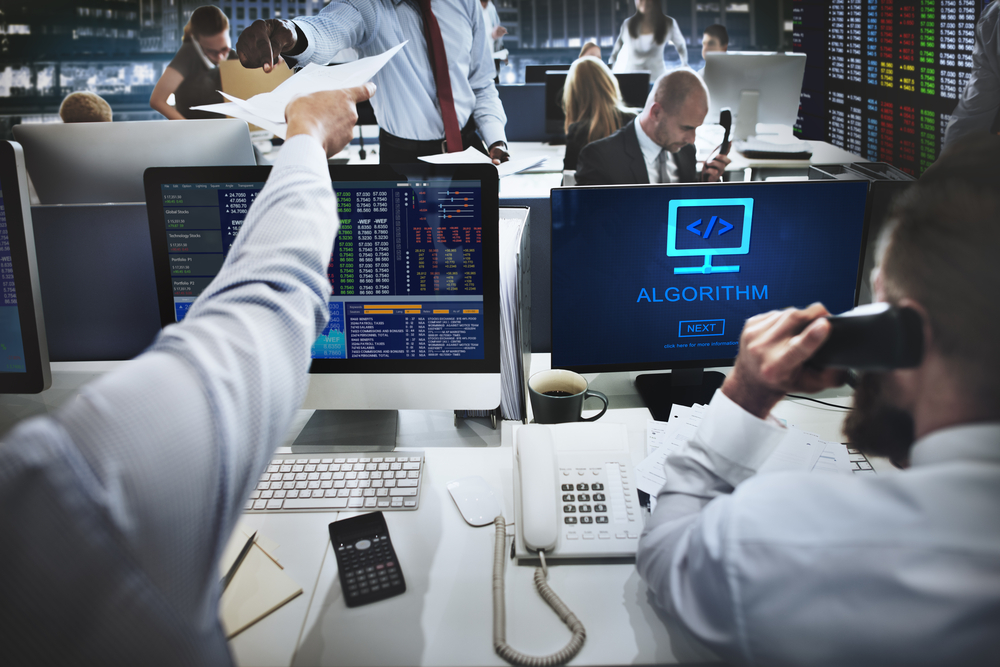
Algorithmic trading is changing market execution. It replaces some human discretion with rule-based, data-driven decisions.
Algorithmic trading platforms can execute trades faster than manual traders. They can also reduce latency and improve consistency.
Traders who apply technical strategies can identify opportunities that manual trading might miss. The meaning of algorithmic trading goes beyond automation. It uses mathematical models, statistical analysis, and real-time data to detect patterns and execute trades consistently.
Unlike traditional trading, these algorithms follow predefined rules, ensuring objective, precise decisions—critical in high-frequency trading, where milliseconds matter.
What is algorithmic trading?
At its essence, algorithmic trading refers to the use of automated systems to execute trades based on predefined criteria. This is not only about speed. It is also about precision.
Human traders often struggle with emotional reactions, such as fear or greed, which can lead to costly mistakes.
Algorithmic trading reduces the human element in execution. Automated trading Platforms analyse market data in real time and place orders automatically.
This method can reduce common execution mistakes. It helps limit impulsive decisions, fatigue-related errors, and simple miscalculations.
Beyond removing human error, algorithmic trading excels at capitalising on rare or special events that might not be immediately apparent to human traders.
Another key advantage of algorithmic trading is its ability to supplement existing strategies rather than replace them entirely. Many traders use a combination of fundamental analysis and technical indicators to inform their decisions. Algorithmic trading can then act as a complementary tool, executing trades based on those informed signals with the precision of a machine.
Remove human error
Human traders are prone to cognitive biases, emotional fluctuations, and fatigue, all of which can lead to suboptimal trading decisions. Algorithmic trading eliminates these vulnerabilities by executing trades based on predefined rules and data-driven logic.
Beyond eliminating human error, algorithmic trading also reduces the risk of emotional decisions. Fear and greed often drive impulsive decisions. In volatile markets, panic selling or impulsive buying can increase losses.
Algorithmic systems, on the other hand, follow strict rules, ensuring trades are executed based on objective criteria rather than emotional reactions. This consistency is particularly valuable in high-stakes environments where emotions can quickly escalate.
Another way algorithmic trading reduces human error is by automating repetitive tasks.
Capitalize on rare or special events
One advantage of algorithmic trading is the ability to react quickly to specific signals. It can respond to events that human traders may miss in real time.
These events can range from news releases and earnings reports to geopolitical shifts or even unexpected market anomalies. Algorithmic systems are designed to detect these signals in real time and react accordingly, often before the market fully adjusts.
Supplement your existing strategy
Algorithmic trading doesn’t have to replace traditional trading methods—it can serve as a powerful supplement to enhance existing strategies. Many traders use a combination of fundamental analysis, technical indicators, and market sentiment analysis to inform their decisions. Algorithmic trading can then act as a complementary tool, executing trades based on those informed signals with the precision of a machine.
Why use algorithmic trading?
The decision to adopt algorithmic trading is driven by several key advantages that set it apart from traditional trading methods. One of the most significant benefits is the low maintenance required. Unlike manual trading, which demands constant attention and quick reflexes, algorithmic trading systems operate autonomously. Once a strategy is set up, the algorithm handles the execution, allowing traders to focus on refining their approach rather than managing the day-to-day operations.
Another major advantage is the ability to backtest strategies effectively. Algorithmic trading platforms provide the tools to simulate trades using historical data, enabling traders to evaluate the performance of their strategies across various market conditions. This backtesting capability is invaluable for identifying strengths and weaknesses in a trading approach before risking real capital. By testing strategies in a controlled environment, traders can make informed decisions about which algorithms to deploy in live markets.
Low maintenance
One of the most compelling reasons to use algorithmic trading is its low maintenance requirements. Unlike manual trading, which demands constant attention and quick reflexes, algorithmic trading systems operate autonomously. Once a strategy is set up, the algorithm handles the execution, allowing traders to focus on refining their approach rather than managing the day-to-day operations. This shift from active management to passive execution is a game-changer for traders who want to maximise their time and resources.
Backtest
Backtesting is essential in algorithmic trading. It helps traders evaluate and optimise strategies using historical data before risking real capital.
Simulate Past Trades: Test strategies against historical market conditions to gauge potential performance.
Assess Risks & Rewards: Identify strengths and weaknesses to make informed deployment decisions.
Refine Strategies: Adjust algorithms for different market scenarios to ensure adaptability.
Optimise Real-World Performance: Improve strategy effectiveness beyond theoretical potential.
Increased opportunity with instant execution
One of the most significant advantages of algorithmic trading is its ability to capitalise on real-time opportunities. In fast-moving markets, speed matters. Human traders may not react quickly enough to capture short-lived opportunities.
Algorithmic trading systems, however, can execute trades at speeds far exceeding human capabilities, ensuring traders don’t miss out on potential profits.
This instant execution is particularly valuable in high-frequency trading (HFT), where traders execute thousands of trades per second. By leveraging algorithmic trading, even retail traders can compete with institutional players who have access to advanced infrastructure.
What are the main algorithmic trading strategies?
Algorithmic trading encompasses a wide range of strategies, each designed to exploit different market dynamics. Understanding these strategies is essential for traders looking to implement trading strategies effectively. Below, we explore some of the most common and effective approaches used in modern trading.
Trend-Following Strategies
Trend-following strategies are among the most popular in algorithmic trading, as they capitalise on the momentum of existing price movements. These strategies assume the trend will continue in the same direction and aim to ride the wave of market movement.
One common trend-following strategy is the use of moving averages to determine entry and exit points. For instance, a trader might set up a strategy where they enter a long position when the price crosses above a 200-day moving average, indicating a strong upward trend. Conversely, they might exit the position when the price crosses below the moving average, signalling a potential reversal. This approach is particularly effective in trending markets, where prices move in a consistent direction for extended periods.
Another variation of trend-following strategies involves using relative strength indicators (RSI) to confirm the strength of the trend.
Arbitrage Opportunities
Arbitrage is a strategy that exploits price differences between different markets or exchanges. The idea is simple: buy an asset at a lower price in one market and sell it at a higher price in another, profiting from the price discrepancy. Algorithmic trading makes this process much more efficient by automating trade execution across multiple platforms.
Arbitrage strategies can be further categorised into statistical arbitrage, which involves identifying price discrepancies between related assets, and tri-party arbitrage, which involves trading across different currencies or commodities. Algorithmic trading platforms are well-suited for these strategies, as they can execute trades at lightning speed and manage the risk associated with market volatility.
Index Fund Rebalancing
Index fund rebalancing is another common algorithmic trading strategy that maintains an index fund’s composition according to predefined rules. Index funds are designed to track the performance of a specific market index, such as the S&P 500 or the Nasdaq Composite. However, over time, the index’s composition may change due to mergers, acquisitions, or delistings.
Algorithmic trading systems can automate index fund rebalancing by monitoring the index’s composition and adjusting the portfolio as needed. This strategy is particularly valuable for institutional investors who need to ensure their portfolios remain aligned with the index they track.
Mathematical Model-Based Strategies
Mathematical model-based strategies are at the core of algorithmic trading, as they rely on statistical analysis, probability theory, and machine learning to identify trading opportunities. These strategies are designed to exploit patterns and anomalies in market data that may not be apparent to human traders.
Trading Range (Mean Reversion)
Trading range or mean reversion strategies assume that prices tend to revert to their historical average over time. These strategies are based on the idea that extreme price movements are temporary and that the market will eventually correct itself. Algorithmic trading systems can identify when the price is deviating significantly from its mean and enter trades to capitalise on the expected reversal.
Volume-Weighted Average Price (VWAP)
Volume-Weighted Average Price (VWAP) is a popular benchmark used in algorithmic trading to measure the average price of an asset based on its trading volume. VWAP is particularly useful for institutional traders who need to execute large trades while minimising market impact. Algorithmic trading systems can use VWAP to determine optimal entry and exit points, ensuring trades are executed in line with the asset’s historical trading behavior.
Additionally, VWAP can support mean-reversion analysis. For example, traders may combine VWAP with Bollinger Bands or standard deviation measures:
Beyond Bollinger Bands and standard deviation, traders often use other statistical tools to refine mean-reversion strategies.
Another sophisticated approach involves autocorrelation analysis, which examines how past price movements correlate with future ones. By identifying periods when price deviations from the mean tend to persist, traders can adjust their entry and exit rules to capture reversals more effectively.
Time-Weighted Average Price (TWAP)
Time-Weighted Average Price (TWAP) helps traders, especially institutions, execute large orders smoothly over time, minimising market impact and slippage.
Time-Based Execution: Divides total order value evenly across a set period, independent of volume.
Ideal for Block Trades: Reduces sudden price spikes or drops in large orders.
Automated Platforms: Algorithmic trading systems break orders into smaller increments for efficiency.
Dynamic Rebalancing: Adjusts execution in real time based on market conditions for flexibility.
Percentage of Volume (POV)
Percentage of Volume (POV) is a lesser-known but highly effective algorithmic trading strategy that focuses on the proportion of an asset’s volume relative to its total volume. The idea behind POV is simple: trades executed at higher percentages of total volume are often more significant and can provide better entry or exit points. By analysing the volume distribution, traders can identify key levels where the market is most likely to react.
Implementation Shortfall
Implementation shortfall is a critical concept in algorithmic trading that measures the difference between the expected return of a trade and the actual return experienced due to market impact, slippage, and other execution-related costs. Unlike traditional trading, where execution costs are often overlooked, algorithmic trading systems must account for these inefficiencies to ensure profitability. Implementation shortfall measures the gap between expected and actual trade results. It reflects execution costs such as slippage and market impact.
Algorithmic trading platforms use sophisticated algorithms to minimise implementation shortfall by optimising execution strategies. One common approach is order routing, where the algorithm selects the most efficient exchange or market maker to execute trades. Another strategy is dynamic order sizing, in which the algorithm adjusts the size of each order based on real-time market conditions, ensuring trades are executed at the best possible price.
Technical Requirements for Algorithmic Trading
ProRealTime
ProRealTime is a popular choice among algorithmic traders for its advanced charting, technical analysis tools, and backtesting capabilities. ProRealTime is a charting and automated trading platform offering backtesting and strategy tools. Its user-friendly interface makes it accessible to both novice and experienced traders, while its powerful features enable sophisticated algorithmic trading.
One of the standout features of ProRealTime is its automated strategy builder, which lets traders create and test trading algorithms without writing complex code. This tool enables users to define entry and exit rules, backtest strategies using historical data, and even deploy live strategies with minimal setup. ProRealTime also supports multi-asset trading, enabling traders to develop and test strategies across markets such as stocks, forex, futures, and cryptocurrencies.
Automated trading
Automated trading is the cornerstone of algorithmic trading, enabling traders to execute trades based on predefined rules without constant human intervention. The process involves developing a trading algorithm that analyses market data, identifies trading opportunities, and executes trades automatically. This automation not only enhances speed and consistency but also reduces the risk of human error, emotional biases, and fatigue.
The implementation of automated trading typically involves several key steps:
1. Strategy Development: Traders define the trading rules and criteria for entering and exiting positions. This can include technical indicators, price levels, volume thresholds, or other market conditions.
2. Backtesting: The strategy is tested using historical data to evaluate its performance under various market conditions. This step helps identify strengths, weaknesses, and potential risks before deploying the strategy live.
3. Risk Management: Automated trading systems must incorporate robust risk management protocols, such as stop-loss orders, position sizing, and leverage controls, to mitigate losses and ensure sustainability.
4. Integration with Trading Platforms: The algorithm is integrated with a trading platform or brokerage that supports automated trading. This may involve using APIs, trading bots, or specialised algorithmic trading software.
5. Monitoring and Optimisation: Once deployed, the automated trading system requires ongoing monitoring to ensure it continues to perform as expected. Traders may need to adjust parameters, backtest new strategies, or refine existing ones based on real-time performance data.
Advanced automated trading systems can also incorporate machine learning and artificial intelligence (AI) to enhance decision-making.
Application Programming Interfaces
APIs (Application Programming Interfaces) play a crucial role in enabling seamless communication between trading platforms, data providers, and algorithmic trading systems. APIs allow developers to access real-time market data, execute trades, and manage accounts programmatically. This integration is essential for building custom algorithmic trading solutions that can interact with multiple exchanges, brokers, and data feeds.
There are several types of APIs commonly used in algorithmic trading:
1. Market Data APIs: These APIs provide real-time or delayed market data, including price quotes, order books, trade history, and fundamental data. Examples include APIs from brokers such as Interactive Brokers and TD Ameritrade, as well as from financial data providers such as Bloomberg, Refinitiv, and Yahoo Finance.
2. Order Execution APIs: These APIs enable traders to place, modify, and cancel orders programmatically. They often include features like limit orders, market orders, stop-loss orders, and conditional orders. For example, the Interactive Brokers API allows traders to execute trades in multiple markets with a single code.
3. Account Management APIs: These APIs provide access to account information, such as balance, positions, and transaction history. They are useful for managing funds, tracking performance, and automating account updates.
4. Custom APIs: Traders can also develop their own APIs to integrate with third-party tools, data providers, or specialised trading platforms. For instance, a trader might create an API to connect their algorithmic trading system with a proprietary data feed or a machine learning model.
Choosing an API depends on your needs and budget. It also depends on how complex your strategy is.
Some APIs offer free tiers with limited functionality, while others require subscription fees or have restrictions on trading volume. It’s important to carefully evaluate an API’s terms, performance, and reliability before integrating it into an algorithmic trading system.
How Algorithmic Trading Works
Algorithmic trading operates on a structured framework that combines data analysis, automation, and real-time execution. Understanding how these components work together is key to leveraging the full potential of algorithmic trading. Below is a breakdown of the process, from data collection to trade execution.
Algo-Trading Time Scales
Algorithmic trading strategies can be categorised by the time scales on which they operate, ranging from high-frequency trading (HFT) to long-term investment strategies. Each time scale presents unique opportunities and challenges, requiring tailored approaches to data analysis, execution, and risk management.
1. High-Frequency Trading (HFT): HFT strategies execute trades within milliseconds or microseconds, often leveraging low-latency infrastructure and advanced algorithms to capitalize on tiny price movements. These strategies are typically based on arbitrage opportunities, market making, or statistical arbitrage. HFT systems require ultra-fast data feeds, specialised hardware, and sophisticated risk management protocols to mitigate losses from adverse market conditions.
2. Scalping: Scalping is a short-term strategy that focuses on capturing small price movements over minutes or seconds. Scalpers use tight stop-loss orders and rapid rebalancing to profit from minor fluctuations. Algorithmic scalping often involves automated order routing, dynamic position sizing, and real-time market data analysis to identify short-lived opportunities.
3. Day Trading: Day trading strategies execute trades within a single trading day, aiming to profit from intraday price movements. Algorithmic day traders use a combination of technical indicators, order flow analysis, and real-time market data to identify entry and exit points. These strategies often involve automated execution, backtesting, and risk management tools to ensure profitability.
4. Swing Trading: Swing trading strategies hold positions for days or weeks, capitalising on medium-term price trends. Algorithmic swing traders use moving averages, RSI, and other indicators to identify trend reversals or continuations. These strategies benefit from automated backtesting and risk management to adapt to changing market conditions.
5. Position Trading: Position trading strategies hold positions for months or years, focusing on long-term trends and fundamental analysis. Algorithmic position traders use statistical models, machine learning, and fundamental data to identify high-probability trades. These strategies require robust risk management and periodic strategy optimisation to ensure sustainability.
6. Long-Term Investing: While not strictly algorithmic, long-term investing strategies can be enhanced with algorithmic tools for portfolio management and rebalancing. Algorithmic portfolio managers use statistical arbitrage, index fund rebalancing, and risk-adjusted return models to optimise asset allocation and manage risk over extended periods.
Example of Algorithmic Trading
To illustrate how algorithmic trading works in practice, let’s consider a simple yet effective example: a mean reversion strategy using Bollinger Bands and VWAP. This strategy combines technical indicators to identify overbought and oversold conditions while ensuring trades are executed at optimal times using VWAP.
Step 1: Data Collection
The algorithm begins by collecting real-time market data for a specific stock, including price, volume, and historical data. In this example, the stock is ABC Corp., trading on the NYSE.
Step 2: Indicator Setup
The algorithm sets up two key indicators:
Bollinger Bands: A volatility-based indicator that includes a moving average (middle band) and two standard deviation bands (upper and lower bands).
Volume-Weighted Average Price (VWAP): A benchmark that reflects the average price of the stock based on its trading volume.
Step 3: Entry and Exit Rules
The algorithm defines the following rules:
Long Entry: When the price touches the upper Bollinger Band, and the volume exceeds a predefined threshold (e.g., 20% of total volume), the algorithm enters a long position.
Long Exit: When the price crosses below the VWAP line, the algorithm exits the long position.
Short Entry: When the price touches the lower Bollinger Band, and the volume exceeds the predefined threshold, the algorithm enters a short position.
Short Exit: When the price crosses above the VWAP line, the algorithm exits the short position.
Step 4: Execution
The algorithm executes the trades automatically using the selected broker’s API. For example:
If the price of ABC Corp. touches the upper Bollinger Band and there is high volume, the algorithm places a market order to buy the stock.
If the price subsequently crosses below VWAP, the algorithm closes the position, ensuring the trade is completed at an optimal price.
Step 5: Risk Management
To mitigate risks, the algorithm incorporates the following measures:
Stop-Loss Orders: A fixed stop-loss is set at 5% below the entry price for long positions and 5% above for short positions.
Position Sizing: The size of each trade is adjusted based on the trader’s risk tolerance and account size, ensuring that no single trade exceeds a predefined percentage of the total capital.
Step 6: Monitoring and Optimisation
Once deployed, the algorithm continuously monitors market conditions and adjusts its parameters as needed. For example:
If the strategy underperforms during a volatile market, the algorithm may adjust the Bollinger Bands’ period or the volume threshold to improve performance.
Real-time performance data is analysed to ensure the strategy remains profitable and adaptable.
FAQs
What does algorithmic trading mean?
Algorithmic trading refers to the use of computer programs and predefined rules to execute trades automatically in financial markets. These algorithms analyse data, identify opportunities, and place orders faster than manual trading.
How do algorithmic trading algorithms work?
Algorithmic trading algorithms follow specific instructions based on price, volume, timing, or technical indicators. Once conditions are met, the system automatically executes buy or sell orders without human intervention.
What are the most common algorithmic trading strategies?
Popular algorithmic trading strategies include trend-following, arbitrage, mean reversion, market-making, and momentum trading. Each strategy relies on data analysis and automated execution to capture market opportunities.
What is an algorithmic trading platform?
An algorithmic trading platform is software that allows traders to create, test, and run trading algorithms. These platforms provide market data, backtesting tools, and automated order execution features.