
Stock trading gives individuals access to price movements in publicly listed companies, but beginners need to understand exactly what they are trading before placing an order. Buying real shares, investing for the long term, and trading stock CFDs are not the same activity, even when the same company names and market prices appear on a platform. This guide explains stock trading for beginners in practical terms: how the market works, what moves stock prices, the main trading styles, how risk is managed, and how to start in a structured way. It also explains where stock CFDs differ from direct share ownership so expectations remain clear from the beginning.
What Is Stock Trading?
Stock trading is the activity of buying and selling exposure to publicly listed companies with the aim of responding to changes in market prices. In traditional share trading, a trader buys actual shares and becomes a shareholder in the company. Depending on the share class and local rules, direct ownership may provide rights such as voting and eligibility for declared dividends.
Trading can also be done through derivatives such as Contracts for Difference, or CFDs. A stock CFD follows the price movement of the underlying share, but the trader does not own that share. Instead, the trader opens a position based on whether the price is expected to rise or fall. This distinction matters because ownership rights, costs, leverage, short exposure, and risk can differ significantly.
For beginners, the first goal should not be predicting the next winning stock. It should be understanding the instrument, the platform, the order being placed, and the amount of capital at risk. Stock trading becomes much easier to evaluate once those four points are clear.
Stock Trading vs. Stock Investing
The terms “trading” and “investing” are often used as if they mean the same thing, but they usually describe different objectives. Stock traders generally focus more on price movement over shorter or medium timeframes. Investors usually focus on business ownership, long-term growth, dividends, and portfolio development over years.
| Factor | Stock Trading | Stock Investing |
| Main objective | Capture price movements | Build long-term ownership and capital growth |
| Typical timeframe | Minutes, days, weeks, or months | Years or decades |
| Decision focus | Price action, catalysts, momentum, technical or fundamental signals | Business quality, valuation, earnings, long-term prospects |
| Activity level | Usually higher | Usually lower |
| Main risks | Volatility, timing, leverage, overtrading, execution | Business risk, valuation risk, market declines, concentration |
| Ownership | Depends on instrument used | Usually direct ownership when real shares are purchased |
Neither approach is automatically better. The more useful question is whether the method matches the trader’s objective, time horizon, knowledge, and risk tolerance. A beginner who wants long-term ownership should not accidentally choose a leveraged derivative simply because the platform displays a familiar stock name.
Real Stock Ownership vs. Stock CFDs
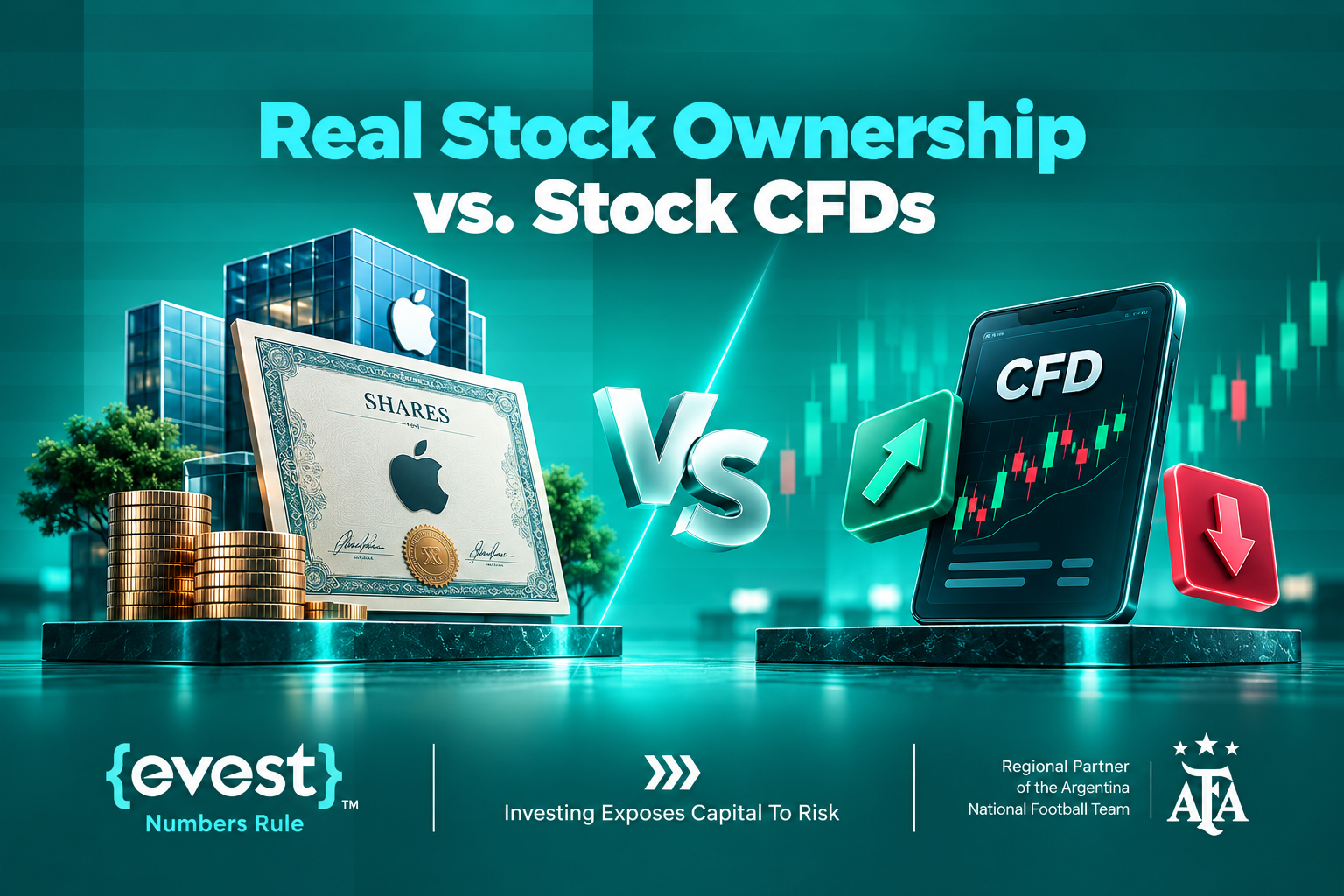
This is one of the most important distinctions in stock trading for beginners. Real shares and stock CFDs can reference the same company, but they are different financial instruments.
| Feature | Real Stock Ownership | Stock CFD Trading |
| Do you own the underlying share? | Yes | No |
| Shareholder voting rights | May apply depending on the share class | No direct shareholder voting rights |
| Dividends | Eligible shareholders may receive declared dividends | Cash adjustments may apply according to broker terms |
| Ability to use leverage | Depends on account and jurisdiction | Often available, increasing both exposure and risk |
| Short exposure | Usually requires a borrowing or margin process | A sell position can provide downward price exposure without borrowing the actual share |
| Settlement | Real securities follow the applicable market settlement cycle | CFD positions are derivative contracts rather than transferred share ownership |
| Main cost considerations | Commission, spread, taxes, custody or other broker fees | Spread, financing or product-specific fees, and other broker charges |
In the United States, the standard settlement cycle for most broker-dealer securities transactions moved from T+2 to T+1 on May 28, 2024. That means most covered securities settle one business day after the trade date. This rule relates to real securities transactions; it should not be used to describe the mechanics of a CFD position.
The practical lesson is simple: always check what the platform is actually offering. “Trade Apple,” for example, can mean buying Apple shares through one broker and trading a CFD that tracks Apple’s price through another. The screen may look similar while the legal and economic exposure is different.
How Does Stock Trading Work?
Stock prices are formed in markets where buyers and sellers continuously submit orders. Major exchanges such as the New York Stock Exchange and Nasdaq provide marketplaces for listed securities, while brokers and trading platforms give clients access to market prices and order execution. With CFDs, the platform provides derivative exposure based on the underlying market rather than transferring ownership of the share itself.
Every tradable market has two important quoted prices: the bid and the ask. The bid is the price at which the market is willing to buy, while the ask is the price at which it is willing to sell. The difference is the spread. A narrower spread generally means a lower immediate trading friction, while a wider spread makes a position start further away from break-even.
Beginners should also understand the main order types before trading with real money:
- Market order: aims to execute quickly at the best available price, but the final execution price can differ in fast markets.
- Limit order: executes only at the chosen price or better, giving more price control but no guarantee of execution.
- Stop order: activates when a specified trigger price is reached and is often used to enter or exit after a market moves.
- Stop-loss order: is designed to close or reduce a position when price reaches a predefined risk level, although slippage can occur.
- Take-profit order: is designed to close a position when a predetermined favorable price level is reached.
Once an order is executed, the position will gain or lose value as the market moves. A long position benefits if price rises and loses if price falls. A short position is the opposite. With leveraged products such as CFDs, relatively small market moves can have a larger effect on the trader’s account, which is why position sizing is more important than simply choosing a direction.
What Moves Stock Prices?
Stock prices change because market participants continuously reassess what a company may be worth and what they are willing to pay for it. A price move rarely has only one cause. Short-term changes can reflect news and trading flows, while longer-term trends may reflect earnings, growth, valuation, industry conditions, interest rates, and broader economic expectations.
Common price drivers include:
- Company earnings, revenue, margins, forecasts, and management guidance.
- Product launches, acquisitions, leadership changes, lawsuits, or regulatory decisions.
- Economic data such as inflation, employment, growth, and interest-rate expectations.
- Sector trends that affect groups of companies at the same time.
- Market sentiment, liquidity, positioning, and unexpected global events.
- Valuation expectations: even strong companies can fall if the market expected stronger results.
This is why a stock can report higher profits and still decline. Markets do not react only to whether news is “good” or “bad”; they react to the difference between actual information and what participants had already expected.
Main Stock Trading Styles
A trading style is mainly defined by timeframe, decision frequency, and the type of market movement the trader is trying to capture. Beginners should understand the differences before choosing a strategy.
- Day trading involves opening and closing positions within the same trading day. It demands close monitoring, strict risk control, fast execution, and the ability to make decisions under pressure. It should not be presented as an easy shortcut to regular income.
- Swing trading usually holds positions for several days or weeks. Swing traders try to capture larger directional moves than day traders and may combine chart analysis with company or market catalysts. It often requires less screen time than intraday trading but still involves overnight and gap risk.
- Position trading holds trades for weeks or months and focuses on larger trends. It can use technical and fundamental analysis, but it remains different from long-term investing when the primary objective is to trade a market trend rather than own a business for years.
Options, margin, and leveraged CFDs are not separate “trading styles.” They are instruments or account mechanisms that can change exposure and risk. Beginners should learn the core market process first before adding leverage or complex derivatives.
Risk Management for Stock Trading Beginners
Risk management is the part of trading that determines whether a bad decision becomes a manageable loss or a serious account problem. No analysis method removes uncertainty. Even a well-researched trade can move in the wrong direction.
A beginner should define risk before entering a position, not after the market turns against it. This means deciding the maximum acceptable loss, choosing a position size that fits that limit, and identifying the price or condition that invalidates the trade idea.
A practical beginner risk framework includes:
- Risk only money that is not needed for essential expenses or short-term obligations.
- Keep position size small enough that one losing trade does not materially damage the account.
- Avoid increasing a losing position simply because the price is lower.
- Understand leverage before using it; leverage magnifies losses as well as gains.
- Use predefined exit rules instead of making decisions only after emotions increase.
- Review total exposure across correlated stocks, sectors, and markets rather than viewing each trade in isolation.
Diversification can reduce concentration risk, but it is not a guarantee against loss. Stop-loss orders can help manage planned risk, but they cannot promise an exact exit price during gaps or fast markets. The goal is not to eliminate risk; it is to make risk visible, limited, and intentional.
How to Start Stock Trading?
A structured starting process is more useful than immediately searching for “the best stock to buy.” Beginners can use the following sequence to build knowledge before committing significant capital.
- Define the objective. Decide whether the goal is active trading, long-term investing, or learning how markets behave. This choice affects the account type, instruments, timeframe, and risk process.
- Learn the instrument. Confirm whether the platform offers real shares, CFDs, or both. Read how ownership, leverage, short positions, dividends or adjustments, spreads, commissions, and financing work.
- Choose a regulated platform that fits the objective. Review regulation, available markets, fees, execution model, order types, risk controls, educational tools, account protections, and the terms that apply in your jurisdiction.
- Practice in a demo or simulator. Use virtual funds to learn order placement and platform behavior. A demo account removes real-money loss, but it cannot fully reproduce the emotions and execution conditions of live trading.
- Build a simple trading plan. Define the setup you will trade, entry condition, invalidation point, maximum risk, target or exit process, and rules for avoiding impulsive trades.
- Start small and review every trade. Keep a journal that records the reason for entry, position size, risk, result, and whether the original plan was followed. The quality of the decision process matters more than one winning or losing trade.
The purpose of these steps is not to create confidence from excitement. It is to create confidence from understanding what happens before, during, and after a trade.
Stock Trading with Evest: What Beginners Should Know?
For this page, product accuracy is important. Evest’s current help center states that stock trading on Evest is offered through Contracts for Difference. That means clients speculate on stock price movements without owning the underlying shares. Evest also currently states that CFD stock trading is offered with 0% trading commission and that stock positions are not charged swap fees. Other costs, including the spread and account-related charges, can still matter and should be reviewed before trading.
Because Evest stock trading is CFD-based, a sell position should not be explained as the traditional process of borrowing real shares and selling them short. In a stock CFD, the trader opens a sell contract that gains value if the referenced price falls and loses value if it rises. The underlying share is not transferred to the trader.
Evest also provides a demo environment, which can be useful for learning platform mechanics before using real funds. A demo account reduces financial risk during practice, but it does not remove the need to understand leverage, spreads, execution, and live-market psychology.
For Islamic account options, Evest states that the accounts are interest-free and that trades held open for three days or more may incur a Sharia commission according to the applicable account schedule. Traders who require religious compliance should review the latest terms and seek qualified guidance rather than assuming that every trade is automatically permissible because the account is labeled Islamic.
Common Stock Trading Mistakes to Avoid
Many beginner mistakes are process problems rather than market-analysis problems. A trader can have a reasonable idea and still lose more than necessary through poor sizing, excessive leverage, or emotional execution.
The most common mistakes include:
- Trading without knowing whether the product is a real share or a derivative.
- Risking too much capital on one idea or using leverage without understanding its effect.
- Chasing a fast-moving stock after the original entry opportunity has already passed.
- Moving a stop-loss further away simply to avoid accepting a planned loss.
- Overtrading after a win, a loss, or a period of boredom.
- Ignoring spreads, commissions, financing, currency conversion, taxes, or other applicable costs.
A trading journal helps expose these patterns. If losses repeatedly come from breaking rules rather than from the strategy itself, changing indicators will not solve the real problem.
How to Choose a Stock Trading Platform?
A beginner-friendly platform should make the product and its risks easier to understand, not harder. Low advertised commissions can be useful, but they are only one part of total trading cost and platform suitability.
Before opening a live account, check:
- What exactly is being traded: real shares, CFDs, or another derivative.
- Which regulator and legal entity serves your jurisdiction.
- Spreads, commissions, financing, conversion, inactivity, withdrawal, and other fees.
- Available order types, stop-loss tools, and leverage settings.
- Demo access, educational material, charts, market data, and customer support.
- Deposit and withdrawal procedures, account verification, and relevant protection rules.
The right platform is the one whose instrument, costs, regulation, and functionality match the user’s actual objective. A sophisticated interface does not compensate for misunderstanding the product.
FAQs
What is stock trading?
Stock trading is buying and selling exposure to publicly listed companies to respond to price movements. With real shares, the buyer owns part of the company. With stock CFDs, the trader follows price changes without owning the underlying shares.
How do beginners start stock trading?
Beginners should first learn how stocks, orders, spreads, and risk work. Next, choose a regulated platform, confirm whether it offers real shares or CFDs, practice using a demo account, create a simple trading plan, and start with limited risk.
What is the difference between stock trading and investing?
Stock trading usually focuses on shorter-term price movements and more frequent decisions, while investing generally involves holding real assets for longer periods based on business growth, valuation, income, or portfolio goals. The appropriate approach depends on objectives and risk tolerance.
Can I trade stocks without owning them?
Yes. Stock CFDs allow traders to gain exposure to rising or falling share prices without owning the underlying stock. CFDs are leveraged derivatives, so their risks, costs, ownership rights, and trading mechanics differ from purchasing real shares through a brokerage account.
Is stock trading risky for beginners?
Yes. Stock prices can move quickly, and leveraged products can magnify losses. Beginners can reduce avoidable risk by learning the instrument, limiting position size, using a predefined exit plan, practicing first, and never trading money needed for essential expenses.