Snowflake Stock: Cloud Growth Amid Fierce Competition – A Comprehensive Analysis: Snowflake’sstock has been attracting increasing attention from tech sector investors.
It has emerged as a leading cloud-based data storage and analytics player amid a rapidly evolving and competitive market.
Snowflakeis one of the most prominent newcomers in the cloud data space.
It went public in September 2020 in one of the largest IPOs in Wall Street history.
Traded on the NYSE under the ticker SNOW, the company has gained popularity
for its subscription-based business model and rapid revenue growth.
Despite recent tech market fluctuations, Snowflake remains a compelling choice in the cloud software segment.
Key Competitors
Despite its innovative unified data platform, Snowflakefaces stiff competition from tech giants, including:
Amazon Web Services (AWS) – Redshift
Microsoft Azure – Synapse Analytics
Google Cloud Platform – BigQuery
It also competes with up-and-coming firms like Databricks, which is nearing an IPO and targeting similar clientele.
Trading Strategy & Technical Outlook
SNOWstock is often approached with a long-term growth strategy. Key factors investors monitor include:
Customer base expansion Usage metrics of Snowflake’s cloud services
Global market penetration
Quarterly earnings performance
Technically, the stock exhibits volatility and reacts strongly to earnings reports and market sentiment,
making it suitable for active traders and strategic investors.
Company Analysis & Financial Performance
Snowflakehas shown impressive double-digit revenue growth and gradually
narrowing operating losses due to improved cost management. Key performance indicators:
Over 30% annual revenue growth
A robust portfolio of enterprise clients
Continued investment in innovation and AI
While the company is not yet profitable, many investors believe in its long-term potential
as demand for cloud and big data solutions continues to rise.
Conclusion
Snowflakestock offers a promising investment opportunity in the cloud software,
especially for long-term growth investors. With intense competition and a clear expansion strategy,
Snowflake remains a standout player in the data-driven future.
What is the Dollar Index and How Does It Affect the Markets? In the world of trading and financial analysis,
the U.S. Dollar Index (DXY) is a key tool used by traders
to assess the strength of the U.S. dollar against global currencies.
Understanding this index gives you a strategic advantage when trading currencies and commodities,
particularly goldand oil.
In this article from Evest, we explain what the index is, what it measures,
its importance, its relationship with gold, and how you can trade it easily on our platform.
The term “index” in financial markets refers to a tool or measurement
used to track the performance of a group of financial assets
such as stocks, currencies, or commodities—over a specific time period.
A financial index is a statistical figure representing a selected asset group’s overall value.
This helps investors monitor market movements and evaluate general trends.
What is the U.S. Dollar Index (DXY)?
The U.S. Dollar Index (DXY) is a financial instrument used to measure
the value of the U.S. dollar against a basket of global currencies.
Think of it as a scale that reflects the strength or weakness
of the dollar relative to a group of major world currencies.
The index was introduced in 1973 by the U.S. Federal Reserve after
the dollar was unpegged from gold to provide a structured way to track the dollar’s value in the global market.
Which Currencies Make Up the Dollar Index?
The DXYcomprises six major currencies representing the United States’ key trading partners.
These are used to measure the dollar’s strength against them.
The basket includes the euro(EUR), which holds the largest weight at around 57.6%,
followed by the Japanese yen (JPY), British pound (GBP), Canadian dollar (CAD), Swedish krona (SEK), and Swiss franc (CHF).
The index is calculated based on specific weightings for each currency,
which means they do not all have equal influence on the index’s value.
This weighting system makes the index an accurate reflection of the dollar’s performance in the global market.
How Does the Dollar Index Work?
When the index rises, it indicates that it is strengthening against other currencies.
Conversely, when the index falls, it means the index is weakening,
and other currencies are gaining strength.
For example, if the euro, yen, and pound rise against the dollar,
the index will drop. If those currencies weaken against the dollar, the index will climb.
Why is the Dollar Index Important for Traders?
The DXYis a vital tool for traders due to its wide impact on financial markets and asset behavior.
First, it serves as a direct measure of dollar strength or weakness.
A rising index signals a stronger dollar, while a falling index indicates a weaker one.
The index also directly influences the prices of several assets:
Gold typically moves inversely to the index.
Oil is priced in dollars globally, so it reacts to dollar movements.
Forex pairs such as EURUSDand GBPUSD are directly impacted by changes in the index.
Moreover, the DXY helps traders understand the direction of U.S. monetary policy,
as it responds strongly to Federal Reserve decisions.
Traders use it as a tool for speculation (via CFDs) and hedging against dollar-related volatility in other assets.
It also reflects global economic trends, so it is closely followed by investors and institutions worldwide.
The Relationship Between the Dollar Index and Gold
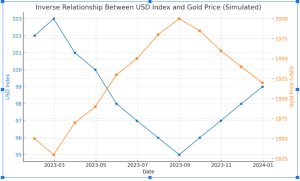
There is a well-known inverse relationship between the Dollar Index and gold prices.
Gold tends to fall when the dollar strengthens and the index rises.
When the dollar weakens and the index drops, gold prices often rise.
This inverse correlation is considered a key indicator in financial analysis,
and many traders use it to predict market trends and make informed trading decisions.
In this illustrative chart, you can see the inverse relationship between the U.S. Dollar Index (USD Index) and the price of gold: When the Dollar Index (blue line) declines, we often observe a rise in gold prices (orange line). Conversely, when the index rises, gold tends to decline. This relationship is considered one of the key indicators in financial analysis,
as traders use it to anticipate market movements and make informed trading decisions.
How to Trade the Index with Evest
With the Evest platform, you can easily trade the U.S. Dollar Index through Contracts for Difference (CFDs).
This allows you to speculate on the movement of the index without owning the actual asset.
Key benefits of trading with Evest include:
Zero-commission accounts on indices
Fast trade execution
Advanced charting and technical analysis tools
Excellent customer support
Easy-to-use platform on both mobile and web
Benefits of Trading the Index
Trading the DXY offers a smart way to diversify your investment portfolio.
Instead of relying on a single asset, you’re trading the dollar’s performance against a group of currencies,
which helps reduce risk—especially during global market volatility.
For example, trading the Indexcan offer more balance and stability if you invest in gold or U.S. stocks.
The index responds quickly to economic and political events, creating frequent trading opportunities.
Whether the indexrises or falls, you can take advantage of both movements using CFDs.
Additionally, the DXY provides valuable insights into economic trends,
helping traders evaluate the impact of interest rate decisions, inflation data, and other key indicators.
Analysts use it as a guide to forecast movements in gold, oil, and forex markets.
Because forex trading is global, the DXY is available 24 hours a day,
five days a week, offering flexibility for traders in any time zone.
Challenges to Be Aware of When Trading the Dollar Index
Trading the DXYdoes come with risks. It can be highly volatile when major economic data,
such as employment reports, inflation figures, and GDP results, are released.
These events can cause sharp and unpredictable price movements, so traders must practice strict risk management.
Additionally, the index is very sensitive to Federal Reserve decisions.
Any changes in interest rates or monetary policy can significantly impact the DXY,
making it crucial to stay updated on Fed statements and economic guidance.
Lastly, trading the DXYrequires continuous monitoring and daily analysis.
It’s not just about buying or selling—it involves understanding the geopolitical and economic events that affect the index.
Successful traders combine technical and fundamental analysis to make informed decisions.
Conclusion
The Indexis a key financial instrument that measures
The dollar’s strength against a basket of global currencies.
It is a critical reference for traders and investors
when analyzing market movements and making strategic decisions,
Especially when trading currencies and commodities like gold and oil.
By understanding how the index works and reacts to economic events,
traders can use it as a core part of their strategy, whether for speculation or hedging.
With Evest, you can trade the Index easily and efficiently.
Start Now with Evest
If you’re looking for a powerful analytical tool and a smart trading opportunity,
the index is an ideal choice.
Start your trading journey with Evest today and enjoy a professional,
secure experience in the world of indices and currencies. Register now and trade with confidence on Evest!
What is the Dollar Index and How Does It Affect the Markets?
As the world shifts rapidly toward clean energy, Rivian emerges as a rising star in the electric vehicle (EV) sector.
But where does it really stand in the market—and is its stock worth watching?
Rivian (Ticker: RIVN) has seen major fluctuations since its IPO on the NASDAQ in November 2021.
It initially launched with a massive valuation exceeding $100 billion, making it one of the largest IPOs in the auto sector.
However, the stock has since come under pressure due to several factors:
Slower-than-expected production.
Rising operating costs.
Fierce market competition.
General volatility in tech stocks.
As of early 2025, RIVN trades between $11 and $16, down over 80% from its all-time high.
Despite this, many investors still see long-term potential—especially if the company improves margins and scales production efficiently.
Market Position and Competition
Despite challenges, Rivian holds a unique position in the EV space.
Its primary focus is on electric trucks and SUVs, a niche where Tesla hasn’t deeply ventured yet.
Tesla: Dominates the EV market, but focuses on sedans and crossovers.
Ford (F-150 Lightning): A direct rival in the electric pickup space.
GM (GMC Hummer EV): Competes in the high-end truck segment.
Lucid Motors and BYD: Competing in different vehicle categories.
Rivian’s competitive edge lies in its strong partnership with Amazon,
which placed an order for 100,000 electric delivery vans—offering stable revenue and long-term growth potential.
Trading Strategy
Thinking of investing or trading RIVN? Consider these approaches:
🔹 Long-Term Investors: RIVN could be a high-risk, high-reward play. If you believe in the long-term future of EVs—especially trucks—buying in at current levels and averaging down may be a smart strategy.
🔹 Short-Term Traders: The stock is highly volatile, ideal for swing trades. Use technical indicators like RSI and MACD for entries and exits. Avoid trading during earnings or major news.
🔹 Watch Closely: Monitor production updates, cash flow reports, Amazon order execution, and any new model announcements or partnerships.
Conclusion:
Rivian isn’t just another EV startup—it’s a bold vision backed by big funding and smart partnerships.
RIVN stock reflects both promise and volatility, so wise investors must balance optimism with clear-eyed analysis.
Trading Bitcoin: Investment Opportunities with Evest: Trading Bitcoin(BTC) against the U.S. Dollar
is among the most popular trades in financial markets.
While the U.S. Dollar (USD) represents the world’s most stable and robust currency, Bitcoin is the first and most famous digital currency.
It offers high-volatility trading opportunities that can generate significant profits.
Cryptocurrencies are digital currencies that rely on blockchain technology to ensure secure transactions.
They are not subject to central regulation by governments or banks, making them unique.
One of the most famous cryptocurrencies is Bitcoin, which is considered the first and largest digital currency.
It was created in 2009 by an anonymous person known as Satoshi Nakamoto.
What Is Bitcoin?
Bitcoinis a decentralized digital currency that is traded online.
It uses encryption techniques to protect transactions and ensure their security.
Unlike traditional currencies, Bitcoin does not rely on a central bank
or government but is traded among individuals through the blockchain network.
What is Blockchain?
Blockchain is a decentralized database technology that securely and transparently records digital transactions.
It is considered one of the most significant technological innovations and is primarily used in digital currencies like Bitcoin.
How Blockchain Works: The blockchain consists of a series of “blocks,” each containing a group of transactions.
The system adds a new transaction to the current block. It then links this block to the previous one using an encryption code called a “hash.”
” creating a chain of interconnected blocks.
As a result, it is nearly impossible to alter or delete transactions once added to the blockchain.
Blockchain Features:
Decentralization: No single entity controls the blockchain network; the data is distributed across a network of connected computers.
Security: Transactions are secured using advanced encryption techniques, making hacking or modifying the data difficult.
Transparency: Anyone can access the transaction history in the blockchain, ensuring complete transparency.
Speed and Efficiency: Blockchain transactions can occur quickly and at a lower cost than traditional systems.
Blockchain Applications:
Cryptocurrencies like Bitcoin and Ethereum.
Smart contracts automatically execute agreements when users meet specific conditions.
In supply chain management, companies track products from the source to the consumer securely and transparently.
In short, Blockchain is an innovative technology that is revolutionizing various industries
by providing a secure and transparent system for recording data and transactions.
Pros and Cons of Trading Bitcoin
Pros:
High-Profit Opportunities: Bitcoin is highly volatile, offering investors the chance to make significant profits.
24/7 Trading: Bitcoin is traded around the clock, meaning you can open and close trades anytime.
No Need for Traditional Intermediaries: Investors can trade Bitcoin directly on trading platforms without financial intermediaries.
Cons:
High Volatility: Due to significant market fluctuations, losses can be substantial if the market moves against you.
Instability: Bitcoin remains prone to significant fluctuations based on supply and demand, news, and regulatory policies.
Regulatory Challenges: Cryptocurrency regulations vary from country to country, creating legal challenges for investors.
Trading Digital Currencies with Evest
Evest offers a platform for trading Contracts for Difference (CFDs) on digital currencies,
allowing investors to speculate on well-known cryptocurrencies like Bitcoin(BTC) and Ethereum(ETH) price movements.
Here are some key benefits of trading with Evest:
24/7 Trading: You can trade digital currencies 24/7.
Lower Risks: Evest offers opportunities to invest with minimal risks.
Affordable Costs: With Evest, traders can access affordable trades.
Start trading digital currencies with Evest today and discover new opportunities in this evolving field. Trading Bitcoin is an Investment opportunity with Evest that offers a powerful entry point into the crypto market.
Advantages of Trading Bitcoin with Evest
User-Friendly Platform: Evest provides an advanced and easy-to-use trading platform for beginner and professional investors.
Powerful Analysis Tools: Advanced technical analysis tools to help you understand market movements and make precise trading decisions.
High Security: Protect your transactions and funds with advanced encryption techniques to ensure complete security.
Conclusion
Whether you’re interested in trading Bitcoin or the Dollar, Evest provides the perfect platform for trading digital currencies safely and effectively.
Explore the available opportunities by carefully monitoring the markets and using the advanced
tools Evest provides to improve your trading strategies.
Trading Bitcoin: Investment Opportunities with Evest
Global Markets Rebound Led by Wall Street and Asia: Global financial markets and U.S. stock indices notably increased as investor appetite for technology stocks
previously under significant pressure—grew steadily.
This was driven by statements from U.S. President Donald Trump
about the potential to grant certain countries exemptions from tariffs,
which boosted investor confidence.
Meanwhile, bond and goldprices declined as attention shifted toward higher-risk assets. Global markets are rebounding, led by Wall Street and Asia,
and there are strong signs of improving investor sentiment worldwide.
This shift sparked a broad rally in the markets,
as stocks across all sectors—from small to large caps—rose in a wave of recovery
following sharp sell-offs from record highs, challenging the notion of “American exceptionalism.” The S&P 500index climbed by over 1.5%, while Tesla led the gains among major companies.
The Magnificent Seven (Apple, Amazon, Alphabet, Nvidia, Tesla, Microsoft, Meta)
also recovered after posting their worst quarterly performance since 2022.
The semiconductor index rose by 3%, and cryptocurrencies saw notable gains. Global markets, led by Wall Street and Asia,
are rebounding as investors regain confidence in higher-risk assets.
Asian Markets Catch Up
Markets in Japan and Australia closed higher, reflecting a general wave of optimism across Asian markets.
In contrast, Chinese markets experienced volatility,
while Hong Kong stocks posted noticeable declines.
On the corporate front, Hyundai Motor stock surged by 7.5%
after the company announced it would increase its investments in the United States to $21 billion by 2028 as part of its plans to boost production and expand its operations in the American market. This positive response confirms that global markets are rebounding,
led by Wall Street and Asia, as market momentum flows evenly across continents.
Monetary and Stimulus Measures in China
The People’s Bank of China introduced new monetary
and stimulus measures by announcing a new pricing mechanism for annual loans under its Medium-Term Lending Facility.
These measures aim to enhance banking liquidity and improve the effectiveness of financial tools. This move reflects Beijing’s ongoing efforts to support economic growth and ensure excellent financial stability. As a sign of recovering investor confidence in Chinese markets, ETFs experienced strong inflows as new funds were directed toward Chinese equities.
Additionally, two subsidiaries of Ark Investment Management, led by renowned investor Cathie Wood,
purchased American Depositary Receipts (ADRs) for Chinese tech giant Baidu,
indicating growing optimism about China’s market performance.
Oil Gains
Oilprices rose following Trump’s announcement of a 25% tariff
on countries that import oil and gas from Venezuela,
heightening geopolitical concerns in the energy sector.
Anticipating “Trade Liberation Day”
Investors are closely watching an expected announcement from
U.S. President Donald Trump on April 2, which he has dubbed “Trade Liberation Day.”
The announcement will include new tariffs targeting countries he claims are “taking advantage” of the U.S. economically. In this context, Thierry Wizman from Macquarie stated that
there are clear signs of trade policy becoming more organized after a period of chaos,
with new negotiation rounds expected soon. On the other hand, warnings have been issued against making hasty decisions. John Gray, President of Blackstone, urged investors to remain cautious and not overreact to Trump’s remarks.
Meanwhile, Raphael Bostic, President of the Federal Reserve Bank of Atlanta,
said tariffs may hinder efforts to curb inflation,
prompting him to revise his expectations for interest rate cuts in 2024 from two to just one.
Is Tariff Escalation Threatening the Global Economy?
Concerns are rising in global financial circles about the impact of escalating tariffs on the global economy.
Several finance ministers and international bankers have expressed
worries that such policies may slow global growth and rising inflation,
complicating central banks’ ability to implement effective monetary responses. Despite these concerns, strategists from J.P. Morgan, Morgan Stanley,
and Evercore believe that markets may have already moved past the worst of the downturn,
supported by improving investor sentiment and positive seasonal expectations. In this context, Christian Floro from Principal Asset Management highlighted
that continued market growth largely depends on corporate
earnings becoming the primary driver of performance rather than high stock valuations.
Projections show that corporate earnings may grow by 10.2% in 2025,
reflecting a rise in bullish sentiment. Floro added: “If earnings take the lead instead of valuations,
we could see a sustainable market rally—especially as growth expands beyond the tech sector.”
Is It Time to Rebalance Your Portfolio?
Global markets, led by Wall Street and Asia, are rebounding, but volatility hasn’t completely disappeared.
Stay informed with our weekly market insights—or start trading today with Evest!
Global Markets Rebound Led by Wall Street and Asia
Cisco Stock Analysis: Importance, Market Position, and Trading Strategy
Cisco Systems, Inc. (CSCO) is one of the most prominent stocks in the technology sector, playing a crucial role in networking and communications infrastructure. Due to its strong market position, the stock attracts both long-term investors and short-term traders looking to capitalize on price movements. In this article, we will discuss Cisco’s stock significance, market position, key competitors, optimal trading strategies, and the pros and cons of trading this stock.
Cisco is a leading provider of networking, cybersecurity, and cloud computing solutions, making it an essential player in the digital economy. Many large enterprises, government agencies, and internet service providers rely on its products.
The stock is a component of the Nasdaq 100 and S&P 500 indices, making it a preferred choice for institutional investors and investment funds seeking stability and long-term growth.
Cisco’s Market Position and Competition
Despite being a market leader, Cisco faces competition from several innovative companies in the networking and communications industry. Some of its key competitors include:
Juniper Networks: Competes with Cisco in routers and switching solutions. Arista Networks: Specializes in high-performance networking solutions, challenging Cisco in the cloud computing sector. Huawei: Despite U.S. trade restrictions, remains a strong competitor globally. Microsoft & AWS: Provide advanced cloud computing solutions that impact Cisco’s cloud infrastructure business.
Despite strong competition, Cisco continues to expand its market position through strategic acquisitions and product innovations.
Optimal Trading Strategy for Cisco Stock
🔸 For Long-Term Investors:
Cisco is a solid choice due to its strong financial stability, consistent dividend payouts, and steady growth.
A buy-and-hold strategy can be effective, especially during market dips, to benefit from long-term appreciation.
Monitoring quarterly earnings reports and technological advancements is essential for making informed investment decisions.
🔸 For Short-Term Traders:
The stock’s high liquidity and stable price movements make it suitable for day trading and swing trading.
Technical analysis can help identify support and resistance levels, while indicators like RSI and MACD can determine optimal entry and exit points.
Market news and announcements, such as acquisitions and product developments, can significantly influence stock price movements.
Pros and Cons of Trading Cisco Stock
✅ Pros:
Strong Financial Stability: Cisco has a robust financial position and regularly distributes dividends, making it attractive to income-focused investors.
Leading Market Position: The company dominates the networking industry with a diverse product portfolio and a broad customer base.
Continuous Growth: Expanding into cloud computing, AI, and cybersecurity boosts its future prospects.
High Liquidity: Being part of major indices like the Nasdaq 100 and S&P 500 ensures easy trade execution and institutional interest.
❌ Cons:
Competitive Pressure: Cisco faces challenges from emerging competitors offering more advanced or cost-effective solutions.
Economic Sensitivity: The stock can be impacted by macroeconomic factors such as interest rate hikes and corporate IT spending slowdowns.
Slower Growth Rate: Compared to fast-growing tech startups, Cisco’s growth might be more stable but less explosive.
Conclusion
Cisco’s stock presents a solid investment opportunity for both long-term investors and short-term traders. Its leading market position, strong dividends, and continuous innovation make it an attractive choice despite the challenges posed by competitors and economic fluctuations.
To make well-informed trading decisions, investors should keep track of company news, financial performance, and technical indicators to leverage market movements effectively.
Cisco Stock Analysis: Importance, Market Position, and Trading Strategy
Tech stocks drive Wall Street to end the week on a high: Wall Street indices saw a notable rebound thanks to gains in major tech stocks,
following a wave of sell-offs triggered by disappointing forecasts from leading companies across various sectors.
Contents
S&P 500 rebounds
Economic fears weigh on U.S. stocks
Continued volatility on Wall Street
Systematic funds shift positions
Trade risks under Trump’s shadow
S&P 500 rebounds amid sharp volatility
Five minutes before the market closed, the S&P 500 recovered after falling by more than 1% earlier.
The market experienced sharp volatility as many options expired,
contributing to a surge in trading activity. Teslawas among the biggest drivers of the rebound in large-cap stocks,
while Boeingshares surged after winning a contract to develop a next-generation U.S. fighter jet.
Meanwhile, disappointing forecasts from Nikkei, FedEx, Micron Technology,
and Lennar Corp weighed on the market.
Wall Street also faced added turbulence from the expiration of derivatives,
equities, indexes, and ETFs worth an estimated $4.5 trillion.
Economic fears weigh on U.S. stocks
The U.S. stock market lost trillions of dollars in market value
last month amid concerns over economic slowdown, rising tariffs,
and escalating geopolitical tensions.
Persistent anxiety over elevated tech stock valuations added to traders’ caution.
Despite the S&P 500 entering a 10% correction last week,
the market failed to sustain a rebound,
putting pressure on the traditionally respected “buy-the-dip” strategy.
Continued volatility on Wall Street
According to Michael Wilson of Morgan Stanley,
volatility is expected to persist into at least the second half of 2025,
with stocks remaining below their record highs from last month.
Wilson told Bloomberg TV this week: “We expect this recovery to continue,
but we don’t foresee record highs being reached in the first half of the year.”
By the close, the S&P 500 and the Dow Jones Industrial Average showed little change,
while the Nasdaq 100 rose by 0.4%.
The 10-year U.S. Treasury note yield rose by one basis point
to 4.25%, and the dollar climbed 0.3%.
Systematic funds shift positions
According to data from Goldman Sachs ‘ trading desk,
trend-following funds turned to short U.S. equities for the first time in over a year,
with commodity trading advisors (CTAs)
reducing their exposure to the S&P 500to its lowest level since 2023.
Conversely, according to JPMorgandata,
retail investors poured over $12 billion into U.S. equities in the week ending March 19.
Analysts are closely watching retail investors,
as they are often the last to reduce their stock holdings
an indicator that markets may not have bottomed yet despite the latest buying spree.
Trade risks under Trump’s shadow
Michael Hartnett from Bank of America said investors
largely ignore the risks of a full-blown trade war,
even as substantial capital flows into global equity markets.
According to market data, despite growing concerns over tariffs,
Since Donald Trump’s election, investors have seen limited chances of a recession,
especially given the positive market performance in key exporting nations like Germany and China.
Analysts from 22V Research, led by Dennis DeBusschere, said:
“The VIX and credit spreads have returned to levels consistent
with a non-recessionary environment but one marked by heightened uncertainty,
supporting technical strength within the stock market.”
They added: “This aligns with our view that the U.S. economy is not on the verge of a fast-approaching recession.”
While the market is awaiting retaliatory tariffs, expected
on April 2, 22V’s Kim Wallace believes that current trade policy risks are less concerning than in December,
with final tariff figures likely to come lower than feared.
22V added: “Uncertainty will remain elevated as negotiations continue,
which is negative from a stability perspective but potentially positive, given
that tensions appear to be easing compared to recent months.”
Tech stocks drive Wall Street to end the week on a high
BYD Takes the Lead Over Tesla: 5-Minute Charging Highlights China’s EV Supremacy
Chinese automaker BYD has stunned the world with the announcement of an ultra-fast electric
charging system capable of powering a vehicle in just five minutes.
This move further cements its lead over Tesla, which is currently grappling with the fallout from its CEO’s political stances and slowing sales.
Sometimes, a chart is just a collection of data points. But at the start of 2025,
the contrast between Tesla and BYD tells a deeper story: an American company under internal pressure,
and a Chinese counterpart making tangible technological leaps.
BYD made headlines by unveiling a new model that can travel 400 kilometers (about 248 miles) on a charge that takes less than five minutes,
using its advanced Super e-Platform.
While such claims naturally warrant some skepticism—especially with mentions of 1-megawatt charging capacity—BYD is not a fledgling startup.
It is the world’s largest EV manufacturer, including plug-in hybrid vehicles.
Notably, BYD plans to roll out around 4,000 ultra-fast charging stations across China, signaling a major shift in electric mobility.
The first deliveries of vehicles equipped with this technology are expected as early as April,
showcasing the company’s speed of execution and placing Tesla in an increasingly challenging position.
Flash charging not only eliminates long wait times but could completely reshape the EV landscape—reducing the need for large batteries
and easing the strain on supply chains for rare minerals.
Tesla
Tesla’s Struggles Mount Amid Growing Challenges
Tesla, in contrast, appears to be bogged down by its issues—from declining sales and stock value to Elon Musk’s
polarizing political engagements that have tarnished the brand image.
While competitors are rolling out affordable EVs, Tesla has abandoned plans for a low-cost model,
instead launching the high-end Cybertruck priced above $100,000.
Despite the dip in Tesla’s stock, it remains highly overvalued, trading at a price-to-earnings ratio of 84,
which is four times higher than BYD’s—raising questions about the justification for such a premium amid recent developments.
Meanwhile, BYD includes driver-assist features as standard in most of its models,
while Tesla charges extra for its more advanced system—widening the gap in value for money between the two companies.
The Decline of American Dominance
This isn’t just about Tesla. The entire U.S. auto industry faces mounting pressure.
With Washington continuing to impose tariffs to keep Chinese technology out,
American consumers are being deprived of innovations that could revolutionize transportation.
Moreover, given that automakers like General Motors and Ford rely heavily on manufacturing in Mexico and Canada,
Trump’s repeated threats to renegotiate trade deals pose serious risks to the North American supply chain and could stifle innovation.
The reality suggests that the 21st century may not be a continuation of America’s automotive dominance in the 20th.
Instead, the future of mobility may well belong to the East.
Evest and Tawsiat Academy Host Special Ramadan Evening in Bahrain: In a unique Ramadan atmosphere, Evest, in collaboration with Tawsiat for Consulting and Training, organized a unique evening titled: “Investor’s Suhoor: Financial Talks with a Ramadan Touch”
on Friday, March 14, 2025, at The Art Hotel & Resort, Amwaj Islands – Bahrain. Content Details The Attendees Highlights of the evening
Details
This notable event saw prominent figures in the financial sector,
including members of the Bahraini Parliament, alongside a select group of investors,
trading experts, and members of the Evestteam, in an atmosphere of warmth and collaboration.
The gathering aimed to strengthen the ties among financial sector professionals and solidify the partnership
between Evestand its partners by providing deep insights into trading strategies and the latest trends in the financial markets.
The event featured a discussion session titled “The Future of Trading in Financial Markets,”
in which the role of advanced technologies, such as artificial intelligence and blockchain,
in reshaping the investment ecosystem was highlighted.
The discussion also covered major shifts in investor behavior,
particularly the increasing reliance on algorithmic trading,
which now accounts for over 70% of global executed trades.
The Attendees
Among the prominent attendees was financial advisor Mr. Ali Abdullah Albastaki,
along with the Evest team, who participated in rich discussions about the future
of the markets and offered exclusive recommendations on navigating the markets during Ramadan and the impact of global events.
Financial advisor Mr. Ali Abdullah Albastaki said: “We are witnessing a radical shift in investor behavior,
where artificial intelligence and data-driven analysis have become essential elements in investment decision-making.
Financial markets no longer rely solely on intuition and experience;
they are now driven by algorithms that analyze vast amounts of data in seconds,
offering investors unprecedented opportunities for greater profits with less risk.”
On his part, Mr. Wael Rashid, Financial Advisor and Business Development Manager at Evest, stated:
“We are in a historic phase where investment is transitioning from traditional models
to an integrated digital environment driven by technology and innovation.
The financial future will be fully digital, and we are working on providing
advanced solutions that make trading more efficient and accessible for investors worldwide.”
Highlights of the evening
Warm reception and registration: Guests were warmly welcomed in a special Ramadan atmosphere.
Discussion session: The session covered the future of trading in the financial markets,
featuring experts from Evest Academy and Recommendations,
offering exclusive insights and recommendations to the attendees.
Networking opportunities: The event was a unique opportunity to connect beginner traders with professionals,
exchanging ideas and experiences in a distinctive Ramadan atmosphere.
Exclusive prize draw: Attendees participated in a special raffle with valuable prizes.
Luxurious Suhoor: A lavish Ramadan suhoor was served in a distinguished atmosphere,
contributing to enhancing networking opportunities.
This event is part of a broader strategy to empower our partners with the latest analyses,
exclusive recommendations, and unique opportunities that support our mutual success.
Evest and Tawsiat Academy Host Special Ramadan Evening in Bahrain
3M Stock Analysis – Opportunities, Challenges, and Investment Strategies
3M is one of the world’s leading industrial and technology companies,
with a strong presence in sectors such as healthcare, electronics, and infrastructure.
Listed under the ticker MMM on the New York Stock Exchange,
the company’s stock has long been considered an attractive investment.
But is it still a good option today?
In this article, we analyze 3M’s stock performance, market position, competitors,
investment strategies, and the pros and cons of trading its shares.
3M’s stock has experienced fluctuations in recent years,
influenced by global economic challenges, shifting demand, and legal disputes.
While the company continues to generate stable annual profits,
its stock performance has been impacted by rising costs and slowdowns in some sectors.
Key Financial Indicators (as per the latest available reports)
Market capitalization: Over $50 billion.
Earnings per share (EPS): Relatively stable but with occasional declines.
Price-to-earnings ratio (P/E): Moderate compared to major industrial firms.
Dividend payments: 3M maintains a consistent dividend policy, making it appealing for income-focused investors.
Position and Competitors
3M competes with several major industrial companies across various fields, including:
Competitor
Main Industry
Competitive Strength
GE (General Electric)
Industrial equipment & medical technology
Strong
Honeywell
Engineering solutions & aerospace
Strong
DuPont
Chemicals & polymers
Moderate
Siemens
Technology solutions & infrastructure
Strong
Despite strong competition, 3M’s diverse product portfolio gives it an edge in adapting to market changes.
Investment Strategies
1. Long-Term Investment
Why? 3M is financially stable and has a strong track record of dividend payments, making it attractive for long-term investors.
Risk: Industrial sector fluctuations could impact future growth.
2. Short-Term Trading (Speculation)
Why? Market fluctuations present opportunities for short-term gains based on price movements.
Risk: Requires constant market monitoring and accurate trend analysis.
Risk: Dividend yields may be affected by financial downturns.
Pros and Cons
Pros
Diverse product range: 3M operates in multiple industries, reducing reliance on a single sector. Stable dividends: The company is among the “Dividend Kings”, increasing payouts for decades. Strong market presence: 3M is globally recognized for innovation and quality.
Cons
Legal challenges: The company has faced lawsuits affecting investor confidence. Slowdowns in some sectors: Decreasing demand in certain industries may limit growth. Strong competition: Despite its leadership, 3M competes with major players that could affect its market share.
Conclusion
3M remains a strong investment option due to its financial stability and dividend history,
but it is not without risks.
Long-term investors may find the stock attractive, while short-term traders should closely monitor market fluctuations.
Ultimately, investment decisions should align with each investor’s financial goals and risk tolerance.
3M Stock Analysis – Opportunities, Challenges, and Investment Strategies