
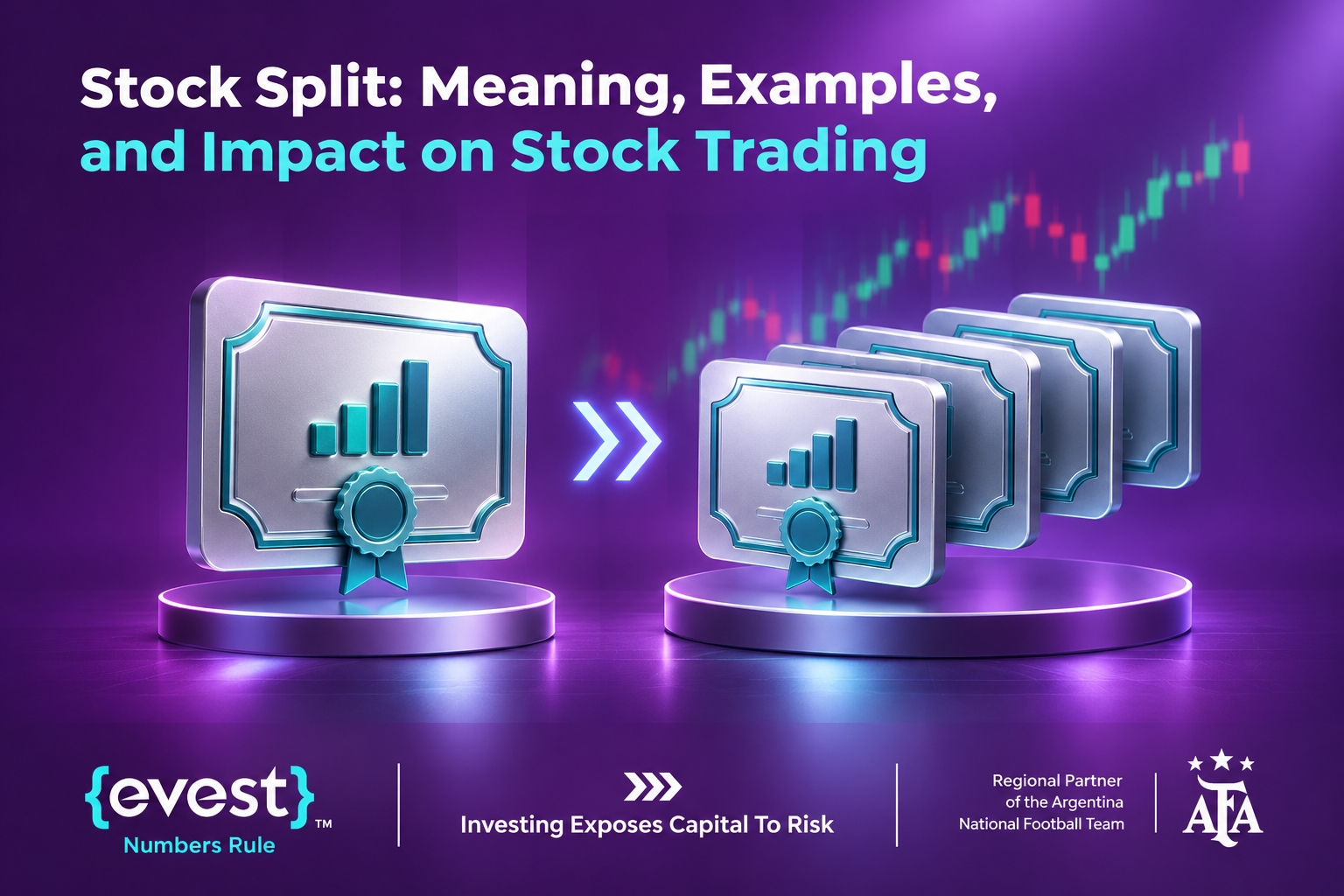
A stock split is a corporate action in which a publicly traded company increases the number of its outstanding shares while proportionally reducing the price of each share. This adjustment does not directly change the company’s market capitalization or the total value of an investor’s holdings. Understanding how share divisions work helps traders interpret price adjustments, evaluate market reactions, and avoid confusing a lower share price with a decline in company value.
Stock Split Meaning: What Changes for Shareholders?
In stock trading, a share division changes how ownership is distributed across individual shares without changing an existing investor’s proportional ownership of the company.
For example, imagine a trader owns 50 shares of a company trading at $200 per share. The total position is worth $10,000.
If the company completes a 2-for-1 division:
- The trader’s share count increases from 50 to 100.
- The theoretical share price decreases from $200 to $100.
- The total investment value remains $10,000 before subsequent market movements.
- The trader’s percentage ownership remains unchanged.
The company has not created additional economic value simply by increasing its share count. However, a lower price per share may make whole-share purchases more accessible to certain retail investors.
How Do Share Splits Work in the Stock Market?
A company generally announces a share division after receiving the necessary corporate approvals. The announced ratio determines how many shares investors will hold after the adjustment.
Common forward split ratios include:
| Split Ratio | Shares Before | Shares After | Price Before | Adjusted Price |
| 2-for-1 | 100 | 200 | $100 | $50 |
| 3-for-1 | 100 | 300 | $90 | $30 |
| 4-for-1 | 100 | 400 | $200 | $50 |
| 10-for-1 | 100 | 1,000 | $500 | $50 |
These examples assume no market-driven price changes.
After the adjustment, brokerage accounts generally reflect the updated number of shares and corresponding price. Historical price charts may also be adjusted to maintain consistency when analyzing past performance.
Why Do Companies Divide Their Shares?
Companies may implement forward splits for several reasons:
- Share accessibility: Reducing the price of an individual share can make whole-share purchases easier for retail traders.
- Potential liquidity improvements: A more accessible trading price may encourage market participation, although higher liquidity is not guaranteed.
- Market perception: Management may believe a lower share price creates a more attractive trading range.
- Investor interest: Announcements can generate additional attention and influence short-term trading activity.
These potential benefits do not guarantee that the share price will increase after the adjustment.
Stock Split vs Reverse Stock Split
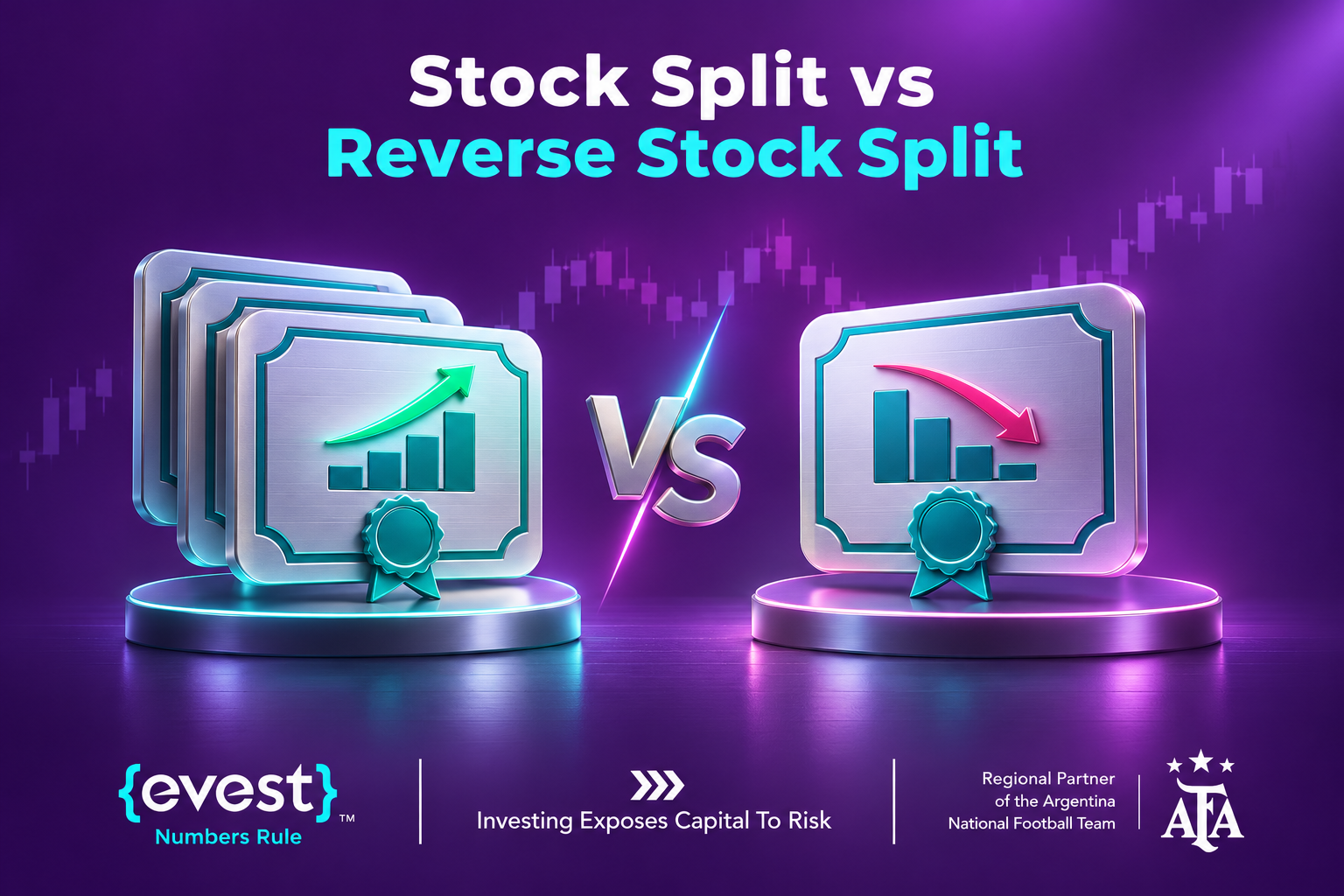
Forward and reverse divisions change share counts in opposite directions, but neither automatically changes the underlying value of a company.
| Feature | Forward Split | Reverse Split |
| Number of shares | Increases | Decreases |
| Price per share | Decreases proportionally | Increases proportionally |
| Company market value | No direct change | No direct change |
| Common objective | Improve share accessibility | Raise the quoted share price |
| Possible market interpretation | Growth-related optimism | Potential financial or listing concerns |
A reverse division combines existing shares into fewer shares.
For example, in a 1-for-10 reverse division, an investor holding 1,000 shares priced at $2 would hold 100 shares with a theoretical adjusted price of $20.
The investment remains worth $2,000 before market movements.
Companies sometimes use reverse divisions to address minimum bid-price listing requirements. Traders should examine the company’s financial condition rather than interpreting the higher quoted price as an improvement in business performance.
How to Use a Stock Split Calculator?
A stock split calculator helps traders estimate their adjusted share count, theoretical share price, and cost basis after a corporate action.
For a forward division, the basic formulas are:
New Share Count = Original Shares × Split Factor
Adjusted Share Price = Original Price ÷ Split Factor
Adjusted Cost Basis per Share = Original Cost Basis per Share ÷ Split Factor
Practical Calculation Example
Suppose an investor owns 80 shares purchased at $150 each, and the company announces a 4-for-1 division.
The calculations would be:
- Original shares: 80
- Original purchase price: $150
- Split factor: 4
- New share count: 320
- Adjusted cost basis per share: $37.50
- Total original investment: $12,000
- Total cost basis after adjustment: $12,000
For reverse divisions, the calculation works in the opposite direction. Share count decreases while the theoretical price per share increases.
If the resulting share count includes a fractional share, the brokerage or company may apply specific fractional-share or cash-in-lieu arrangements.
How to Read a Stock Split Calendar?
A stock split calendar helps market participants track scheduled corporate actions affecting publicly traded companies.
These calendars typically provide:
- Company name and ticker: Identifies the security undergoing the adjustment.
- Split ratio: Indicates how existing shares will be converted.
- Announcement date: Shows when the company disclosed the event.
- Record date: Identifies the shareholder record date specified for the action, where applicable.
- Distribution date: Indicates when additional shares are scheduled to be distributed, when relevant.
- Effective or ex-date: Shows when shares are expected to begin trading on the adjusted basis.
Traders should distinguish between an announcement date and the date when trading reflects the new share structure.
Schedules may change, so company disclosures, brokerage notifications, and exchange corporate-action notices are important for confirming event details.
Why Are Split Dates Important for Traders?
Corporate-action dates can influence trading decisions, market expectations, and order management.
Traders holding positions through these events should verify how their broker handles share adjustments and outstanding orders.
For example, an unadjusted price alert may trigger incorrectly after a large forward division if it is still based on the previous share price.
Options contracts may also receive adjustments to their deliverables, strike prices, or other contract terms, depending on the action.
How to Interpret Stock Split Announcements?
Stock split announcements can attract significant investor attention because they provide information about a company’s planned changes to its share structure.
A typical announcement identifies the division ratio, relevant dates, approval status, and the company’s stated reasons for the decision.
Before trading around an announcement, investors should examine several factors.
- Company’s Financial Performance: Review earnings, revenue growth, cash flow, and profitability. A share division does not improve weak financial fundamentals.
- Price Movement Before the Announcement: Determine whether the stock has experienced a substantial rally before the event. Strong historical performance does not guarantee continued gains.
- Trading Volume and Volatility: Monitor changes in volume, liquidity, and price fluctuations. Increased attention around the announcement may produce volatile trading conditions.
- Market Expectations: Consider whether the corporate action was anticipated. A widely expected announcement may generate a smaller market reaction than unexpected news.
- Broader Market Conditions: Evaluate the overall market trend and the stock’s sector performance. Corporate-action news is only one factor affecting price behavior.
Does a Share Split Affect Trading Profit or Loss?
The adjustment itself does not create an immediate investment profit or loss.
Consider a trader who owns 20 shares at $500 each. After a 5-for-1 division, the position becomes 100 shares at a theoretical price of $100.
Both positions have a total value of $10,000.
However, the market price may rise or fall after trading begins on the adjusted basis.
A trader’s actual profit or loss depends on subsequent market movements, transaction costs, and the price at which the position is eventually sold.
Common Mistakes Traders Should Avoid
Misunderstanding share divisions can lead to unnecessary trading risks.
Common mistakes include:
- Assuming a lower share price means the stock is undervalued.
- Believing additional shares automatically increase investment wealth.
- Treating an announcement as a guaranteed bullish trading signal.
- Ignoring the financial condition of companies executing reverse divisions.
- Comparing historical and current prices without checking whether chart data is split-adjusted.
- Overlooking changes to cost basis, open orders, or derivatives positions.
Successful analysis requires evaluating the company’s fundamentals and the market environment rather than relying on the corporate action alone.
FAQs
Does a share split increase the value of my investment?
No. The adjustment increases the number of shares while proportionally reducing their theoretical price. Your total investment value stays unchanged at the moment of adjustment, although subsequent market movements can generate gains or losses.
Is a 10-for-1 share division good for investors?
It can make individual shares more accessible and may attract trading interest. However, receiving ten shares for every original share does not increase investment value or guarantee positive future returns.
Should I buy shares before or after a split?
Neither timing automatically provides a financial advantage. Traders should evaluate valuation, market trends, company performance, and volatility before deciding whether to establish or adjust a position.
What happens to dividends after a share division?
The dividend per share is generally adjusted proportionally if the company maintains the same total dividend payout. However, future dividends depend on corporate decisions and are not guaranteed.
Can a reverse division cause investors to lose money?
The adjustment itself does not normally reduce total position value. However, market prices may decline afterward, and fractional-share arrangements can affect the holdings of certain investors.
Do share splits affect technical analysis?
Yes. Unadjusted historical prices can create misleading chart movements around the effective date. Traders should use appropriately adjusted charts when examining trends, historical levels, and technical indicators.