
Understanding What Is Bitcoin starts with recognizing its role as a decentralized digital currency that allows people to send and receive money online without relying on traditional banks. Launched in 2009, Bitcoin introduced a new way to transfer value using blockchain technology.
Its transactions are recorded on a public ledger and verified by a distributed network of computers. Unlike traditional currencies, Bitcoin has a limited supply of 21 million coins. Learning how Bitcoin works can help readers understand its potential uses, benefits, and risks in the digital economy.
What Is Bitcoin?
Bitcoin is a peer-to-peer digital currency introduced in 2009. Its network records transactions on a public blockchain, and miners use Proof of Work to help validate blocks. Under its existing protocol rules, issuance follows a predictable schedule and the total supply is capped at approximately 21 million BTC. BTC is the asset ticker; BTCUSD typically denotes its price expressed in US dollars.
How to Trade Bitcoin Through CFDs?
A Bitcoin CFD follows the price of BTC without transferring coins to the trader. The typical process is:
- Confirm the broker offers a Bitcoin CFD in your jurisdiction and read its contract specifications.
- Review BTC market conditions, volatility, liquidity and scheduled news events.
- Choose a long position if expecting a rise or a short position if expecting a decline, where available.
- Calculate position size using an acceptable loss limit, margin requirements and the intended stop level.
- Check the live spread, any overnight funding and other applicable charges before placing the order.
- Set risk controls where available, monitor margin and exit according to the trading plan.
On Evest, cryptocurrency instruments including Bitcoin are offered as CFDs. Availability, trading hours, margin and terms can vary by account and jurisdiction; check the live instrument details.
How Do Bitcoin CFDs Work?
- The trader opens a CFD referencing the Bitcoin market price at the quoted buy or sell rate.
- The position changes in value as the underlying reference price moves; the result depends on price change and contract size.
- The trader closes the position and realizes profit or loss after applicable spreads, financing and other fees.
- If leverage is used, gains and losses are magnified relative to margin; an adverse move can trigger margin close-out.
No BTC is transferred to a personal blockchain wallet. A CFD creates exposure to price movements plus contractual and counterparty risk, not ownership of the coins.
How to Buy Bitcoin Directly?

- Select a provider that offers actual BTC purchases and is permitted to serve your jurisdiction.
- Review custody arrangements, trading charges, withdrawal rules and platform security.
- Create an account and complete any legally required identity checks.
- Fund the account, choose the BTC amount and review the order before confirming.
- Decide whether to retain custody with the provider or withdraw to a compatible wallet, taking care to verify the receiving address and network.
Direct BTC buyers own the asset, but custody and security responsibilities can be significant. A custodial exchange account and a self-custodied wallet create different risks.
Buying Bitcoin vs Trading Bitcoin CFDs
| Factor | Buying BTC directly | Bitcoin CFD |
| Underlying BTC ownership | Yes | No |
| Personal wallet / keys | Optional; depends on custody | Not needed |
| Long price exposure | Yes | Yes |
| Short exposure | Requires a separate product | May be available |
| Leverage | Not inherent to spot ownership | May be available |
| Ongoing costs | Custody/platform fees may apply | Overnight financing may apply |
| Distinctive risk | Custody, scams, market volatility | Market, leverage, provider and margin risk |
What Affects Bitcoin’s Price?
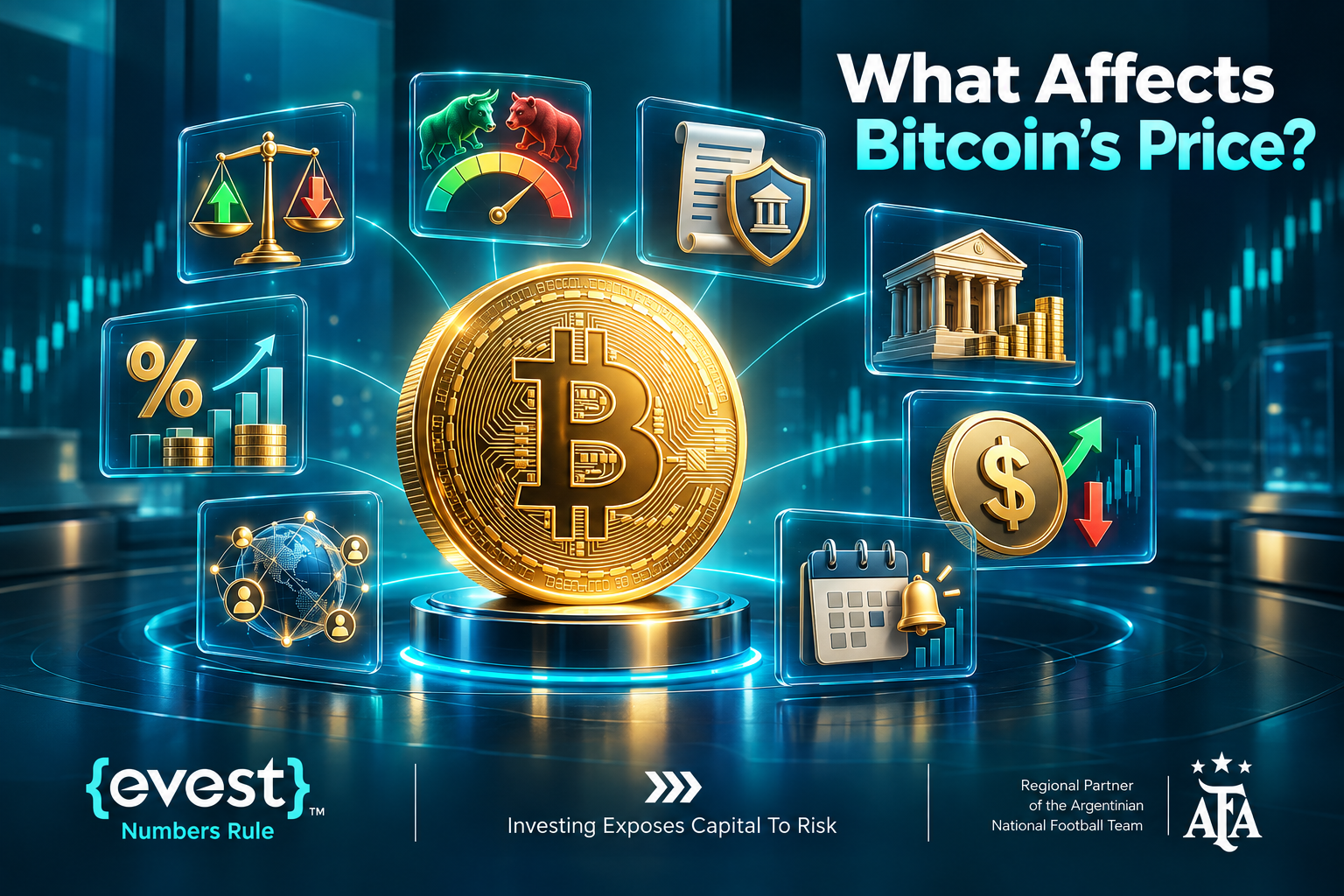
- Demand, investor sentiment and speculative positioning.
- Institutional market participation and fund flows.
- Changes in interest rates, global liquidity and risk appetite.
- Regulation, enforcement and policy developments.
- Market liquidity, exchange interruptions and forced liquidations.
- Bitcoin adoption, network activity and mining economics.
No single factor reliably determines BTC price. Short-term reactions to news can differ from longer-term trends.
Why Is Bitcoin So Volatile?
Bitcoin trades continuously on global spot markets, and its price is sensitive to shifts in liquidity, sentiment and leveraged positioning. Sudden liquidations can reinforce a move. Bitcoin does not have a central bank targeting exchange-rate stability, while its programmed supply schedule does not prevent large price declines.
When Is the Next Bitcoin Halving?
Bitcoin’s most recent halving occurred on April 20, 2024, at block 840,000, reducing the block subsidy from 6.25 BTC to 3.125 BTC. The next halving is expected around 2028 at block 1,050,000, when the subsidy is scheduled to drop to 1.5625 BTC. The date is an estimate because block production varies; a halving does not guarantee future price appreciation.
Can You Profit From Bitcoin Trading?
Profits are possible, but never assured. Results depend on entry and exit prices, direction, size, execution quality and costs. Leveraged CFDs increase the speed at which capital may be lost; traders should only risk capital they can afford to lose.
Is Bitcoin a Good Investment?
Suitability depends on financial objectives, investment horizon, loss tolerance, exposure concentration and custody arrangements. Bitcoin has no guaranteed income stream or minimum redemption value. Historical returns do not establish future performance.
Bitcoin vs Strategy (MSTR): Are They Equivalent?
No. Bitcoin is a digital asset; Strategy Inc. (formerly MicroStrategy) is a publicly traded company whose Class A common shares trade as MSTR. Its corporate financing, liabilities, share count and Bitcoin holdings affect the equity’s value. There is no permanent number of MSTR shares equivalent to one BTC. This is an adjacent comparison, not a substitute for understanding direct BTC versus CFD exposure.
What Costs Apply to Bitcoin CFD Trading?
Check the spread between bid and ask, possible overnight swap or financing, currency-conversion charges and applicable account or withdrawal fees. Evest’s July 2026 fee guidance states that cryptocurrency trading costs can be reflected in spreads and that overnight swap charges may apply. Published fee tables and actual terms can change, so inspect the live order ticket and account fee schedule instead of assuming fixed or zero costs.
How Can Traders Manage Bitcoin Risk?
- Set a maximum acceptable loss for the trade before opening it.
- Size the position using volatility, the stop distance and account equity rather than maximum allowed leverage.
- Review leverage, available margin and total exposure across correlated crypto positions.
- Use Stop Loss instructions if appropriate, understanding that gaps and slippage can lead to a worse fill.
- Check upcoming macroeconomic, regulatory and market events; reassess if liquidity deteriorates.
- Record results after costs and avoid increasing losing positions impulsively.
FAQs
What is BTCUSD?
A quote expressing the price of one Bitcoin in US dollars; contract specifications depend on the platform.
Can I trade Bitcoin without owning BTC?
Yes. A CFD can provide price exposure without transferring the underlying cryptocurrency.
Do I own Bitcoin when trading its CFD on Evest?
No. A Bitcoin CFD does not convey ownership of BTC.
Can a Bitcoin CFD position benefit from falling prices?
A short CFD position may gain value if the reference price falls, but losses can occur if it rises and the product permits such positions.
Is Bitcoin CFD trading risky?
Yes. Bitcoin volatility, leverage, financing costs and execution risks can cause significant losses.