
If you are wondering what is a hedge fund, the essential idea is a privately offered investment pool managed under a defined strategy for eligible investors. Unlike a typical retail mutual fund, it may use short selling, derivatives, leverage or specialized market positions. Those tools can help pursue particular objectives, but they can also amplify losses.
This guide explains how these funds operate, who may invest, what managers actually do, how fees and withdrawal restrictions work, and why investing in a hedge fund is different from trading CFDs through a platform such as Evest.
What Is a Hedge Fund?
A hedge fund pools investors’ capital in a privately offered vehicle, with investments selected by an investment manager. Depending on its mandate, the fund may hold equities, bonds, currencies, commodities, derivatives or other assets. Its objectives and risk profile are set by the strategy rather than the label “hedge fund.”
Some managers seek to reduce specific exposures; others take directional or highly concentrated positions. Professional management does not guarantee profits or preserve capital.
How Does a Hedge Fund Work?
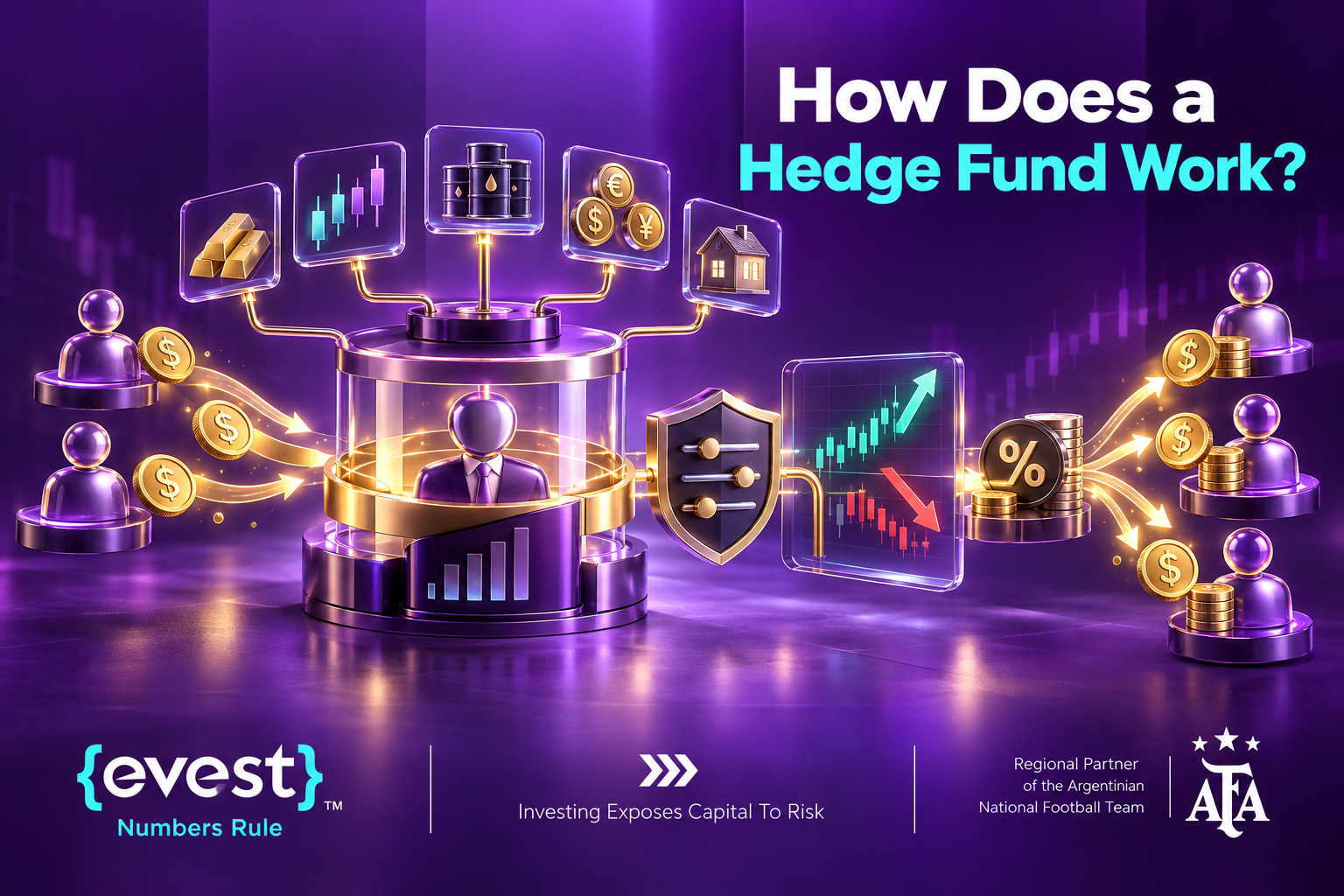
- Eligible investors subscribe or commit capital subject to the fund’s offering terms.
- The manager invests pooled assets according to the strategy and disclosed limits.
- The investment team monitors market exposure, liquidity, counterparties and risk.
- Assets and liabilities are valued to determine the fund’s net asset value, subject to its valuation policies.
- Investors receive performance reporting and may request redemptions only as permitted by the fund documents.
- Management fees, performance allocations and other expenses affect investors’ net returns.
An investor generally does not choose the fund’s individual trades. The manager makes those decisions under the fund’s mandate.
Who Manages a Hedge Fund?
Portfolio managers usually lead investment decisions, often supported by analysts, traders, compliance staff, operations teams and risk specialists. A manager may be registered with a regulator or operate under an exemption, depending on jurisdiction and structure; the fund itself may be privately offered rather than a registered retail product.
What Strategies Do Hedge Funds Use?
- Long/short equity: buy selected shares while taking short positions in others.
- Global macro: take positions informed by monetary policy, inflation, growth and geopolitical trends.
- Event-driven: invest around mergers, restructurings or other corporate events.
- Relative value: seek pricing differences between related securities while managing residual risks.
- Quantitative or systematic: use data-driven models and rules to select and manage exposures.
These categories overlap. A fund’s actual risk depends on its holdings, use of leverage, market conditions and how effectively controls are implemented.
Why Do Hedge Funds Use Leverage?
Leverage gives a portfolio exposure larger than its invested equity through borrowing or derivatives. It can increase returns when positions move favorably, but also magnifies losses, financing expenses, margin demands and forced-selling risk. Investors should ask for both gross and net exposure measures rather than assuming a hedge neutralizes all risks.
What Is the Difference Between a Hedge Fund and a Mutual Fund?
| Factor | Hedge fund (typical) | Retail mutual fund (typical) |
| Investor access | Often restricted to eligible investors | Generally broadly available |
| Investment methods | Potentially flexible; shorting and leverage possible | Subject to product and regulatory constraints |
| Reporting | Private fund disclosures; vary | Standardized public disclosures |
| Liquidity | May impose lock-ups or redemption windows | Often permits daily redemptions, subject to fund terms |
| Fees | May include management and performance fees | Typically expense ratio; exact fees vary |
These differences are general, not universal. Rules, offering terms and protections differ by jurisdiction and product.
Hedge Funds vs Individual CFD Trading
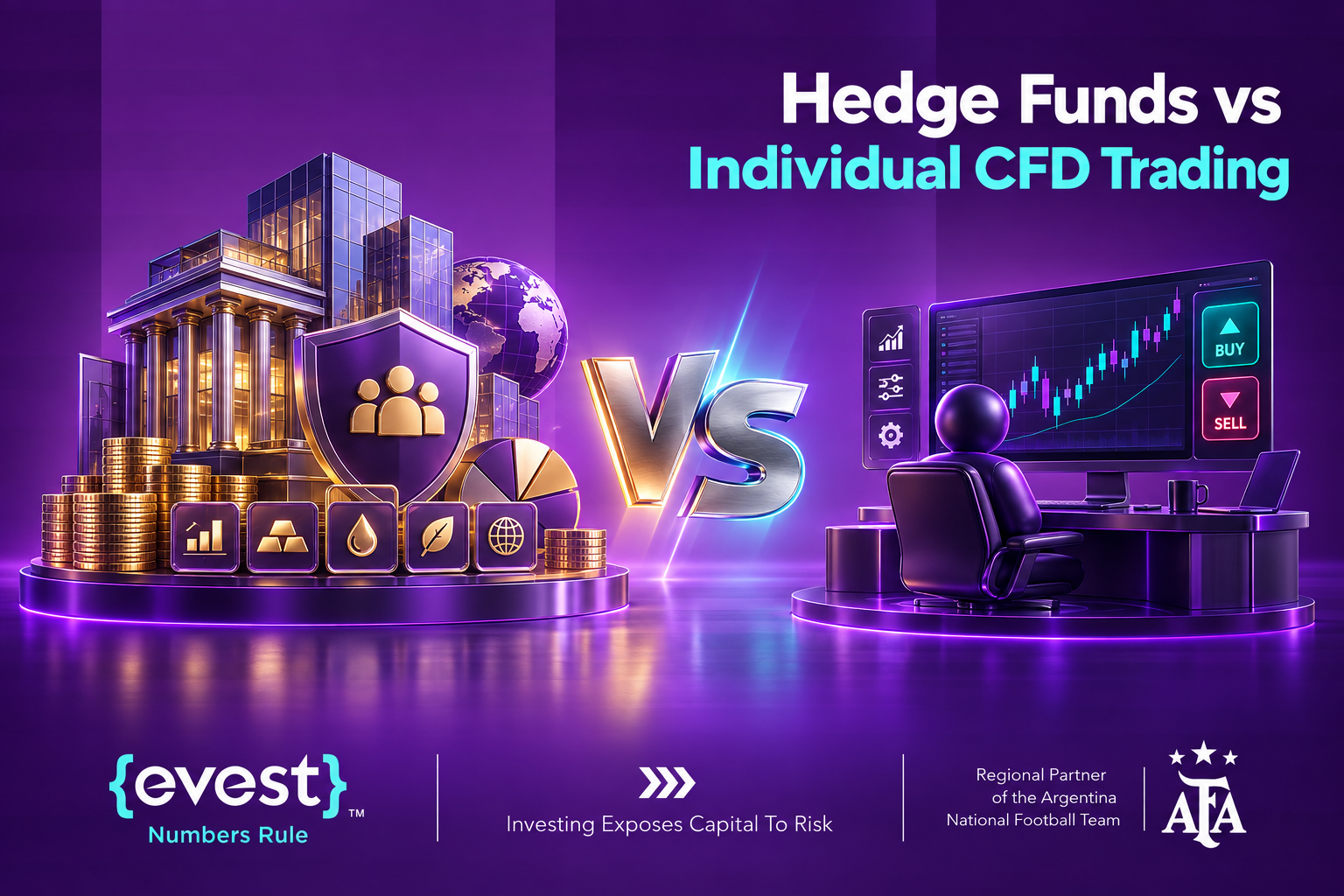
In a hedge fund, investors participate in a pooled managed vehicle. In an individual CFD account, the account holder typically controls individual leveraged positions in contracts that track price changes; the underlying asset is not owned.
Evest describes its trading service as CFD-based, including exposure to shares without underlying ownership. Accessing CFDs on Evest is not the same as buying an interest in a hedge fund. CFD losses can be substantial, especially when leverage is used.
How Do Hedge Funds Manage Risk?
- Set limits on position sizes, portfolio concentration and gross/net exposures.
- Assess liquidity, including how quickly holdings could be sold in stressed markets.
- Measure sensitivity to interest rates, equity markets, credit and currencies.
- Stress-test adverse price moves and potential correlation breakdowns.
- Monitor leverage, financing terms, margin and counterparty exposure.
- Adjust or hedge exposures when risks exceed the mandate’s limits.
These measures can reduce certain risks but cannot remove losses, illiquidity, valuation uncertainty or operational failures.
Does Hedging Eliminate Risk?
No. A hedge aims to offset a defined exposure. For example, shorting an index future can reduce broad equity-market sensitivity but leaves stock-selection risk, hedge mismatch and costs. A hedge may also reduce gains when markets move favorably.
How Do Hedge Funds Make Money?
- Take market positions based on the fund’s investment thesis.
- Realize gains or losses on securities, derivatives and other holdings.
- Pay transaction, financing and operating expenses that reduce portfolio results.
- Apply the fund’s management and any performance fees to determine investors’ net outcomes.
A fund can lose money despite extensive research, sophisticated tools or a positive historical track record.
How Do Hedge Fund Fees Work?
- Review the annual management charge and the base on which it is calculated.
- Check whether a performance fee or allocation applies and whether it uses a high-water mark or hurdle.
- Identify fund expenses, financing, trading, administration and other charges.
- Confirm when fees are accrued, crystallized and paid, especially on redemption.
- Compare reported gross results with net results after all investor-level costs.
The US SEC’s investor education materials describe management fees often around 1–2% of assets and performance fees often around 15–20% of profits, but these are examples of common arrangements, not universal or mandatory rates.
Who Can Invest in a Hedge Fund?
Eligibility depends on the country, legal offering and fund structure. In the United States, privately offered hedge funds commonly require accredited-investor or qualified-purchaser status, depending on the offering. Financial thresholds and professional qualification routes should be checked against applicable rules at the time of investment.
Minimum subscriptions, lock-ups, redemption notice periods, gates or suspension provisions may also restrict access to funds or cash withdrawals. These are separate from whether an investor qualifies legally.
Can Hedge Funds Trade Cryptocurrencies?
Some hedge funds trade digital assets, crypto-linked securities or derivatives where permitted by their mandates and applicable regulation. Other funds exclude crypto entirely. A crypto hedge fund is not automatically less risky than trading the assets individually; custody, counterparty, liquidity, valuation and regulatory issues can still be significant.
Are “Hedge-Fund Style Crypto Signals” the Same Thing?
No. “Hedge-fund style” is not a standardized investor-protection or performance designation. A buy/sell signal alone does not establish a professionally managed fund, tested portfolio process, audited results or appropriate risk controls. Claims of institutional-grade signals should be evaluated critically.
What Are the Main Risks of Hedge Funds?
- Market and strategy risk: positions or assumptions can fail.
- Leverage and financing risk: losses can be amplified and positions forced to unwind.
- Liquidity risk: assets may be hard to sell and investors may face redemption limits.
- Valuation risk: certain holdings are not priced frequently or transparently.
- Operational and counterparty risk: systems, service providers or trading counterparties can fail.
- Fees and disclosure limitations: costs and limited transparency may make comparisons difficult.
FAQs
Do hedge funds always hedge their investments?
No. Strategies range from highly hedged to strongly directional.
Can hedge funds lose money?
Yes, including substantial losses, despite professional management.
Do hedge funds use automated trading?
Some do; others rely on discretionary investment teams or combine both.
Are hedge funds available to all investors?
Not generally. Eligibility and offering restrictions depend on the applicable jurisdiction and fund.
Can I invest in a hedge fund through Evest CFDs?
Trading CFDs is not purchasing a hedge-fund interest. Evest describes its market access as CFD trading.