
If you are wondering what is commodity trading, it involves buying, selling, or taking financial exposure to raw materials such as gold, crude oil, natural gas, and agricultural products. People use commodity markets to hedge business risks, invest in resources, or speculate on changes in prices through products such as futures, exchange-traded funds, and contracts for difference (CFDs).
Prices respond to supply and demand, economic activity, weather, geopolitics, and currency movements. This guide explains the main commodity categories, how trades work, what moves prices, and how to assess costs and risk. On Evest, commodity CFDs offer price exposure rather than ownership or delivery of the underlying asset.
What Is Commodity Trading?
Commodity trading involves transacting in physical goods or financial instruments linked to their prices. A commodity is generally a standardized resource of a specified grade, rather than a share in a company. The contract matters: buying physical gold, holding a commodity fund, trading a futures contract, and opening a CFD position do not create identical rights or risks.
Producers and commercial users may use futures to hedge price exposure; investors and traders may instead seek price exposure. A CFD is a derivative contract settled on price differences, with no physical delivery or ownership of the commodity.
What Types of Commodities Can Be Traded?
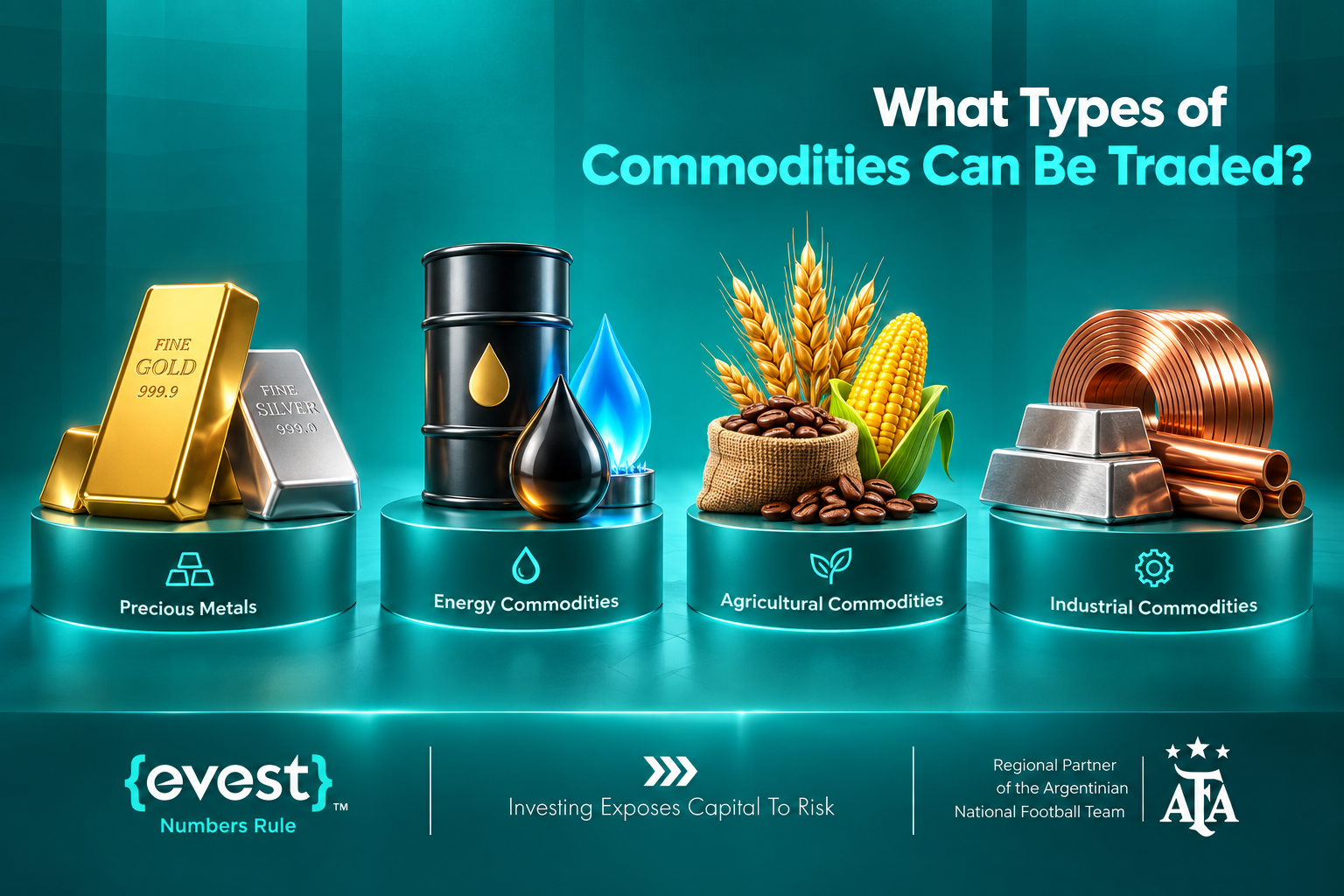
| Category | Examples | Typical price drivers |
| Precious metals | Gold, silver, platinum | Real yields, US dollar, investment and industrial demand |
| Energy | Crude oil, natural gas | Production, inventories, consumption, geopolitical supply risks |
| Agricultural goods | Wheat, corn, coffee, sugar | Weather, harvests, seasonality, transport and trade |
| Industrial metals | Copper, aluminum | Construction, manufacturing, infrastructure and supply |
The exact products accessible to a trader depend on the exchange, fund or broker. Some platforms quote spot-linked instruments, while others reference expiring futures contracts.
How Does Commodity Trading Work?
- Choose the underlying market and instrument: for example, physical gold, an exchange-traded product, a futures contract, or a gold CFD.
- Check the contract specifications, including quote currency, position size, trading hours, expiry or rollover rules, and whether delivery is possible.
- Assess the market using supply-and-demand information, relevant economic releases, and price behavior.
- Decide the direction and size of the position. A long position generally benefits from rising prices; a short derivative position generally benefits from falling prices.
- Review margin requirements, the spread, commissions, financing and the maximum loss you can tolerate.
- Place and monitor the trade, then close or settle it according to the instrument’s rules.
For example, if a CFD position tracks gold and the quoted price increases, a long position may gain value before costs; if the market moves against the position, it loses value. The exact result also depends on contract size and any currency conversion.
What Affects Commodity Prices?
Supply and demand are central, but their underlying causes are different across markets. Oil is sensitive to production policy and inventory changes, crops to weather and harvest yields, and precious metals to interest-rate expectations and investor demand.
- Supply disruptions, inventories and production decisions.
- Global growth and industrial consumption.
- Inflation expectations, interest rates and financing conditions.
- Weather, geopolitics and trade restrictions.
- US dollar exchange-rate moves and changes in market positioning.
A market can move because conditions change or because new information differs from what traders expected. This is why one headline rarely explains every price movement.
What Is the Historical Relationship Between the US Dollar and Commodity Prices?
Many internationally traded commodities are priced in US dollars. All else equal, a stronger dollar can make dollar-priced commodities more expensive for buyers holding other currencies, potentially reducing demand. A weaker dollar can have the opposite effect.
The relationship is not mechanical. A major supply shock may push oil higher during a strong-dollar period, and gold can respond to real interest rates or geopolitical concerns. Dollar movements are one factor, not a standalone trading rule.
Does a Stronger Dollar Always Push Commodity Prices Lower?
No. The correlation varies by commodity and time period. Assess currency moves alongside actual inventories, production, demand and market expectations rather than assuming a fixed inverse relationship.
How Can You Trade Commodities Through CFDs?
- Open the available commodity instrument list and confirm that the specific product is currently tradable.
- Read its trading specifications: underlying reference, spread, contract size, leverage, margin, trading hours and any expiry or rollover policy.
- Select a buy or sell position according to your market view, and calculate the potential monetary loss for the chosen size.
- Set risk controls where available, remembering that stop orders may execute at a different price in fast or gapping markets.
- Monitor free margin, total exposure and any financing or other applicable charges; close the position according to your plan.
Evest lists commodity CFD products, including metals, energy and some agricultural instruments. Its public commodities page currently displays 16 entries, but that listing is not a guarantee that every instrument is live or available to every account. Instrument availability and terms should be verified on the platform before any trade.
Commodity CFD Trading vs Physical Ownership
| Factor | Physical commodity | Commodity CFD |
| Ownership | Own the asset | No ownership of underlying asset |
| Storage/delivery | May be relevant | No physical delivery |
| Short exposure | Less direct | May be available |
| Leverage | Depends on financing | May be offered, with magnified risk |
| Ongoing costs | Storage/insurance may apply | Spread and financing or account costs may apply |
Exchange-traded products and futures are additional alternatives, each with different structures and fees. Long-term ownership and leveraged speculation should not be treated as interchangeable.
How Can You Manage Commodity Trading Funds on Mobile?
- Define the maximum amount of capital to risk on the trade before placing any order.
- Calculate position size using stop distance, contract specifications and commodity volatility; avoid basing size on margin alone.
- Check margin level, free margin and combined exposure across correlated markets such as gold and silver.
- Use alerts and appropriate order types, but do not assume mobile connectivity or a stop-loss order eliminates execution risk.
- Review open positions, relevant events and any overnight charges; avoid impulsive increases after losses.
Evest supports MetaTrader 5 according to its July 2026 help-center update. Platform access and supported features should be confirmed for the specific account and device.
What Costs Apply to Commodity Trading?
Costs may include the bid–ask spread, commissions, financing or swap charges on overnight leveraged positions, conversion fees, and instrument-specific adjustments or rollover costs. Actual charges depend on contract and account terms. Margin is collateral reserved to support a position, not itself a trading fee.
Evest describes special fee arrangements for Islamic accounts, including potential charges on positions held three days or more. Do not assume all account types are swap-free or that a headline commission rate represents the entire trading cost.
How Does Leverage Work in Commodity Trading?
- Identify the full notional value of a position, rather than focusing only on the cash margin deposited.
- Check the applicable leverage and required margin for the specific commodity and account.
- Estimate how a small adverse price movement would affect account equity at that position size.
- Maintain sufficient available margin and plan for slippage, gaps, and possible forced liquidation.
For illustration, a $10,000 position at 1:100 leverage may require $100 in initial margin, before broker-specific conditions and costs. A 1% adverse move in the underlying represents approximately $100 of gross loss on that notional position—not 1% of the margin. Evest states that its maximum advertised leverage can reach 1:400, but actual leverage differs by instrument, volatility, account and applicable rules; it can change.
What Are the Main Risks of Commodity Trading?
The main risks include price volatility, leverage-amplified losses, liquidity changes, market gaps, changing margin requirements and fees. Agricultural commodities, energy and metals have different supply constraints and seasonal patterns. With leveraged products, losses can occur quickly and risk controls cannot guarantee a particular exit price.
FAQs
Is commodity trading the same as buying physical commodities?
No. Physical ownership, funds, futures and CFDs provide different rights, costs and risks.
Can you trade commodities when prices are falling?
Some derivative products, including CFDs, may allow a short position, subject to product availability and trading conditions.
What commodities are available on Evest?
Its public listing shows 16 commodity entries across metals, energy and agricultural markets as checked in October 2026; verify current instrument status and terms in the platform.
Do I own commodities when trading CFDs on Evest?
No. Commodity CFDs provide price exposure without physical ownership or delivery.
Are commodity CFDs suitable for everyone?
No. Their volatility, margin requirements and potential leveraged losses make them unsuitable for some traders.