
Learning how to buy Intel stock starts with understanding what INTC represents and deciding whether you want to own Intel shares directly or simply gain exposure to its price movements. Intel Corporation is a major semiconductor company whose shares trade on Nasdaq under the ticker INTC.
Investors can buy Intel shares through a brokerage account that offers direct stock ownership, while traders may use stock CFDs to speculate on price movements without owning the underlying shares. On Evest, stock trading is provided through CFDs, so clients gain market exposure rather than shareholder ownership.
This guide explains how to buy Intel shares, where investors can access INTC, what can affect Intel’s stock price, and how direct ownership differs from CFD trading.
What Is Intel Stock?
Intel stock represents ownership in Intel Corporation, a technology company that designs and manufactures processors, semiconductor products, and computing platforms. Intel also operates a foundry business and develops technologies for areas including data centers, personal computing, AI, and edge computing.
Intel’s common stock trades on Nasdaq under the ticker INTC. When an investor buys Intel shares directly, they become a shareholder and gain economic exposure to the company’s future performance.
The value of INTC can change according to Intel’s earnings, product demand, manufacturing progress, competition, semiconductor-industry conditions, and broader market sentiment.
How to Buy Intel Stock
To understand how to buy Intel stock, first decide whether you want direct ownership of the shares or price exposure through a derivative.
For direct ownership, the general process usually involves:
- Choose a brokerage that provides access to Nasdaq-listed stocks.
- Create and verify an investment account.
- Deposit funds using an available payment method.
- Search for Intel using the ticker INTC.
- Decide how many shares or what value you want to purchase.
- Review the order type and trading costs.
- Place the order and monitor the investment.
The exact process varies by broker, jurisdiction, and account type.
Intel itself notes that investors who purchase shares through a broker should manage those holdings through their brokerage provider.
Where to Buy Intel Stock
Intel shares can generally be purchased through brokerage platforms that provide direct access to US-listed equities.
Before choosing where to buy Intel stock, investors should compare several factors, including trading commissions, currency-conversion charges, account fees, access to Nasdaq, and whether the platform provides direct share ownership or only derivative exposure.
This distinction matters because not every platform displaying INTC allows the user to own the underlying stock.
On Evest, stock positions are CFDs. This means traders can speculate on Intel’s price movements but do not receive ownership rights in Intel shares. Evest states that CFD stock trading is conducted without ownership of the underlying stock.
Buying Intel Shares vs Trading Intel CFDs
Directly buying Intel shares and trading Intel CFDs are different approaches.
| Feature | Buying Intel Shares | Trading Intel CFDs |
| Own the underlying stock | Yes | No |
| Shareholder rights | May apply | No |
| Exposure to rising prices | Yes | Yes |
| Short exposure | Requires specific arrangements | May be available |
| Leverage | Usually limited | May be available |
| Main objective | Ownership/investment | Price speculation |
On Evest, Intel exposure would be through CFD trading rather than direct ownership, consistent with the platform’s stock-trading model.
What Can Affect Intel Stock?

Intel’s share price can move because of both company-specific developments and broader semiconductor-market conditions.
Important factors include:
- Revenue and earnings performance.
- Demand for PCs, servers, and data-center products.
- Progress in semiconductor manufacturing.
- Competition from other chipmakers.
- AI and accelerator strategy.
- Capital spending and foundry execution.
- Interest rates and overall technology-sector sentiment.
Because Intel operates across several parts of the semiconductor industry, investors should look beyond one product cycle and consider the company’s broader financial and strategic performance.
Why Does Intel’s Manufacturing Strategy Matter?
Intel is unusual among many large chip designers because it also manufactures semiconductors and is investing heavily in its foundry operations.
Intel describes Intel Foundry as part of its strategy to combine chip design, manufacturing, and advanced packaging.
That means investors may pay close attention to manufacturing execution, factory investment, process-node development, and customer demand for foundry services.
If these projects perform well, they may support long-term growth. If costs rise or execution is delayed, they can also pressure financial performance.
Should I Buy Intel Stock?
There is no single answer to whether someone should buy Intel stock, because suitability depends on investment objectives, risk tolerance, valuation, and expectations for Intel’s future business performance.
Instead of relying on a simple buy-or-sell opinion, investors can evaluate several areas:
- Revenue and profitability trends.
- Cash flow and capital expenditure.
- Competitive position in CPUs, data centers, and AI.
- Progress in Intel Foundry.
- Debt and balance-sheet strength.
- Current valuation relative to expected growth.
Investors should also consider the time horizon. Someone evaluating Intel as a long-term investment may focus heavily on manufacturing strategy and future product competitiveness, while a short-term trader may focus more on earnings releases, momentum, and technical price levels.
How Do Intel Earnings Affect INTC?
Intel’s earnings reports can cause significant price movements because they provide updated information about revenue, margins, expenses, guidance, and business-unit performance.
The market may react not only to whether earnings rise or fall, but also to how the results compare with investor expectations.
Guidance can be especially important because stock prices are forward-looking. Even strong historical results may be followed by a price decline if the company’s outlook is weaker than expected.
What Role Does AI Play in Intel’s Outlook?
AI has become an important part of competition across the semiconductor sector.
Intel develops processors, accelerators, software, and platforms intended for AI workloads across data centers, enterprise systems, and edge devices. The company describes its strategy as spanning processors, accelerators, software, cloud, enterprise, and edge computing.
For investors, the key question is not simply whether Intel participates in AI, but whether its products gain sufficient demand and compete effectively within a rapidly changing market.
What Are the Risks of Buying Intel Stock?
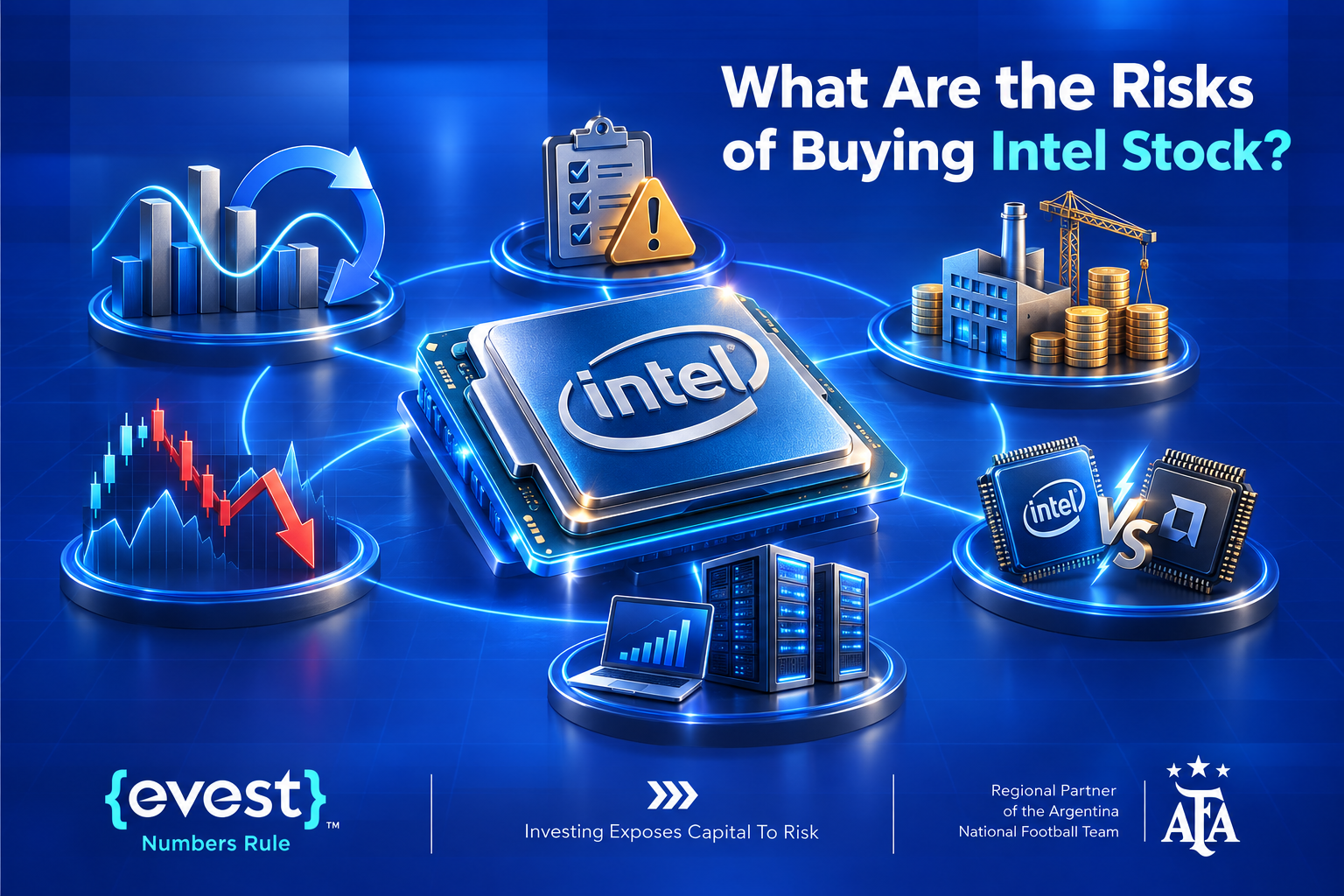
Intel stock carries both company-specific and market-wide risks.
Competition within the semiconductor industry can be intense, and product delays or weaker demand may affect revenue. Manufacturing investments can also require significant capital, while changes in interest rates or investor sentiment can affect technology stocks broadly.
Investors should also consider:
- Semiconductor-industry cycles.
- Execution risk.
- High capital expenditure.
- Competitive pressure.
- Changes in PC and data-center demand.
- Broader equity-market volatility.
For CFD traders, leverage adds another layer of risk because it can magnify both favorable and unfavorable price movements.
How to Trade Intel Stock on Evest?
On Evest, stock trading is conducted through CFDs, which means clients speculate on price movements instead of acquiring the underlying shares.
A typical CFD trading process involves selecting the stock instrument, analyzing the market, choosing whether to open a buy or sell position, setting position size, and applying risk-management tools.
Evest states that stock CFDs are offered with 0% trading commission, while the spread remains a trading cost.
This is different from buying Intel shares through a traditional brokerage account because CFD traders do not become Intel shareholders.
FAQs
What is Intel's stock ticker?
Intel Corporation trades on Nasdaq under the ticker INTC.
How can I buy Intel shares?
You can generally buy Intel shares through a brokerage that provides direct access to Nasdaq-listed stocks. Search for INTC, decide the amount you want to invest, and place a purchase order.
Can I trade Intel without owning the stock?
Yes. CFDs can provide exposure to Intel's share price without direct ownership of the underlying stock.
Do I own Intel shares when trading on Evest?
No. Evest states that its stock trading is conducted through CFDs, so the client does not own the underlying stock.
Is Intel stock suitable for long-term investing?
That depends on the investor's objectives, valuation assumptions, risk tolerance, and expectations for Intel's future business performance. No stock is automatically suitable for every investor.