
NVIDIA stock represents ownership in NVIDIA Corporation, a technology company listed on the Nasdaq under the ticker NVDA.
For traders, understanding what NVIDIA stock is also means understanding what drives its price. NVDA can react to AI demand, data-center spending, earnings results, chip competition, new products, regulation, and broader stock-market conditions.
On Evest, traders can gain exposure to NVIDIA through stock CFDs without owning the underlying shares. This guide explains what NVIDIA stock is, what moves NVDA, and how traders can gain exposure to its price.
What Is NVIDIA Stock?
NVIDIA stock is the publicly traded equity of NVIDIA Corporation, traded on the Nasdaq under the ticker NVDA.
Buying NVIDIA shares through a service that provides direct stock ownership generally means acquiring an ownership interest in the company.
NVIDIA generates much of its business from computing technologies, including:
- AI and accelerated computing.
- Data-center hardware.
- Graphics processors.
- Networking.
- Gaming.
- Automotive and robotics technologies.
- Software and AI infrastructure.
NVIDIA’s recent growth has been heavily driven by demand for AI infrastructure. In its second quarter of fiscal 2027, the company reported $96.2 billion in revenue, including $89 billion from Data Center, highlighting the importance of AI-related demand to its business.
What Moves NVIDIA Stock?
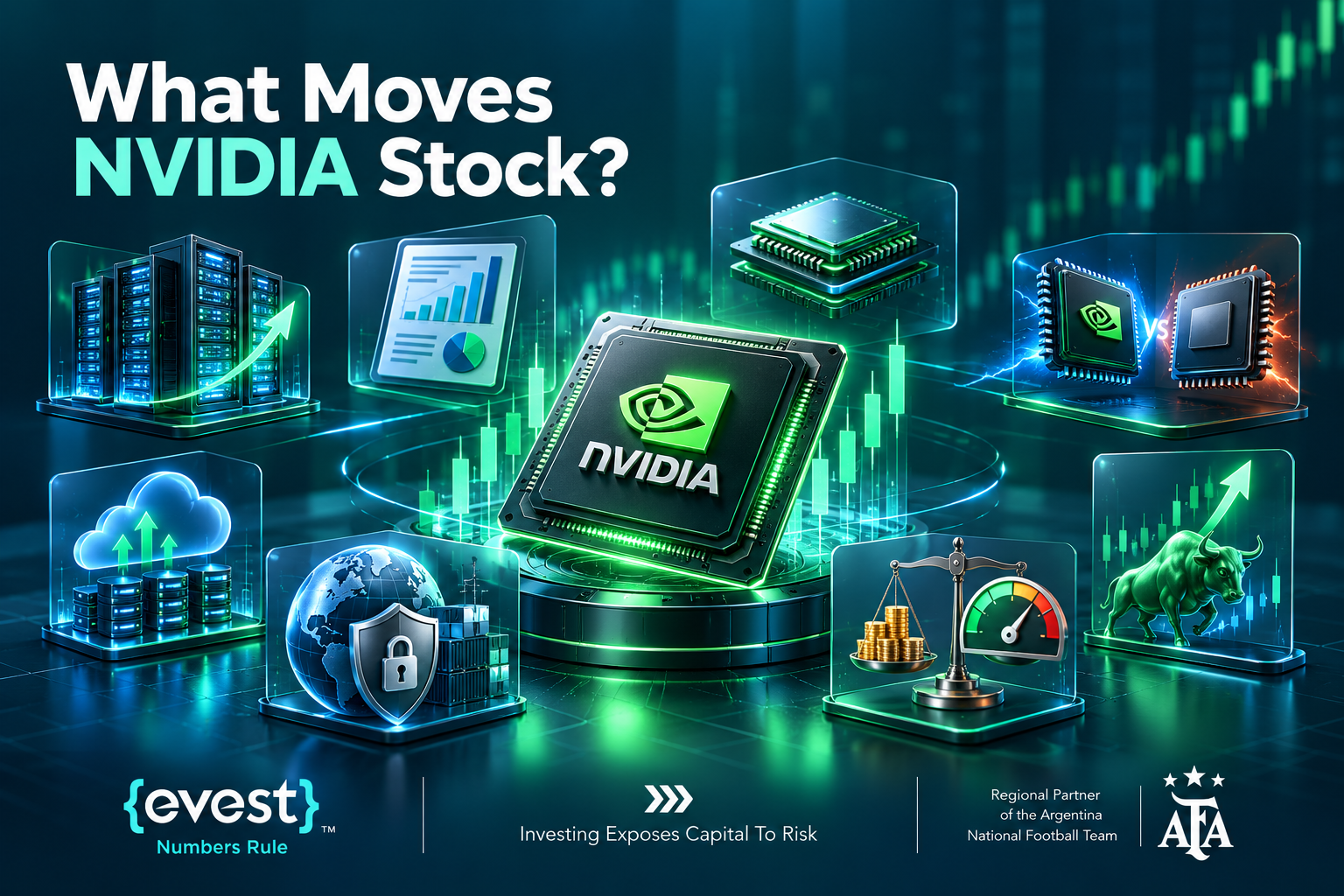
NVIDIA stock mainly moves in response to changes in expected revenue, earnings, AI demand, competition, and investor expectations.
The most important factors include:
- AI Infrastructure Demand: Higher spending on AI data centers can support expectations for NVIDIA’s chip and networking businesses.
- Earnings Results: Revenue, margins, profit, and management guidance can cause sharp movements in NVDA.
- New Chip Releases: Demand for new computing platforms can influence future growth expectations.
- Competition: Products from AMD, custom chips, and other semiconductor companies can affect NVIDIA’s expected market position.
- Cloud Spending: Capital expenditure from major cloud and technology companies is an important indicator of demand for AI infrastructure.
- Regulation and Export Controls: Restrictions affecting semiconductor sales can change NVIDIA’s addressable markets.
- Valuation: A high share valuation can make the stock more sensitive to changes in growth expectations.
- Market Sentiment: Broader moves in technology and AI-related stocks can also influence NVDA.
Why Do NVIDIA Earnings Matter So Much?
NVIDIA earnings matter because investors use them to judge whether AI-related growth is meeting expectations.
Markets typically focus on:
- Revenue growth.
- Data Center revenue.
- Gross margins.
- Earnings per share.
- Future revenue guidance.
- Demand for new NVIDIA platforms.
Strong results do not always guarantee a higher share price. If investors were expecting even stronger numbers, the stock may fall despite reporting growth. Likewise, guidance can sometimes move the stock more than the previous quarter’s results.
How Does AI Demand Affect NVIDIA Stock?
Strong AI demand can support NVIDIA stock because AI infrastructure is a major source of company revenue. NVIDIA supplies GPUs, networking products, software, and computing platforms used in AI training and inference.
Its Q2 fiscal 2027 Data Center revenue reached $89 billion, up 117% from a year earlier.
However, traders should also monitor whether:
- AI infrastructure spending continues growing.
- Customers develop more of their own chips.
- Competitors gain market share.
- AI companies generate enough revenue to sustain infrastructure spending.
- New NVIDIA products maintain demand.
Rapid AI investment can therefore create both growth opportunities and valuation risks.
Is NVIDIA the Leading AI Company?
NVIDIA is a leading AI computing company, particularly in AI accelerators and data-center infrastructure, but there is no single objective measure that makes one company “the leading AI company.”
NVIDIA competes in an AI ecosystem that also includes:
- Cloud providers.
- AI model developers.
- Semiconductor companies.
- Software companies.
- Data-center infrastructure providers.
Its position is particularly strong in accelerated computing. Reuters described NVIDIA as dominating the AI training market, supported in part by its CUDA software ecosystem.
However, leadership can mean different things depending on whether the comparison is based on chips, AI models, cloud services, revenue, or market value.
Is NVIDIA the Biggest Company in the World?
NVIDIA has been among the world’s largest publicly traded companies by market capitalization, but the top position can change as share prices move.
For example, Apple overtook NVIDIA as the world’s most valuable company in July 2026, while Reuters later described NVIDIA in August as the most valuable publicly traded US company.
This is why “biggest company” should always include a date and metric.
Market capitalization is calculated from:
Share price × shares outstanding
It does not measure revenue, profit, employees, or total assets.
What Other Factors Can Affect NVDA?
Several additional factors can move NVDA even when NVIDIA does not release earnings.
These include:
- Semiconductor industry demand.
- Interest-rate expectations.
- US economic conditions.
- Technology-sector valuations.
- Supply-chain conditions.
- Major customer spending.
- Geopolitical developments.
- Export restrictions.
- Acquisitions and strategic investments.
NVIDIA also makes investments across the AI ecosystem. Its July 2026 quarterly filing reported $99 billion of equity investments and another $25 billion of equity investment commitments as of July 26, 2026.
These investments can strengthen ecosystem relationships, but investors may also assess their cost, risk, and expected strategic value.
Has NVIDIA Invested in AI Companies Recently?
Yes. NVIDIA has continued making substantial investments in AI-related companies and infrastructure.
For example, Reuters reported in July 2026 that NVIDIA planned a $5 billion investment in Safe Superintelligence, the AI company co-founded by Ilya Sutskever.
NVIDIA has also participated in other technology financing rounds, including SiFive’s $400 million funding round in April 2026.
However, NVIDIA participating in a funding round does not necessarily mean it was the lead investor. The role should be checked deal by deal.
How to Trade NVIDIA Stock?
NVIDIA can be traded by analyzing NVDA, choosing a market direction, managing risk, and opening a position.
A typical process includes:
- Analyze NVIDIA: Review earnings, AI demand, product developments, and market conditions.
- Choose a Direction: A trader may take a long position when expecting NVDA to rise or a short position when expecting it to fall.
- Set Position Size: Determine how much exposure to take.
- Manage Risk: Use risk-management tools where available.
- Monitor the Position: Follow earnings, sector news, and market conditions.
- Close the Trade: The result depends on the opening and closing price, position size, and applicable costs.
NVIDIA Corporation is included among the stock instruments listed by Evest.
When NVIDIA is traded through a CFD, the trader does not own the underlying NVIDIA shares. Instead, the position tracks changes in the share price.
Buying NVIDIA Stock vs Trading NVIDIA CFDs
Buying NVIDIA shares means owning the underlying stock, while trading an NVIDIA CFD means gaining exposure to NVDA price movements without owning the shares.
On Evest, NVIDIA exposure is provided through CFDs, so traders can take positions on NVDA price movements without becoming shareholders in NVIDIA.
| Feature | Buying NVIDIA Shares | Trading NVIDIA CFD |
| Own underlying shares | Yes | No |
| Exposure to rising prices | Yes | Yes |
| Ability to trade falling prices | Usually requires another mechanism | May be available through a short position |
| Leverage | Depends on product | May be available |
| Main exposure | Company ownership | Price movement |
| Risk | Stock-market risk | Market risk plus leverage risk |
The two methods should not be treated as equivalent.
Risks of Trading NVDA
Trading NVIDIA involves risk because the stock can move sharply when expectations change.
Important risks include:
- Valuation Risk: High growth expectations can make the stock sensitive to disappointments.
- AI Spending Risk: Slower AI infrastructure investment could affect expected growth.
- Competition Risk: Rival chips or custom processors could affect market share.
- Regulatory Risk: Export controls and semiconductor regulations may affect sales.
- Earnings Volatility: NVDA can move sharply around financial results.
- Leverage Risk: Leveraged CFD positions can magnify both gains and losses.
- Market Risk: Broader declines in technology stocks can affect NVDA even without company-specific news.
FAQs
What is NVIDIA stock?
NVIDIA stock is the publicly traded equity of NVIDIA Corporation and trades on the Nasdaq under the ticker NVDA.
Has NVIDIA been an investor in other companies recently?
Yes. NVIDIA has made significant investments across the AI ecosystem, including a reported $5 billion investment in Safe Superintelligence in 2026.
Can you trade NVIDIA without owning the stock?
Yes. A CFD can provide exposure to NVIDIA's share-price movements without ownership of the underlying shares.