
Learning how to trade Fartcoin begins with understanding its price behavior, available trading methods, and the difference between buying the underlying token and speculating through a derivative. This Evest guide explains the essential steps of Fartcoin trading, including how to read its price chart, identify the main factors that influence market movements, and evaluate important conditions before opening a position. Because Fartcoin is a highly speculative memecoin, rapid price changes can create opportunities while also increasing the risk of significant losses. Product availability, trading conditions, and eligibility may vary depending on jurisdiction, account type, and the instruments offered by platforms.
What Is Fartcoin?
Fartcoin, represented by the ticker FARTCOIN, is a memecoin operating on the Solana blockchain. It is primarily associated with internet culture, community attention, and speculative market demand rather than a complex technical utility or a claim on business revenue. The project’s official website describes the token as a memecoin with no intrinsic value or expectation of a financial return, making it important for traders to separate online popularity from evidence of sustainable market demand.
Fartcoin uses Solana’s blockchain infrastructure for token transfers and ownership records. Users who purchase the underlying token should verify that their wallet and chosen platform support the Solana network. They should also confirm the official token address before sending funds because imitation tokens may use similar names or symbols. For traders evaluating FARTCOIN, the central point is that its market behaviour may be driven more by attention, momentum, and liquidity than by traditional valuation models.
What Moves the Fartcoin Price?
The token can change sharply because memecoin markets are often influenced by speculative activity and rapid shifts in attention. Unlike a company share, FARTCOIN does not have revenue, earnings, or cash flow that traders can use as traditional valuation inputs.
Factors that may affect the market include:
- Social media trends and online community activity.
- Changes in trading volume and liquidity.
- Large purchases or sales by major token holders.
- New exchange listings or delistings.
- Broader movements in Bitcoin, Solana, and the cryptocurrency market.
- Regulatory announcements affecting cryptocurrency access or trading.
- Project-related announcements and community campaigns.
- Sudden changes in risk appetite across speculative markets.
A price move supported by rising volume may show broader market participation. By contrast, a sharp move in a thin market may reverse quickly because fewer orders are available to absorb buying or selling pressure. Traders should avoid assuming that a viral post or short-term price spike confirms a lasting trend, because memecoin markets can move quickly before information is verified.
Social media claims may be incomplete, exaggerated, or deliberately misleading, so traders should wait for clearer confirmation from volume, liquidity, price behaviour, and reliable market sources before making any trading decision.
Fartcoin Price and Live Market Data
Before opening a trade, traders should review live market information instead of relying on a static price quoted in an article. Cryptocurrency prices can change continuously, and the available quote may differ between platforms because of liquidity, spreads, and the product being traded. Therefore, the article should include a live Fartcoin price module, an interactive price chart, and a clear “last updated” date and time so readers can assess the most recent market conditions before making any decision.
The live module should display, where available:
- Current price.
- Daily price change.
- Trading volume.
- Market capitalization.
- Daily high and low.
- Relevant trading pair or CFD symbol.
- The time and source of the latest data.
When reviewing the live quote, traders should also check whether the market is moving on strong volume, whether the spread has widened, and whether a large percentage move occurred in a short period. A rapidly widening spread may increase the cost of entering and exiting a position.
How to Read a Fartcoin Chart?
A Fartcoin chart can help traders assess recent price direction, momentum, volatility, and key support or resistance levels. While chart analysis cannot predict future movements with certainty, it provides a structured way to understand how buyers and sellers have reacted to different market conditions.
Support and Resistance
Support is an area where buying interest previously increased enough to slow or reverse a decline. Resistance is an area where selling pressure previously interrupted an advance. These are zones rather than guaranteed prices, and they can fail during periods of strong momentum.
Trading Volume
Volume shows how much of the asset was traded during a selected period. Rising prices combined with stronger volume may suggest broader participation. A breakout on weak volume may be less convincing and more vulnerable to reversal.
Moving Averages
Moving averages smooth price data and can help traders identify direction over a selected period. A short-term average rising above a longer-term average may indicate improving momentum, while the opposite may indicate weakening momentum. Moving-average signals can lag behind the market and should not be used alone.
Relative Strength Index
The Relative Strength Index, or RSI, is commonly used to evaluate momentum. Readings near the upper or lower parts of its range may suggest that the price has moved quickly, but an overbought or oversold reading is not a guaranteed reversal signal.
Recent Highs and Lows
Recent swing highs and swing lows can help traders define invalidation points, possible breakout levels, and areas where risk may increase. On a volatile memecoin, these levels may be broken quickly. When using technical analysis, combine chart analysis with position sizing and predefined exit rules. A technical indicator should not be treated as a guarantee, especially when sudden Fartcoin news or large on-chain transactions can invalidate a chart pattern.
How to Trade Fartcoin Online?
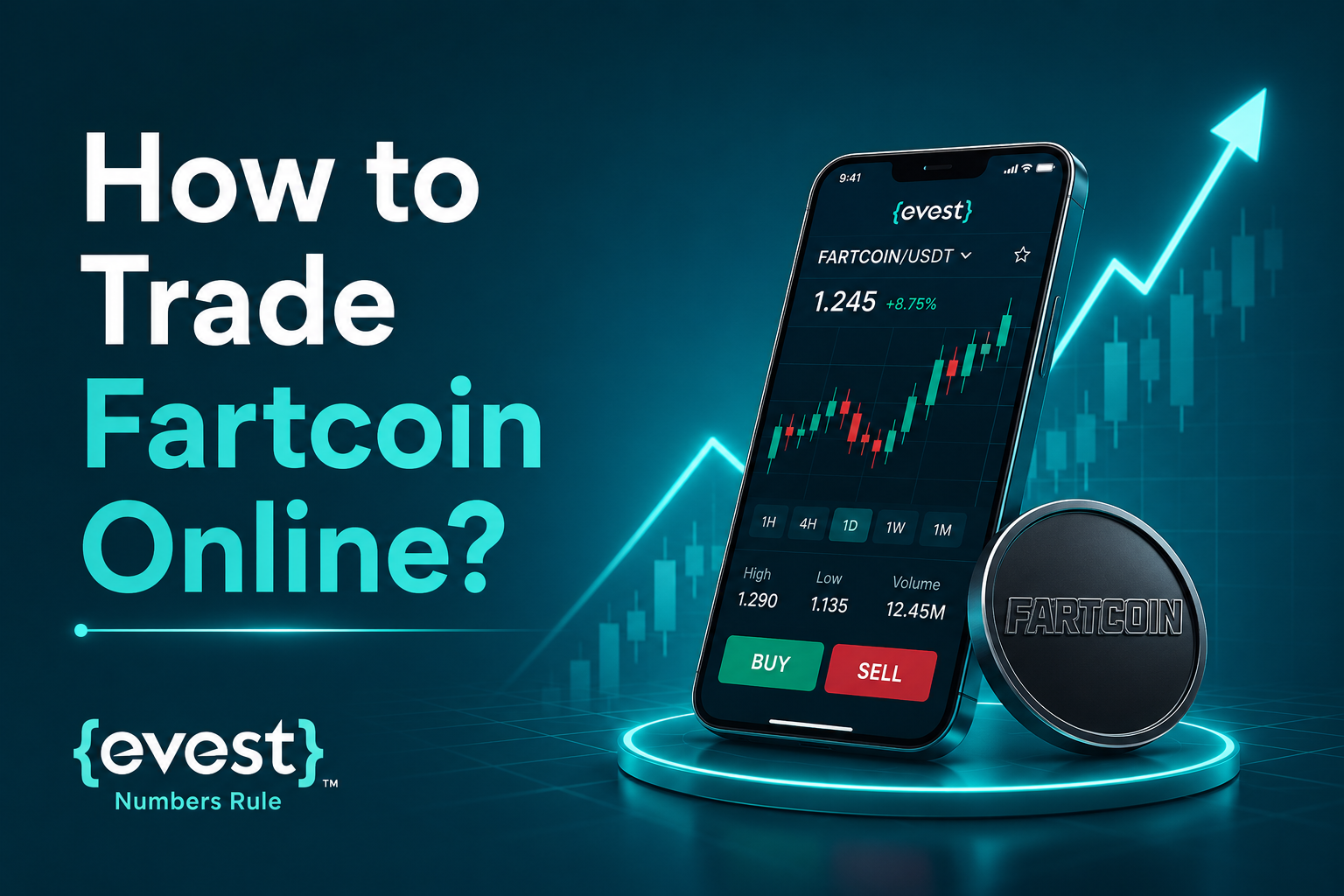
The process depends on whether the trader wants to purchase the underlying token or speculate on its price through a derivative.
Step 1: Confirm Product Availability
Check whether FARTCOIN is currently listed on the platform and whether it is available to clients in your jurisdiction. A platform may support cryptocurrency products generally without offering every individual token. For Evest users, the instrument list available inside the platform should be treated as the source of truth. If FARTCOIN is not displayed in the account, it may not currently be available to that user.
Step 2: Review the Instrument Details
Before opening a position, review:
- The instrument name and symbol.
- Whether the product is the underlying token or a CFD.
- The current bid and ask prices.
- The spread.
- Minimum and maximum trade sizes.
- Margin requirements.
- Trading hours.
- Overnight financing or other applicable costs.
- Stop-out conditions.
These details can vary by product, jurisdiction, and account type.
Step 3: Analyse the Market
Review the live price, recent volatility, trading volume, chart structure, and relevant market developments. Avoid entering a position only because the token is trending on social media.
Step 4: Define the Trade
Decide whether your market view is bullish or bearish, how much capital you are prepared to risk, and which price movement would invalidate the idea. The position size should be determined before the order is opened.
Step 5: Add Risk Controls
Where available, use stop-loss and take-profit orders to define possible exit levels. Stop-loss orders may reduce risk, but they do not guarantee execution at the selected price during gaps, low liquidity, or extreme volatility.
Step 6: Review and Place the Order
Check the position direction, trade size, estimated margin, spread, and other applicable costs. Confirm the order only after reviewing all details.
Step 7: Monitor the Position
Monitor price movement, margin levels, changes in liquidity, and significant market developments. Avoid moving a stop-loss repeatedly simply to prevent a losing position from closing. This process provides a practical framework for trading FARTCOIN, but it does not ensure a profit or prevent losses.
Fartcoin CFD vs Spot Trading
Spot trading and CFD trading provide different forms of exposure to the token’s market price.
| Feature | Buying FARTCOIN | Trading a CFD |
| Ownership | You own the underlying token | You do not own the underlying token |
| Wallet | A compatible wallet may be required | A crypto wallet is generally not required |
| Direction | Typically benefits from a price increase | May allow long or short positions, depending on product terms |
| Leverage | Usually not required for a standard spot purchase | May involve leverage and margin |
| Main costs | Trading, withdrawal, and network fees | Spread, possible financing costs, and other product charges |
| Main risks | Price decline, custody, wallet, and token risks | Market movement, leverage, margin, and stop-out risks |
A Fartcoin CFD, when available, is a derivative that allows traders to speculate on price changes without purchasing the cryptocurrency. Evest explains that the instruments offered through its platform are CFDs, meaning clients trade contracts linked to underlying market prices rather than directly acquiring the underlying assets.
Depending on the applicable product terms, CFD trading may allow traders to open long positions when they expect the market to rise or short positions when they expect it to fall. However, while leverage can increase market exposure with a smaller initial margin, it also magnifies potential losses.
Where to Buy Fartcoin or Trade Its Price?
People searching for where to buy Fartcoin should first decide what type of exposure they need. Buying the underlying token generally requires a cryptocurrency exchange or decentralised platform that supports Solana-based assets. The buyer may also need a compatible wallet and should understand deposit, withdrawal, network, and custody risks.
Trading the price through a CFD is different. The trader does not receive or store the underlying token. Instead, the position follows the price movement of the referenced market according to the broker’s product terms.
Before choosing a venue for buying the token or trading its price, compare:
- Whether the underlying token or a derivative is offered.
- Product availability in your country.
- Liquidity and spread.
- Trading and financing costs.
- Deposit and withdrawal methods.
- Wallet requirements.
- Security controls.
- Regulatory status of the service provider.
- Risk disclosures and client protections.
For Evest users, the priority is to understand the product type accurately and verify the current instrument list and applicable specifications before trading.
Fartcoin Trading Strategies
No strategy guarantees a profit, particularly in a highly speculative market. The following approaches are examples of how traders may structure their analysis rather than recommendations to buy or sell.
Trend-Following
A trend-following trader looks for a sequence of higher highs and higher lows during an uptrend, or lower highs and lower lows during a downtrend. Moving averages and momentum indicators may be used to support the analysis. The main risk is entering after a large move has already occurred. Memecoin trends may reverse quickly when attention or liquidity declines.
Breakout Trading
A breakout trader watches for the price to move beyond a clearly identified resistance or support zone. Volume can be used to evaluate whether market participation increased during the move. False breakouts are common. A trader may wait for confirmation or use a smaller position, but neither method removes the risk of reversal.
Range Trading
When the market moves between identifiable support and resistance zones, a trader may look for entries near the edges of the range. This approach becomes dangerous when the range breaks and the market begins trending.
News-Based Trading
Some traders react to exchange listings, community announcements, regulatory developments, or major changes in trading activity. Market headlines may move the token quickly, but the first report may be incomplete or inaccurate. Trading immediately after a headline may expose the trader to wider spreads, slippage, and abrupt reversals. News should be checked against reliable sources before it is used in a trading decision.
Fartcoin News and Market Catalysts
Because FARTCOIN is a memecoin, short-term attention can significantly influence its market activity. Traders should monitor developments that may affect liquidity, investor sentiment, and access to the token, including exchange listings, social media trends, large transactions, and broader cryptocurrency market movements.
Relevant catalysts may include:
- New listings or delistings.
- Changes in trading volume.
- Large wallet transactions.
- Solana network developments.
- Community or project announcements.
- Social media trends.
- Broader cryptocurrency market movements.
- Regulatory or platform-related announcements.
Not every market catalyst develops into a sustainable trend. A headline may trigger an immediate price reaction, but the market can reverse once traders reassess the information. For stronger confirmation, traders should monitor trading volume, liquidity, and whether price momentum continues after the initial reaction.
Managing Risk in Fartcoin Trading
Fartcoin trading carries substantial risk because prices can move sharply and market liquidity may weaken without warning. Traders should define their position size, exit levels, and maximum acceptable loss before opening a trade rather than waiting until the market moves against them.
Practical risk controls may include:
- Using a smaller position size.
- Defining the maximum acceptable loss.
- Setting an exit level before entering.
- Avoiding excessive leverage.
- Checking the spread and liquidity.
- Avoiding trades based only on online hype.
- Monitoring margin and stop-out levels on CFD positions.
- Avoiding repeated additions to a losing position without a predefined plan.
- Keeping trading funds separate from money needed for essential expenses.
A stop-loss order may help limit exposure, but during extreme volatility or market gaps, it may execute at a different price than expected. Take-profit orders can define an exit point, although they may close a position before a larger move develops. Each order type involves trade-offs.
When deciding how to trade Fartcoin, traders should first determine the maximum loss they can tolerate if the market moves unexpectedly. Potential profit should only be considered after the risks, position size, and exit plan have been clearly defined.
Trading Costs to Check
The total cost of a trade is not limited to the visible market price.
Depending on the product, the trader may need to consider:
- The bid-ask spread.
- Trading commission, if applicable.
- Overnight financing.
- Currency conversion.
- Blockchain network fees for token transfers.
- Withdrawal fees.
- Slippage during fast market conditions.
For a CFD position linked to FARTCOIN, the exact costs should be taken from the instrument specifications displayed on the trading platform. Spreads, leverage ratios, and financing rates may change and can vary by jurisdiction and account type.
Availability and Regional Considerations
The availability and legal treatment of cryptocurrency and CFD products vary across jurisdictions. Before attempting to access FARTCOIN products, users should confirm that the relevant product is available in their country and that they meet the platform’s eligibility requirements.
Trading conditions may differ according to the regulated entity serving the client, account classification, and local requirements. Users should review the applicable Evest terms, risk disclosures, and product specifications before opening a position. This article is for general educational purposes and does not constitute investment, legal, tax, or religious advice.
FAQs
How Do I Trade Fartcoin?
To trade Fartcoin, first confirm whether the token or an eligible derivative is available on your chosen platform. Review the current price, chart, spread, liquidity, and fees, define your position size, add risk controls, and verify the order before execution.
What Is Fartcoin?
Fartcoin is a Solana-based memecoin whose price is influenced mainly by speculative demand, social media attention, liquidity, trading volume, and broader cryptocurrency sentiment. Because it lacks traditional business fundamentals, its market value can rise or fall sharply within short periods
Is Fartcoin Available on Evest?
Fartcoin availability on Evest must be checked through the live platform because instruments can vary by jurisdiction, account type, and product updates. Users should review the instrument details, trading conditions, margin requirements, spreads, and applicable risk disclosures before opening positions.
What Is the Difference Between Buying Fartcoin and Trading a Fartcoin CFD?
Buying Fartcoin means owning the underlying token and usually requires a compatible Solana wallet. Trading a Fartcoin CFD, when available, means speculating on price movements without ownership, while potentially using leverage, paying spreads, and meeting margin or ongoing financing requirements.
What Should I Check on a Fartcoin Chart?
When reviewing a Fartcoin chart, focus on trend direction, support and resistance, trading volume, recent highs and lows, moving averages, and momentum indicators. Chart signals should be combined with current Fartcoin news, liquidity conditions, position sizing, and predefined risk limits.
Is Fartcoin Trading Risky?
Yes, Fartcoin trading is highly risky because memecoin prices can move rapidly, liquidity can weaken, and spreads may widen. Leveraged CFD positions may magnify losses. Traders should use funds they can afford to lose and review all risk disclosures carefully.